 2024, Vol. 46
 Issue (6): 25-35


2. 山东师范大学 光场调控及应用协同创新中心,山东 济南 250358
2. Collaborative Innovation Center of Light Manipulations and Application, Shandong Normal University, Jinan 250358, China
在波动光学和量子光学的交叉领域,光学能流的概念占据了核心地位,它描述了光在传播过程中的能量流动[1]。该概念不仅阐明了光的波粒二象性,而且对光纤和激光技术的发展起到了推动作用[2],这些技术在提升信息传输的效率和容量[3]、可再生能源的开发[4]以及在成像技术[5]和遥感探测[6]的应用中扮演了关键角色。横向能流,即光波能量在垂直于传播方向上的流动,对光束的聚焦、传输和操控具有决定性的影响。通过调制横向能流,可以显著提高光束质量及其应用效率[7-10]。此外,横向能流的分布对光束在不同介质中的反射、折射和散射行为产生了影响,这对于设计高性能光学器件和系统具有重要意义[11-14]。近期研究在横向能流的操控方面取得了显著进展,例如He等[15]提出的一维多层膜与二维超表面结合的准三维亚波长结构,通过高效耦合传输波和布洛赫波,增强了多重散射并提升了非局域能流的调控能力。
在非近轴光场中,横向能量流的产生与显著的纵向场分量密切相关[16-18]。Richards和Wolf在1959年首次在非平面高数值孔径物镜系统中观察到线偏振平面波聚焦时产生的负传播光,从而揭示了横向能流的存在[19]。Jiao等在2012年的研究中指出,对于紧聚焦的线偏振平面波,并不产生横向能流[20]。Khonina等在2018年的研究进一步发现,紧聚焦的圆极化拉盖尔−高斯光束在焦点附近可观测到能流密度纵向分量的负值[21]。在光学研究领域,单光束聚焦系统在横向能流调控方面的研究已取得了显著进展[9-10,22-24]。随着4π聚焦系统的出现,其能够实时调制入射光束的振幅和相位,为特殊光束转换提供了更高的操控灵活性[25-27]。Wang等[28]近期提出了一种基于4π聚焦系统的三维空间横向能流调控方法,该方法能够实现包括纯横向能流在内的任意方向能流控制。尽管这一成果为横向能流调控开辟了新路径,但对纯横向能流产生机制的系统性解析仍显不足,且现有方法的复杂性限制了其在更广泛领域的应用。因此,通过简化光场调制技术,并系统地探究4π聚焦系统下的能流调控机制,尤其是纯横向能流的产生机理,对于促进该领域科学进步具有显著的学术价值和应用前景。
本研究系统分析了4π聚焦系统下入射光场的偏振分布和涡旋特性对焦场中能流的影响。入射光场的偏振态和相位结构显著地影响了能流的横向和纵向分量。特别是,仅当两束从相对方向入射的光束具有0或π的初始相位差时,才能在焦点区域实现纯横向能流。本文的发现对于操控4π聚焦系统中的能流分布,进而优化光学捕获和操控微粒的能力,具有重要的理论和实际意义。
1 理论模型| $ {\boldsymbol{E}}{{ = }}{A_0}\left[ {\cos T\exp \left( {\rm{i}\delta } \right){{\hat {\boldsymbol{e}}}_r} + \sin T\exp \left( { - \rm{i}\delta } \right){{\hat {\boldsymbol{e}}}_l}} \right], $ | (1) |
式中:A0是光束的振幅;T是相对强度分数,它描述了光束的强度分布;δ = mϕ + Δ是一个相位偏移,决定了光场偏振分布,其中m是偏振阶数,ϕ是方位角,Δ是一个额外的相位常数;
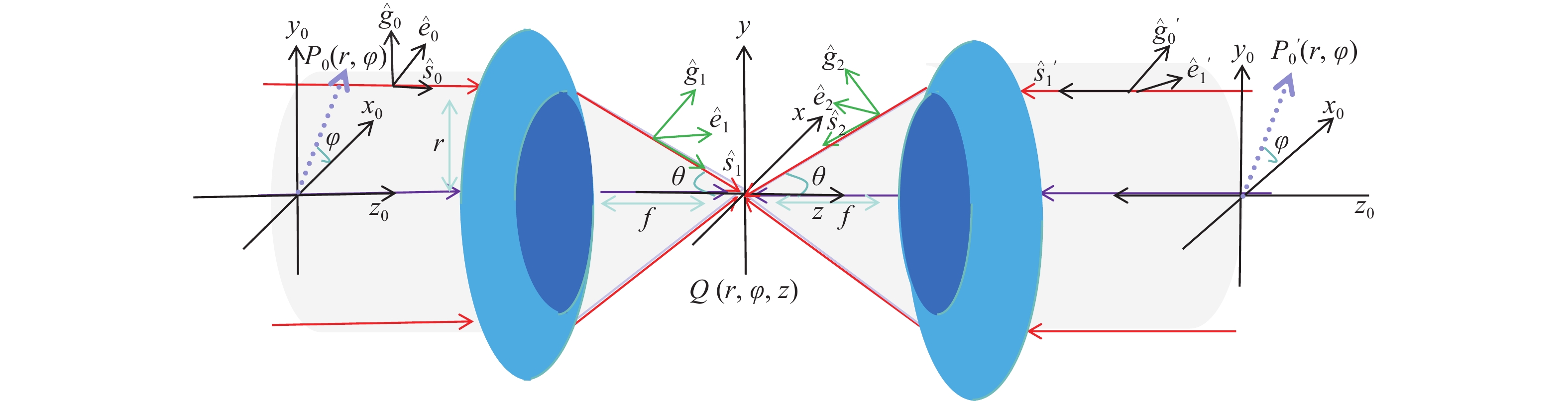
在这里,采用贝塞尔−高斯复振幅分布来研究焦场中的能流分布。图1给出了4π聚焦系统的示意图。
|
图 1 4π 紧聚焦系统示意图 Figure 1 Schematic diagram of the 4π compact focusing system |
根据Richards和Wolf理论,对于左侧3种入射光束,焦点区域 Q(r, φ, z)处的电场和磁场表示为[19]
| $ \begin{split} \left[ \begin{gathered} {{\boldsymbol{E}}_1}({\boldsymbol{r}}) \\ {{\boldsymbol{H}}_1}({\boldsymbol{r}}) \\ \end{gathered} \right] =& - \frac{{{\rm{i}}kf}}{{2{\text{π}} }}\int\limits_0^\alpha \int\limits_0^{2{\text{π}} } \exp \left( { - \frac{{{\beta ^2}{{\sin }^2}\theta }}{{{{\sin }^2}\alpha }}} \right){{\mathrm{J}}_1}\left( {\frac{{2\beta \sin \theta }}{{\sin \alpha }}} \right) \\ &\exp ({\mathrm{i}}l\varphi )\left[ \begin{gathered} {{\boldsymbol{e}}_1} \\ {{\boldsymbol{h}}_1} \\ \end{gathered} \right] \sqrt {\cos \theta } \exp \{ {\rm{i}}k[ - r\sin \theta \cos ( \varphi -\\ & \phi ) + {\textit{z}}\cos \theta ] \}\sin \theta {\mathrm{d}}\varphi {\mathrm{d}}\theta \\[-16pt] \end{split}$ | (2) |
| $\begin{split} \left[ \begin{gathered} {{\boldsymbol{E}}_2}({\boldsymbol{r}}) \\ {{\boldsymbol{H}}_2}({\boldsymbol{r}}) \\ \end{gathered} \right] = & - \frac{{{\text{i}}kf}}{{2{\text{π}} }}\int\limits_0^\alpha \int\limits_0^{2{\text{π}} } \exp \left( { - \frac{{{\beta ^2}{{\sin }^2}\theta }}{{{{\sin }^2}\alpha }}} \right){{\mathrm{J}}_1}\left( {\frac{{2\beta \sin \theta }}{{\sin \alpha }}} \right) \\ &\exp (il\varphi )\left[ \begin{gathered} {{\boldsymbol{e}}_2} \\ {{\boldsymbol{h}}_2} \\ \end{gathered} \right] \sqrt {\cos \theta } \exp \{ {\text{i}}k[ - r\sin \theta \cos ( \varphi - \\ & \phi ) - {\textit{z}}\cos \theta ] \}\sin \theta {\mathrm{d}}\varphi {\mathrm{d}}\theta \\[-16pt] \end{split} $ | (3) |
其中焦距f定义了成像平面与透镜之间的距离。最大会聚角α与数值孔径NA和介质折射率n相关,α = arcsin(NA/n)。给定的数值孔径NA = 0.95,折射率n为图像空间的折射率。另外,J1代表第一类一阶贝塞尔函数,瞳孔半径与光束腰比β = 1.5,入射光场的拓扑电荷表示为l。e1和h1代表左侧入射光束的电场和磁场矢量部分,而e2和h2则对应右侧入射光束的电场和磁场矢量,具体表达如下
| $\begin{split} & {{\boldsymbol{e}}_1} = \\ & \left\{ \begin{gathered} {e_{1x}} = A({\cos ^2}\phi \cos \theta + {\sin ^2}\phi ) + \\ \qquad B\sin \phi \cos \phi (\cos \theta - 1) \\ {e_{1y}} = A(\cos \phi \sin \phi (\cos \theta - 1) +\\ \qquad B({\sin ^{_2}}\phi \cos \theta + {\cos ^2}\phi ) \\ {e_{1{\textit{z}}}} = A\cos \phi \sin \theta + B\sin \phi \sin \theta \\ \end{gathered} \right. \end{split} \;\;$ | (4) |
| $ \begin{split} & {{\boldsymbol{h}}_1} = \\ & \left\{ \begin{array}{l} {h_{1x}} = \sqrt {\dfrac{\varepsilon }{\mu }} [A\sin \phi \cos \phi (\cos \theta - 1) - \\ \qquad B({\cos ^2}\phi \cos \theta + {\sin ^2}\phi )] \\ {h_{1y}} = \sqrt {\dfrac{\varepsilon }{\mu }} [A({\cos ^2}\phi + \cos \theta {\sin ^2}\phi ) - \\ \qquad B\sin \phi \cos \phi (1 - \cos \theta )] \\ {h_{1{\textit{z}}}} = \sqrt {\dfrac{\varepsilon }{\mu }} (A\sin \phi \sin \theta + \\ \qquad B\sin \theta \cos \phi ) \\ \end{array} \right. \end{split}$ | (5) |
| $ \begin{split} & {{\boldsymbol{e}}_2} =\\ & \left\{ \begin{gathered} {e_{2x}}=A({\cos ^2}\phi \cos \theta + {\sin ^2}\phi ) + \\ \qquad\;\;\; B\sin \phi \cos \phi (\cos \theta-1) \\ {e_{2y}}=A(\cos \phi \sin \phi (\cos \theta-1) +\\ \qquad\;\;\; B({\sin ^2}\phi \cos \theta + {\cos ^2}\phi ) \\ {e_{2{\textit{z}}}} =-A\cos \phi \sin \theta-B\sin \phi \sin \theta \\ \end{gathered} \right. \end{split} \;\;$ | (6) |
| $ \begin{split} & {{\boldsymbol{h}}_2} =\\ & \left\{ \begin{gathered} {h_{2x}} = \sqrt {\frac{\varepsilon }{\mu }} [ - A\sin \phi \cos \phi (\cos \theta - 1) +\\ \qquad\;\;\;B({\cos ^2}\phi \cos \theta + {\sin ^2}\phi )] \\ {h_{2y}} = \sqrt {\frac{\varepsilon }{\mu }} [ - A({\cos ^2}\phi + \cos \theta {\sin ^2}\phi ) +\\ \qquad\;\;\;B\sin \phi \cos \phi (1 - \cos \theta )] \\ {h_{2{\textit{z}}}} = \sqrt {\frac{\varepsilon }{\mu }} (A\sin \phi \sin \theta + B\sin \theta \cos \phi ) \\ \end{gathered} \right. \end{split} $ | (7) |
式中:ε是真空的介电常数;μ是像空间的磁导率。A和B具体表示为
| $ \begin{split}A= & \frac{1}{\sqrt{2}}(\cos T\mathrm{e}^{\mathrm{i}\delta}+\sin T\mathrm{e}^{-\mathrm{i}\delta}),\; \; \\ B= & -\frac{\mathrm{i}}{\sqrt{2}}(\cos T\mathrm{e}^{\mathrm{i}\delta}-\sin T\mathrm{e}^{-\mathrm{i}\delta})\end{split} $ | (8) |
| $ \begin{split}\boldsymbol{E}_{\mathrm{total}}(\boldsymbol{r})= & \boldsymbol{E}_1(\boldsymbol{r})+\boldsymbol{E}_2(\boldsymbol{r}) \\ \boldsymbol{H}\mathrm{_{total}}(\boldsymbol{r})= & \boldsymbol{H}_1(\boldsymbol{r})+\boldsymbol{H}_2(\boldsymbol{r})\end{split} $ | (9) |
接下来,根据电场和磁场计算能流。能流由时间平均的能流密度得到,可以表示[28]
| $ \boldsymbol{S}=\mathrm{Re}\left[\boldsymbol{E}_{\mathrm{total}}^*(\boldsymbol{r})\times\boldsymbol{H}\mathrm{_{total}}({\boldsymbol{r}})\right]/2 $ | (10) |
式中:Re表示参数的实部;*表示复共轭。
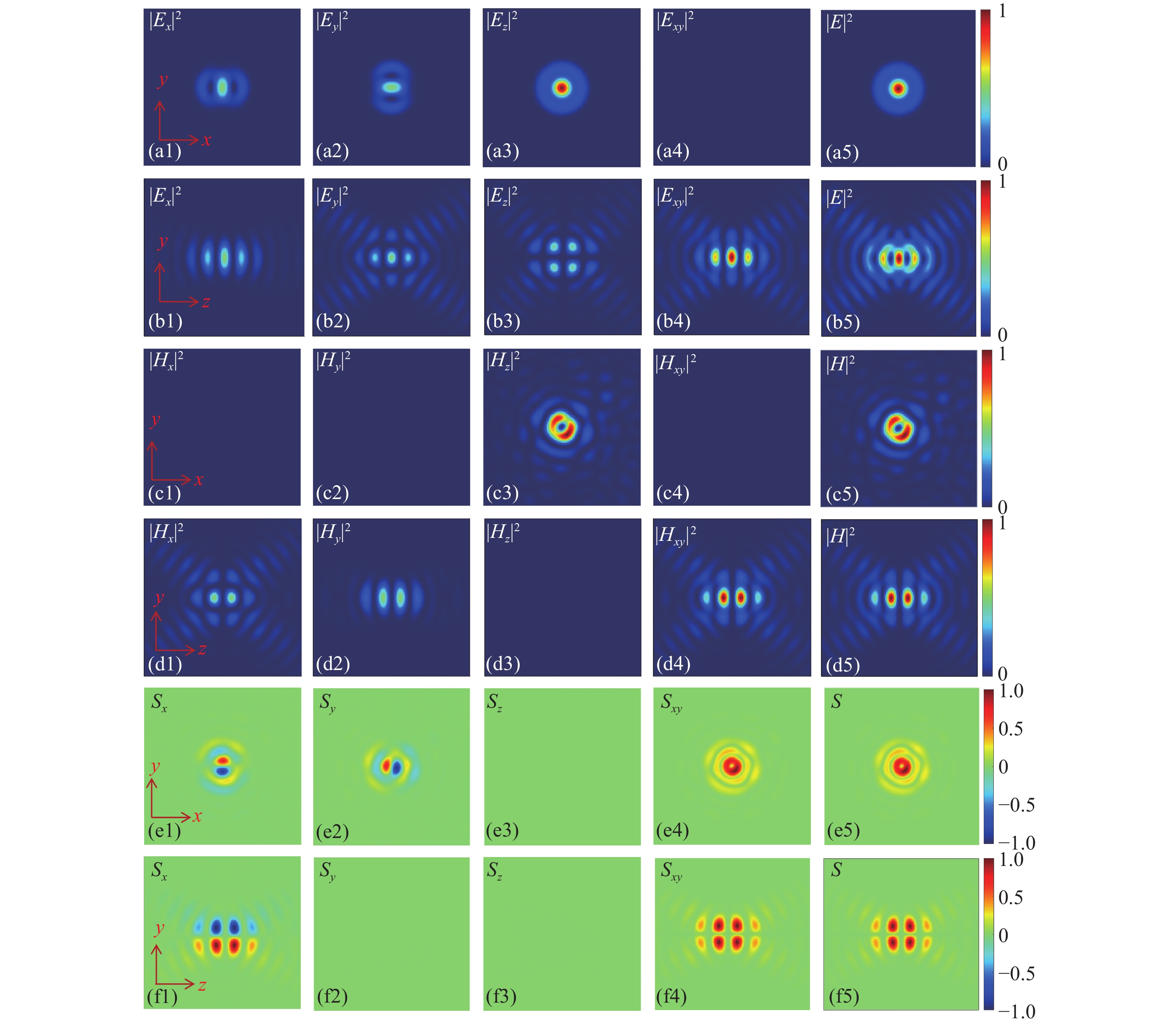
2 结果与分析 2.1 聚焦光束的电磁场与能流密度分布在本研究中,以径向偏振涡旋光束为例,首先探讨了具有相同相位差的入射光束在通过4π聚焦系统后的紧聚焦特性。通过计算分析,得到了如图2所示的结果。在焦面上,电场强度的纵向分量为零,如图2(a3)所示;而磁场强度的纵向分量不为零,如图2(c3)所示。此外,能流密度的纵向分量也为零,如图2(e3)所示。对于过焦平面的情况如图2(f3)所示,能流密度的纵向分量也为零。因此,焦面上的纵向能流密度为零,而过焦平面的纵向能流密度也为零,表明能流主要表现为纯横向分布。
|
(a1)~(a5)和(c1)~(c5)分别是焦平面内电场和磁场强度分布,(b1)~(b5)和(d1)~(d5)分别是传播平面内电场和磁场强度分布,(e1)~(e5)和(f1)~(f5)分别是焦平面和传播平面内的能流密度分布 图 2 径向偏振涡旋光束的4π紧聚焦特性 Figure 2 4π compact focusing properties of radially polarized vortex beams |
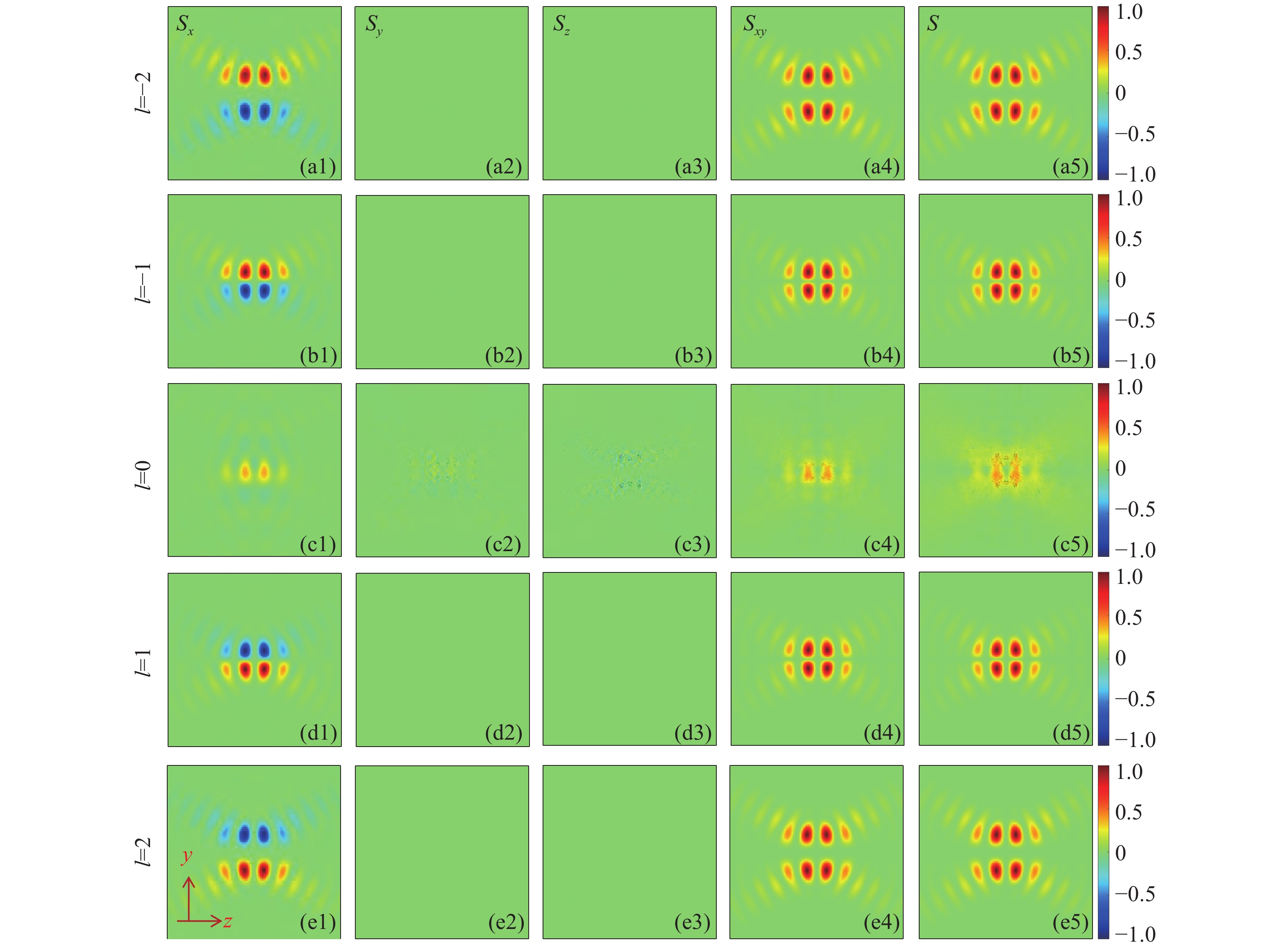
之后,系统探讨了涡旋光束的拓扑荷对其聚焦后的能流密度分布的影响,计算结果如图3所示,当拓扑荷l = 0时,能流密度的3个分量均较小且相互之间的差异不大。然而,当l非零时,横向能流密度远远大于纵向分量,使得纵向能流密度归一化后近似为零。此外,l的绝对值大小仅影响传输平面内能流密度的大小,而当拓扑荷的绝对值相等但符号相反时,例如(a1)与(d1)、(b1)与(c1),能流密度的x方向分布会发生旋转,但横向能流密度和总能流密度的分布保持不变。这是由于当拓扑电荷的符号改变时,光束的旋转方向也会相应改变,导致能流密度的x方向分布发生旋转,而横向能流与总的能流密度的分布特征表现出恒定性,这一现象与拓扑电荷的符号无关,其原因在于,能量通量的计算遵循特定的数学程序:即对各分量进行平方运算后累加,再取平方根。因此,可以认为,在这种情况下涡旋光束的拓扑荷在左右两侧相等且非零,即可产生纯横向能流的效果。
|
图 3 左右两侧的入射光束参数均为m = 1, Δ = 0, σ = 0, l = −2, −1, 0, 1, 2, 经过4π聚焦系统聚焦后,传播平面内能流密度的x, y, z分量,横向分量和总量 Figure 3 The x, y, and z components, transverse components, and total amount of the energy flow density in the propagation plane after focusing by the 4π focusing system for both the left and right sides of the incident beams with parameters m = 1, Δ = 0, σ = 0, l = −2, −1, 0, 1, 2 |
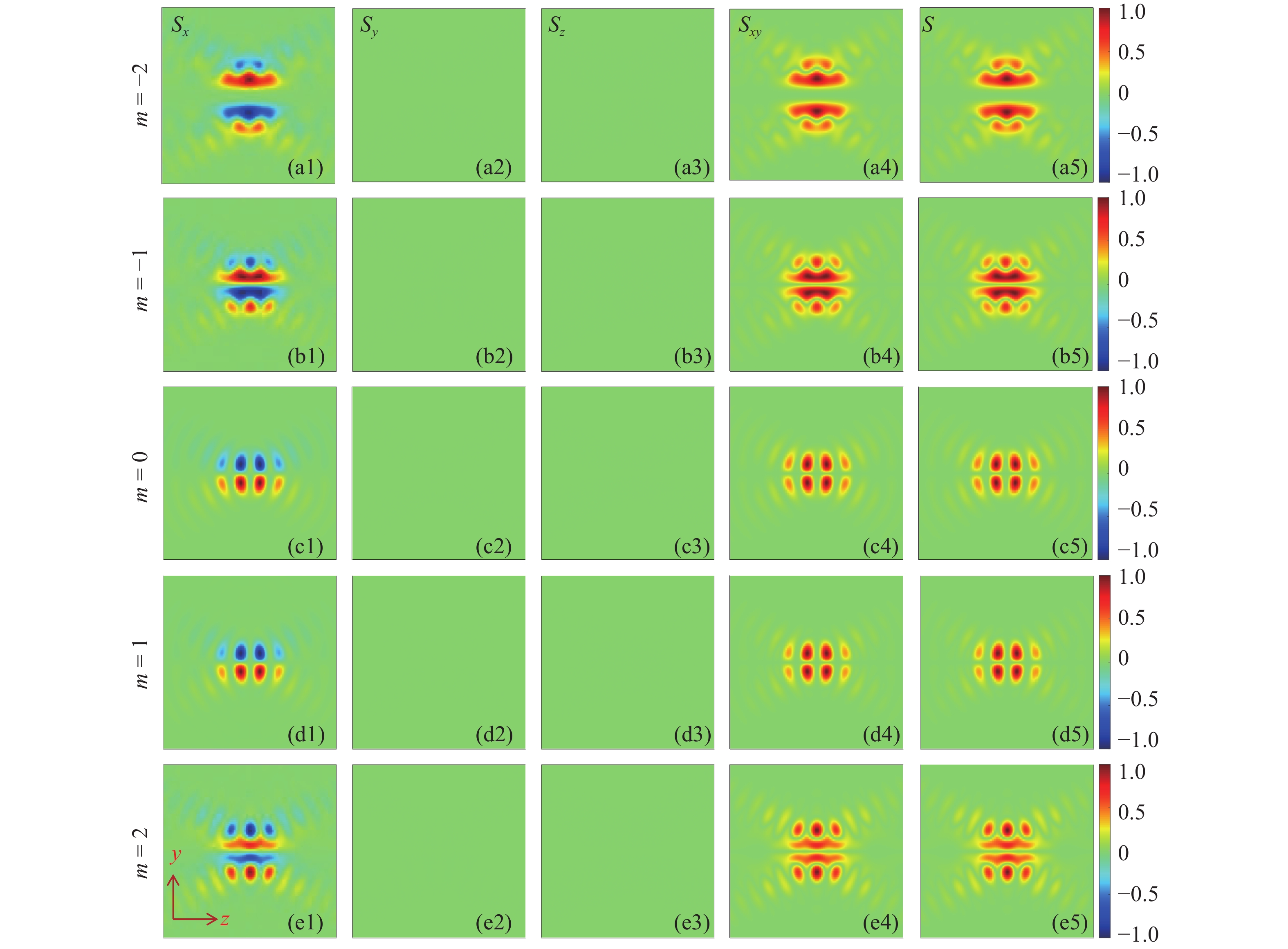
接下来,系统地分析偏振阶数对能流密度的影响。计算结果如图4所示,当两侧入射光束的偏振阶数m相同时,若拓扑荷l非零,则能流密度的分布主要受横向分量的支配。在这一条件下,纵向能流密度与横向分量相比,显著较小为0,因此可以近似认为能流为纯横向分布。此外,随着m的增加,能流密度的幅度相应增大。
|
图 4 左右两侧的入射光束参数均为l = 1, Δ = 0, σ = 0, m = −2, −1 , 0, 1, 2, 经过4π聚焦系统聚焦后,传播平面内能流密度的x, y, z分量,横向分量和总量 Figure 4 The x, y, and z components, transverse components, and total amount of the energy flow density in the propagation plane after focusing by the 4π focusing system for both the left and right sides of the incident beams with parameters l = 1, Δ = 0, σ = 0, m = −2, −1, 0, 1, 2 |
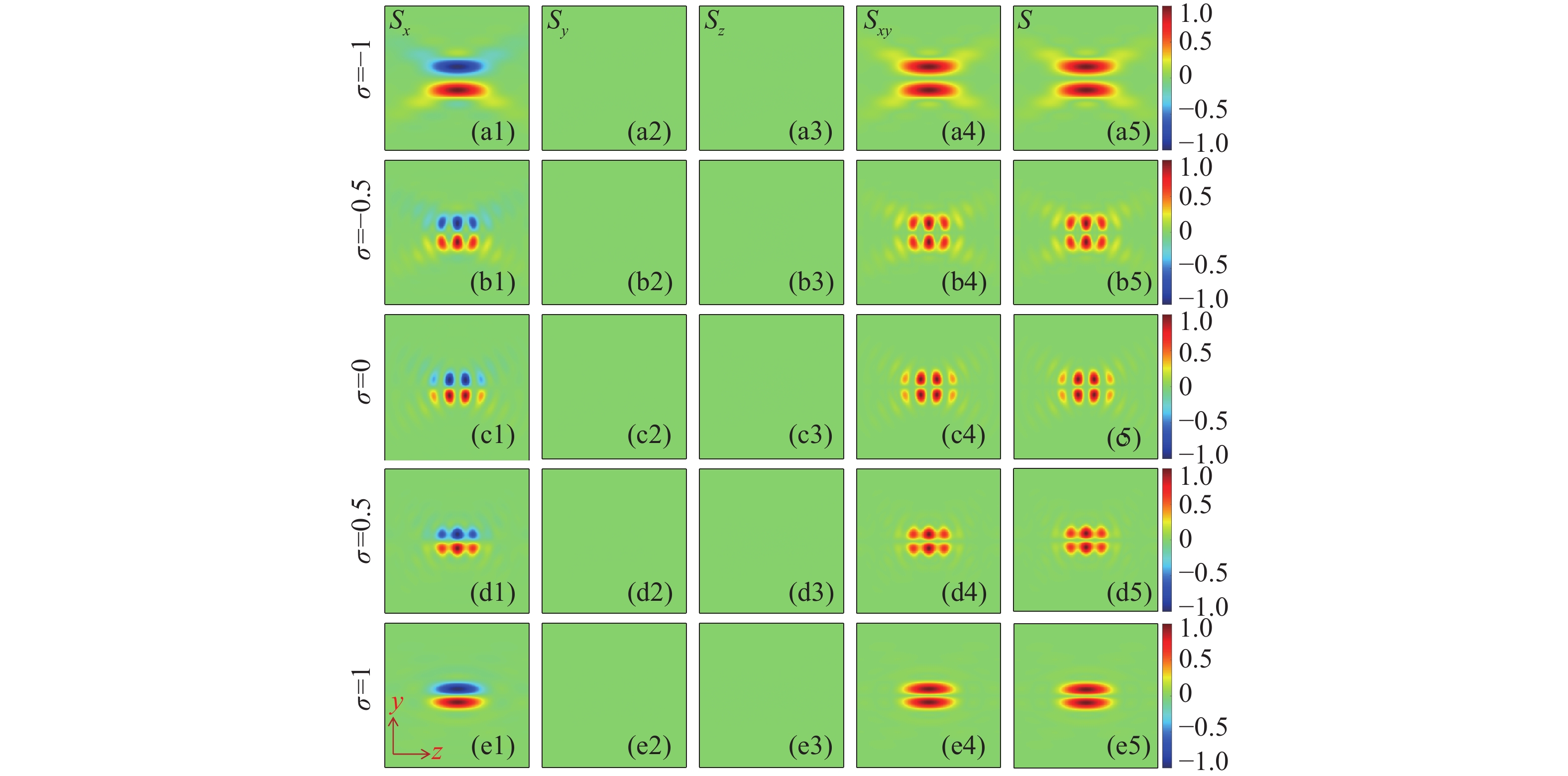
进一步,系统地探讨了偏振椭圆的椭偏度对能流密度分布的影响。如图5所示,当偏振椭圆的椭偏度保持恒定时,能流密度主要由横向分量决定。椭偏度的大小对于纵向能流密度并无显著影响,后者与横向分量相比较小,可以近似视为纯横向能流。此外,随着椭偏度绝对值的增大,能流密度的幅度也相应增强,但纵向能流密度依然接近于零。
|
图 5 左右两侧的入射光束参数均为l = 1, m = 1, Δ = 0, σ = −1, −0.5, 0, 0.5, 1, 经过4π聚焦系统聚焦后,传播平面内能流密度的x, y, z分量,横向分量和总量 Figure 5 The x, y, and z components, transverse components, and total amount of the energy flow density in the propagation plane after focusing by the 4π focusing system for both the left and right sides of the incident beams with parameters l = 1, m = 1, Δ = 0, σ = −1, −0.5, 0, 0.5, 1 |
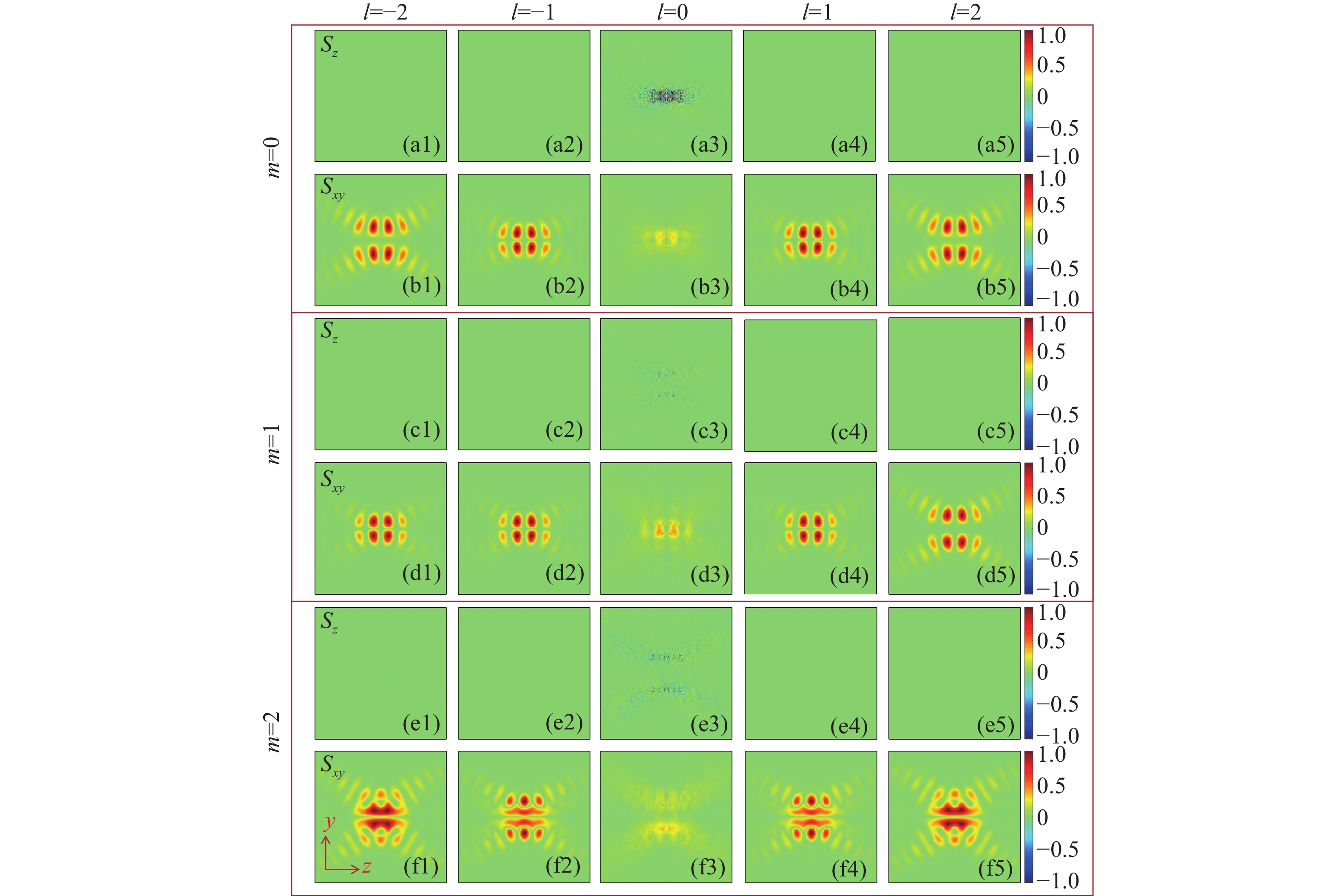
通过计算分析,探讨了偏振阶数和拓扑电荷综合作用下对能流密度分布的影响。如图6所示,当拓扑荷l为零时,横向与纵向能流密度相差不大。然而,当l不等于零时,无论偏振阶数m的数值如何,横向能流密度的数值显著大于纵向能流密度。此外,随着|m|的增加,横向能流密度的光斑更为紧凑,且差异更为明显。这一现象归因于光束在紧聚焦过程中自旋−轨道相互作用的结果。
|
图 6 左右两侧的入射光束参数均为l = −2, −1, 0, 1, 2, m = 0, 1, 2, Δ = 0, σ = 0, 经过4π聚焦系统聚焦后,传播平面内能流密度的横向分量和总量 Figure 6 The transverse components, and total amount of the energy flow density in the propagation plane after focusing by the 4π focusing system for both the left and right sides of the incident beams with parameters l = −2, −1, 0, 1, 2, m = 0, 1, 2, Δ = 0, σ = 0 |
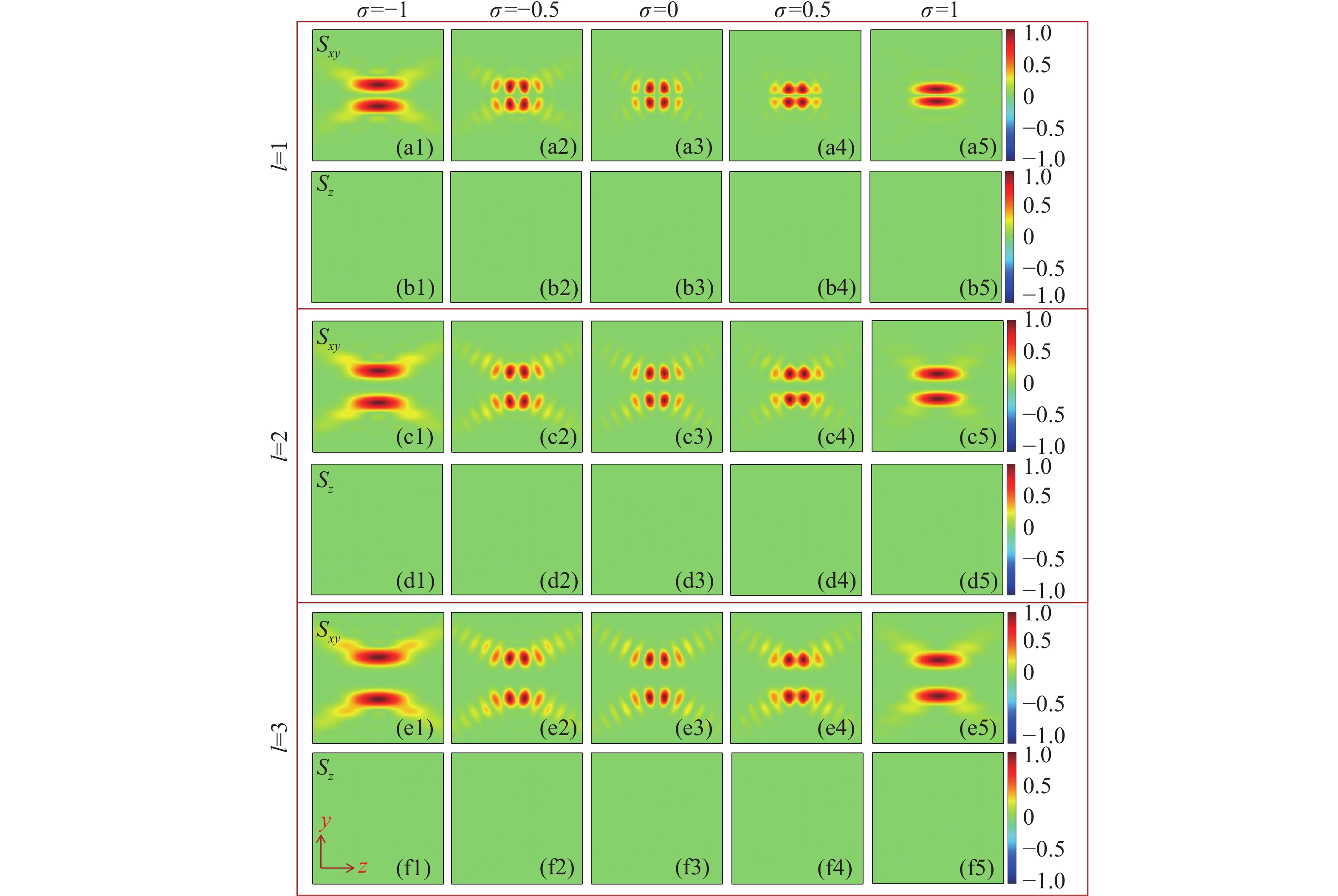
本节探讨了偏振阶数和偏振椭圆的椭圆率对能流密度分布的综合影响。如图7所示,当拓扑荷l保持不变时,椭圆率σ的绝对值决定了横向坡印廷矢量的大小、亮斑的数量以及旁瓣的数量。在所有情况下,纵向能流密度与横向相比,数值较小近似为零。当椭圆率的绝对值增至最大,即σ = ±1时,横向坡印廷矢量呈现为焦点上下的两瓣状分布。在其他情况下,横向坡印廷矢量则表现为四瓣分布。特别地,当椭圆率为零时,并未观察到旁瓣;而当椭圆率绝对值为0.5时,则出现了4个旁瓣。此外,当椭圆率保持不变,增大涡旋拓扑荷的绝对值,横向坡印廷矢量的两瓣状分布会远离焦点位置。
|
图 7 左右两侧的入射,光束参数均为l = 1, 2, 3,m = 1, Δ = 0, σ = −1, −0.5, 0, 0.5, 1, 经过4π聚焦系统聚焦后,传播平面内能流密度的横向分量和总量 Figure 7 The transverse components, and total amount of the energy flow density in the propagation plane after focusing by the 4π focusing system for both the left and right sides of the incident beams with parameters l = 1, 2, 3, m = 1, Δ = 0, σ = −1, −0.5, 0, 0.5, 1 |
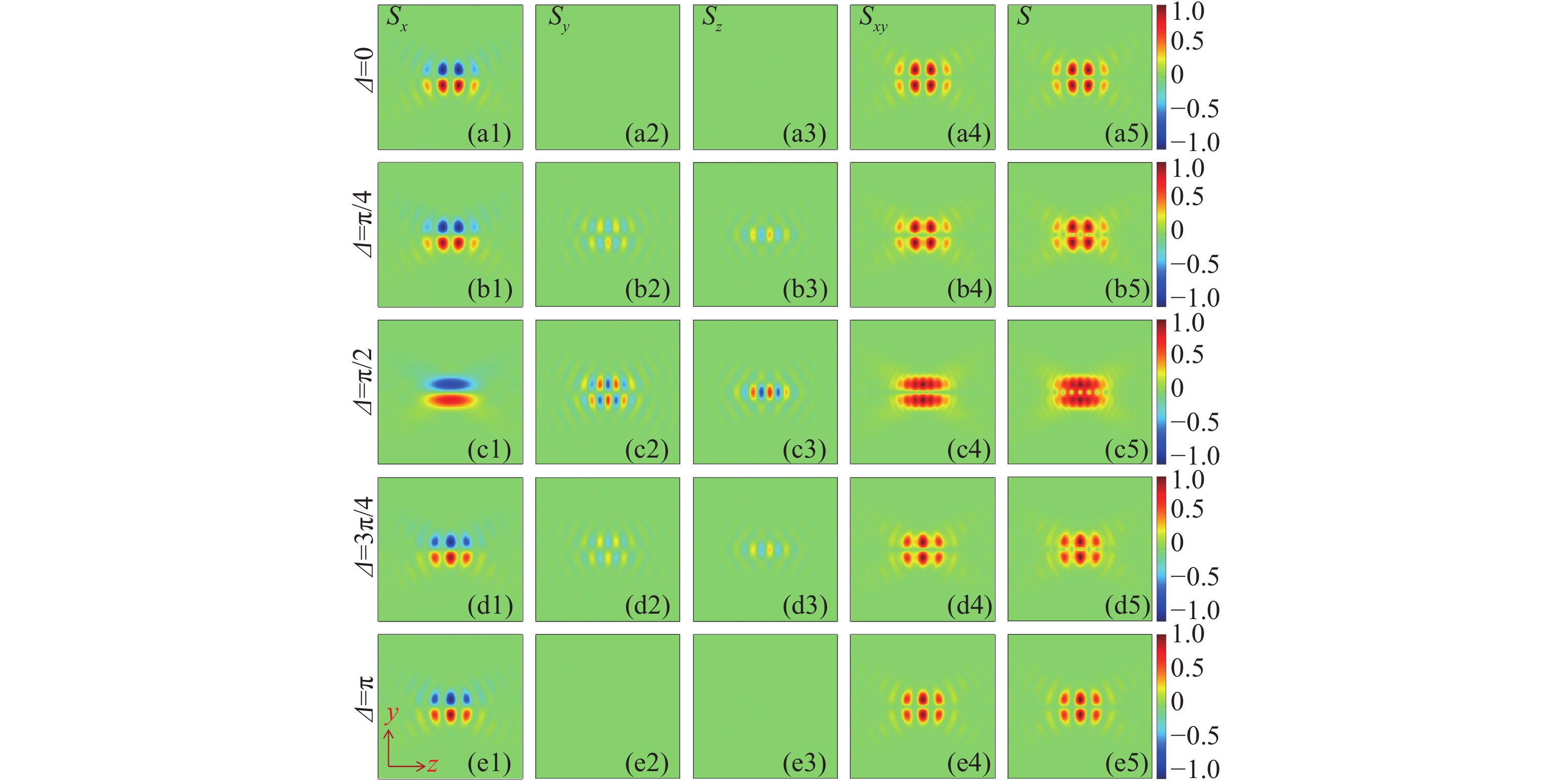
通过计算分析,系统地研究了入射光束在不同相位差条件下对能流密度分布的影响。如图8所示,通过对比图8(a3)和(e3),可以看到仅当左右两侧入射光束的相位差为0或π时,传播平面上的纵向能流密度近似为零,从而实现纯横向能流的产生。这一现象归因于两束光在空间中相位一致或完全相反时,其电场矢量在空间中的分布特性。具体而言,当两束光的相位差为0时,它们在空间中的每一点相位相同,而当相位差为π时,它们在空间中的每一点相位相反。对于具有特定偏振态(如径向偏振或角向偏振)的光束,其电场矢量在空间中形成特定的分布模式。在这种情况下,光束通过聚焦系统后,电场矢量的横向分量将主导能流密度的分布,而纵向分量将显著减小或消失。相反,当相位差不为0和π时,如图8(b3)、(c3)和(d3)所示,纵向能流密度显著不为零。这是因为在空间中某些点,两束光的相位部分叠加,而在另一些点则部分抵消,导致纵向能流密度不再为零,而是呈现出一定的非零值。
|
图 8 左右两侧的入射光束参数均为l = 1, m = 1, Δ = 0, π/4, π/2, 3π/4, π, σ = 0,经过4π聚焦系统聚焦后,传播平面内能流密度的x,y,z分量,横向分量和总量 Figure 8 The x, y, and z components, transverse components, and total amount of the energy flow density in the propagation plane after focusing by the 4π focusing system for both the left and right sides of the incident beams with parameters l = 1, m = 1, Δ = 0, π/4, π/2, 3π/4, π, σ = 0 |
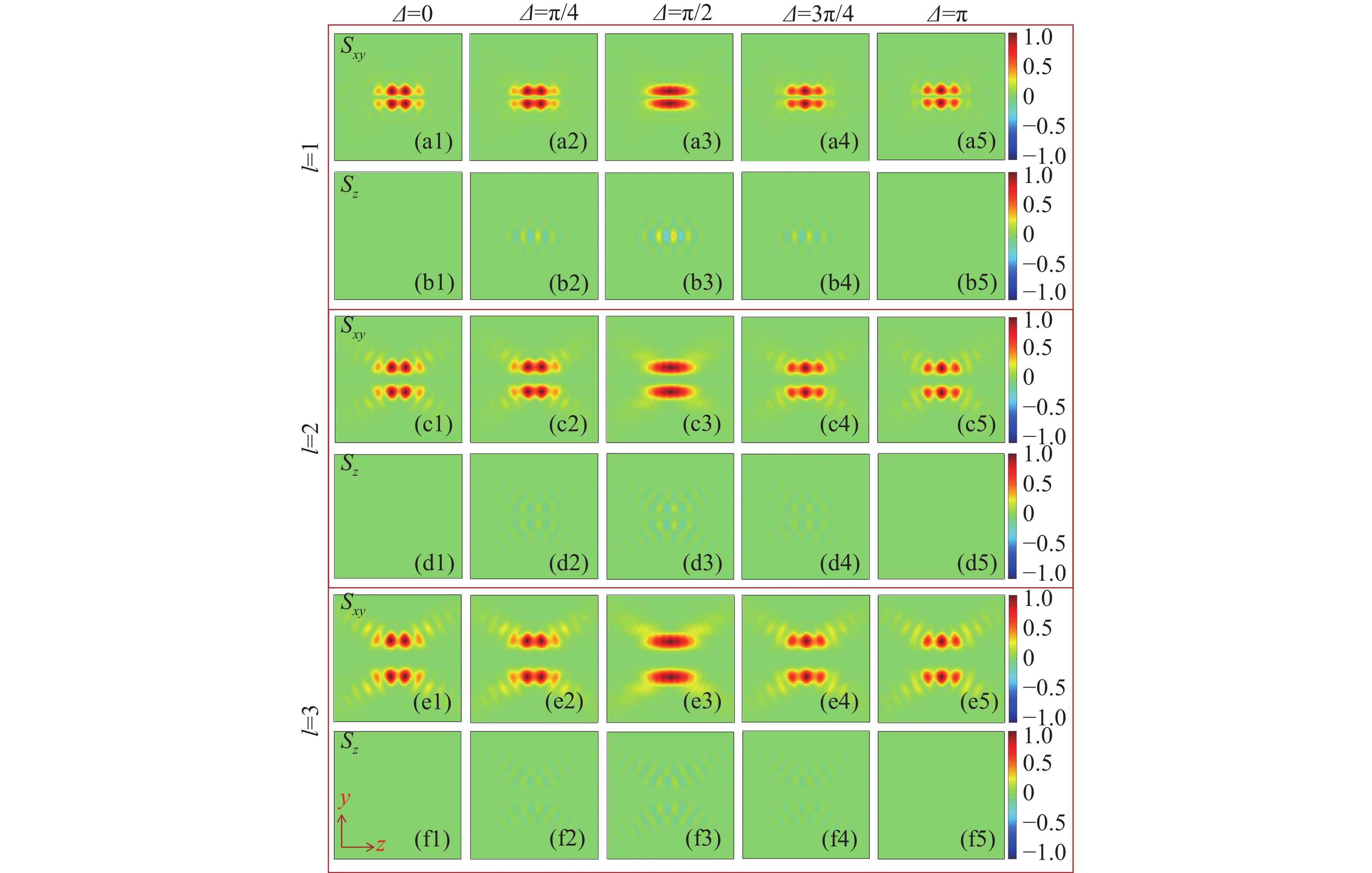
在本节中,探讨了相位差和涡旋拓扑荷对能流密度分布的影响。如图9所示,当涡旋拓扑荷保持恒定时,随着相位差的增加,纵向能流密度仅在相位差为0或π时近似为零,而在其他情况下,其数值显著增大。这一现象表明,相位差为0或π时,光束的纵向能流密度最小,有利于实现纯横向能流的产生。进一步地,当相位差保持恒定,而增大涡旋拓扑荷时,可以看到横向能流密度的分布呈现出两瓣结构,并且随着涡旋拓扑荷的增加,这两瓣分布逐渐远离焦点。这一趋势表明,涡旋拓扑荷的增加会导致横向能流密度的分布范围扩大,从而影响光束的聚焦特性。此外,当相位差不为0或π时,随着涡旋拓扑荷的增大,纵向能流密度的瓣数分布增多,呈现出上下两行的分布特征。同时,旁瓣的分布也有所增强。这些结果表明,涡旋拓扑荷的增加不仅影响纵向能流密度的瓣数分布,还会增强旁瓣的强度,从而对光束的能流分布产生显著影响。
|
图 9 左右两侧的入射光束参数均为l = 1, 2, 3, Δ = 0, π/4, π/2, 3π/4, π, m = 1, σ = 0.5, 经过4π聚焦系统聚焦后,传播平面内能流密度的x, y, z分量,横向分量和总量 Figure 9 The x, y, and z components, transverse components, and total amount of the energy flow density in the propagation plane after focusing by the 4π focusing system for both the left and right sides of the incident beams with parameters l = 1, 2, 3, Δ = 0, π/4, π/2, 3π/4, π, m = 1, σ = 0.5 |
本文采用Richards-Wolf矢量衍射理论,推导出了空间变化均匀椭偏度矢量涡旋光束通过4π紧聚焦系统后的电场和磁场分量的解析表达式模型。本文进一步系统地分析了涡旋拓扑荷、偏振拓扑荷、相位差和椭偏度对焦场中能流分布的影响。研究结果揭示,在特定条件下,即左右两侧入射光束的相位差为0或π,且其他光束参数保持一致时,焦场中可产生近似纯横向能流的效果。这些发现不仅为涡旋光束的能流调控提供了理论基础,而且对于光学捕获和手性粒子鉴别等应用领域具有重要的实际意义。
| [1] | LAX M, LOUISELL W H, MCKNIGHT W B. From Maxwell to paraxial wave optics[J]. Physical Review A, 1975, 11(4): 1365–1370. |
| [2] | ANGELSKY O V, GORSKY M P, MAKSIMYAK P P, et al. Investigation of optical currents in coherent and partially coherent vector fields[J]. Optics Express, 2011, 19(2): 660–672. |
| [3] | ZHANG Y J, BAI J P. Improving the recording ability of a near-field optical storage system by higher-order radially polarized beams[J]. Optics Express, 2009, 17(5): 3698–3706. DOI:10.1364/OE.17.003698 |
| [4] | HU S, BAO P, CAO Y H, et al. Giant lateral photovoltaic effect in Ag/porous silicon/Si structure for high-performance near-infrared detection[J]. Nano Energy, 2024, 120: 109167. DOI:10.1016/j.nanoen.2023.109167 |
| [5] | LU F K, ZHENG W, HUANG Z W. Coherent anti-Stokes Raman scattering microscopy using tightly focused radially polarized light[J]. Optics Letters, 2009, 34(12): 1870–1872. DOI:10.1364/OL.34.001870 |
| [6] | FENG E M, ZHANG C J, CHANG J H, et al. A 16.10% efficiency organic solar module with ultra-narrow interconnections fabricated via nanosecond ultraviolet laser processing[J]. Cell Reports Physical Science, 2024, 5(3): 101883. |
| [7] | HUANG Q S, ZOU C, MAN Z S. Energy flow of strongly focused cylindrical vector beams on higher-order Poincaré sphere[J]. Optics Communications, 2023, 537: 129418. DOI:10.1016/j.optcom.2023.129418 |
| [8] | ZHU M C, FU S G, MAN Z S, et al. Linear and angular momentum properties induced by radial- and azimuthal-variant polarized beams in a strongly focused optical system[J]. Optics Express, 2022, 30(23): 41048–41060. DOI:10.1364/OE.468511 |
| [9] | MAN Z S, BAI Z D, ZHANG S S, et al. Redistributing the energy flow of a tightly focused radially polarized optical field by designing phase masks[J]. Optics Express, 2018, 26(18): 23935–23944. DOI:10.1364/OE.26.023935 |
| [10] | MAN Z S, LI X Y, ZHANG S S, et al. Manipulation of the transverse energy flow of azimuthally polarized beam in tight focusing system[J]. Optics Communications, 2019, 431: 174–180. DOI:10.1016/j.optcom.2018.09.028 |
| [11] | BEKSHAEV A Y, GRIMBLATOV V M. Violation of transversality and transfer of electromagnetic field energy in coherent light beams[J]. Optics and Spectroscopy, 1989, 66(1): 127–128. |
| [12] | BARANOVA N B, SAVCHENKO A Y, ZEL’DOVICH B Y. Transverse shift of a focal spot due to switching of the sign of circular polarization[J]. Journal of Experimental and Theoretical Physics Letters, 1994, 59(4): 232–234. |
| [13] | 陈龙, 何赛灵, 沈林放. 含负折射率材料多层结构中倏逝波的传播及光隧穿效应分析[J]. 物理学报, 2003, 52 (10): 2386 – 2392. 陈龙, 何赛灵, 沈林放. 含负折射率材料多层结构中倏逝波的传播及光隧穿效应分析[J]. 物理学报, 2003, 52 (10): 2386 – 2392. |
| [14] | BEKSHAEV A Y. Polarization-dependent transformation of a paraxial beam upon reflection and refraction: A real-space approach[J]. Physical Review A, 2012, 85(2): 023842. DOI:10.1103/PhysRevA.85.023842 |
| [15] | HE T, LIU T, XIAO S Y, et al. Perfect anomalous reflectors at optical frequencies[J]. Science Advances, 2022, 8(9): eabk3381. DOI:10.1126/sciadv.abk3381 |
| [16] | MAN Z S, XI Z, YUAN X C, et al. Dual coaxial longitudinal polarization vortex structures[J]. Physical Review Letters, 2020, 124(10): 103901. |
| [17] | LIN J, YIN K, LI Y D, et al. Achievement of longitudinally polarized focusing with long focal depth by amplitude modulation[J]. Optics Letters, 2011, 36(7): 1185–1187. DOI:10.1364/OL.36.001185 |
| [18] | DEHEZ H, APRIL A, PICHÉ M. Needles of longitudinally polarized light: guidelines for minimum spot size and tunable axial extent[J]. Optics Express, 2012, 20(14): 14891–14905. DOI:10.1364/OE.20.014891 |
| [19] | RICHARDS B, WOLF E. Electromagnetic diffraction in optical systems, II. Structure of the image field in an aplanatic system[J]. Proceedings of the Royal Society A: mathematical, physical and sciences, 1959, 253(1274): 358–379. |
| [20] | JIAO X Y, LIU S, WANG Q, et al. Redistributing energy flow and polarization of a focused azimuthally polarized beam with rotationally symmetric sector-shaped obstacles[J]. Optics Letters, 2012, 37(6): 1041–1043. |
| [21] | KHONINA S N, USTINOV A V, DEGTYAREV S A. Inverse energy flux of focused radially polarized optical beams[J]. Physical Review A, 2018, 98(4): 043823. DOI:10.1103/PhysRevA.98.043823 |
| [22] | GAO X Z, PAN Y, ZHANG G L, et al. Redistributing the energy flow of tightly focused ellipticity-variant vector optical fields[J]. Photonics Research, 2017, 5(6): 640–648. DOI:10.1364/PRJ.5.000640 |
| [23] | KOTLYAR V V, NALIMOV A G, STAFEEV S S, et al. Orbital energy and spin flows in a strong focus of laser light[J]. IEEE Photonics Journal, 2020, 12(5): 4501713. |
| [24] | ZHU M C, FU S G, MAN Z S. Time-varying optical spin-orbit Hall effect in tightly focused femtosecond optical field[J]. Optics Express, 2024, 32(7): 11715–11725. |
| [25] | CHEN W B, ZHAN Q W. Creating a spherical focal spot with spatially modulated radial polarization in 4Pi microscopy[J]. Optics Letters, 2009, 34(16): 2444–2446. DOI:10.1364/OL.34.002444 |
| [26] | CHEN Z Y, ZHAO D M. 4Pi focusing of spatially modulated radially polarized vortex beams[J]. Optics Letters, 2012, 37(8): 1286–1288. DOI:10.1364/OL.37.001286 |
| [27] | ZHANG S S, FU S G, ZHANG H N, et al. Fully controlled photonic spin in highly confined optical field[J]. Optics Express, 2019, 27(23): 33621–33633. DOI:10.1364/OE.27.033621 |
| [28] | WANG S C, CAO H K, SUN J L, et al. Subwavelength generation of orientation-unlimited energy flow in 4π microscopy[J]. Optics Express, 2022, 30(1): 138–145. |
| [29] | ZHU M C, FU S G, MAN Z S. Evolving electromagnetic chirality of a focused field from the Poincaré sphere perspective[J]. Optik, 2022, 262: 169278. DOI:10.1016/j.ijleo.2022.169278 |
| [30] | BAI Z D, ZHANG S S, LYU Y D, et al. Metallic particle manipulation with adjustable trapping range through customized field[J]. Optics Communications, 2020, 473: 126045. DOI:10.1016/j.optcom.2020.126045 |