 2023, Vol. 45
 Issue (4): 47-53


2. 上海理工大学 光电信息与计算机工程学院,上海 200093
2. School of Optical-Electrical and Computer Engineering, University of Shanghai for Science and Technology, Shanghai 200093, China
涡旋光束是一种具有螺旋波前相位的特殊光束,其光子携带轨道角动量(orbital angular momentum, OAM),与光束的拓扑荷数成正比[1]。由于涡旋光束在光通信[2-5]、微粒操控[6-9]、光学成像[10-13]等领域有着巨大的潜在应用价值,因此近十年来一直是光学以及相关领域的研究热点。
早期的研究主要集中于拉盖尔–高斯涡旋光束和贝塞尔–高斯涡旋光束,但研究者发现,当这些涡旋光束的拓扑荷数发生改变时,会引起光束环半径以及环宽的变化,而这会大幅削弱光束在微粒操控以及光纤传输等方面的应用效率[14-15]。为了克服这一困难,Ostrovsky等[16]在2013年提出了一种振幅为
PVB的提出引起了研究者的兴趣,实际无法产生振幅为
随后研究者提出了各种矢量PVB和变形PVB,并使用了多种技术手段和工具用于PVB的产生。2015年,中国科技大学的卢荣德小组[21]利用数字微镜代替SLM,产生了大拓扑荷数的PVB;2016年,西北工业大学的赵建林课题组[22]提出了矢量PVB的产生和偏振调控方法;2017年,Karahroudi等[23]提出可用弧形叉状光栅一次性产生多种拓扑荷数的PVB,但实际所得光束质量较差;2018年,Li等[24]实验产生了矢量椭圆形PVB并研究了光束性质;2019年,中国科学院西安光学精密机械研究所的姚保利课题组[25]实验产生了双环型PVB并研究了光束性质;2020年,Guo等[26]提出可以使用聚合物相位板代替SLM产生PVB,其相位板的像素可达亚微米级;2021年,Dai等[27]利用声光调制的方法产生拓扑荷数为分数阶的PVB。最近,研究者们[28-30]使用Pancharatnam-Berry相位超表面进一步产生了矢量PVB以及PVB阵列。虽然PVB的产生研究呈现多样性发展,但PVB特有的类
由于锥透镜相位法实验光路简单,且产生光束质量高,因此是目前最为广泛使用的方法。虽然Vaity等提出的改进锥透镜法可以通过SLM方便调控PVB的环半径以及拓扑荷数,但当调整环宽时仍需改变入射高斯光源的光斑大小或更换不同焦距的傅里叶透镜。虽然可以通过额外加载不同焦距的菲涅尔全息透镜相位来代替物理更换透镜,但这样会使得产生光束的质量下降[31],且每次改变全息透镜的焦距后仍然需要调整后续测量或应用光路的位置,使得调控不能实时完成,且增加了实验的操作难度,这对于微粒操控等需要实时调整光束参数的应用来说是十分不利的。为了克服这一困难,本文提出可使用傅里叶空间相位计算全息法[32]产生PVB,改进了相位编码方法,进一步简化了实验光路,使得光束的环半径、环宽以及拓扑荷数都可方便的通过加载于SLM的编码相位进行调控,且在光束调控过程中可固定光路进行实验,降低了实验操作难度。同时,该方法还具有通用性强的优点,不仅可用于产生常规PVB,也可用于产生椭圆形PVB[33]以及双环形PVB[25, 34]等变形PVB。最后,本文对理论分析和数值仿真结果进行了实验验证,实验结果与理论结果相吻合。
1 理论分析理想PVB可表示为[16]
| $ {E_{\rm{PVB}}}\left( {r,\theta } \right) \propto \delta \left( {r - R} \right)\exp \left( {\rm{i}}l\theta \right) $ | (1) |
式中:
| $ F\left( {\rho ,\phi } \right) \propto {{\rm{J}}_l}\left( {{k_r}\rho } \right)\exp \left( {{\rm{i}}l\phi } \right) $ | (2) |
式中:
| $ {F_G}\left( {\rho ,\phi } \right) \propto {{\rm{J}}_l}\left( {{k_r}\rho } \right)\exp \left( { - \frac{{{\rho ^2}}}{{w_{\rm{g}}^2}}} \right)\exp \left( {{\rm{i}}l\phi } \right) $ | (3) |
式中
| $ E\left( {r,\theta } \right) \propto \exp \left( { - \frac{{{r^2} + {R^2}}}{{{T^2}}}} \right){I_l}\left( {\frac{{2Rr}}{{{T^2}}}} \right)\exp \left( {{\rm{i}}l\theta } \right) $ | (4) |
其中
| $ R = {k_r}f/k $ | (5) |
| $ T = 2f/k{w_{\rm{g}}} $ | (6) |
式中:
为了获得式(3)所示的贝塞尔–高斯光束,可使用半径为
| $ \psi {\text{ = }}\exp ({\rm{i}}ar + {\rm{i}}l\theta ) $ | (7) |
式中
由式(6)可知,如果想要改变
为了实现这一目标,本文引入了相位计算全息法[32],并选择针对频谱函数编码,即选择式(3)作为编码对象,这样可将文献中的
| $ {F_G}\left( {\rho ,\phi } \right) = c\left( \rho \right)\exp \left[ {{\rm{i}}\varphi \left( \phi \right)} \right] $ | (8) |
| $ c\left( \rho \right) = A{{\rm{J}}_l}\left( {{k_r}\rho } \right)\exp \left( { - \frac{{{\rho ^2}}}{{w_{\rm{g}}^2}}} \right) $ | (9) |
| $ \varphi \left( \phi \right) = {\rm{i}}l\phi $ | (10) |
式中
| $ \psi \left( {c,\varphi } \right) = \varphi + M\left( c \right)\sin \varphi $ | (11) |
| $ {{\rm{J}}_0}\left[ {M\left( c \right)} \right] = c $ | (12) |
式中
为了将各级衍射光在傅里叶透镜的后焦面分离,可在编码相位中添加一载波相位调制,此时式(11)改写为
| $ \begin{split} \psi \left( {{x_0},{y_0}} \right) = & \left[ {\varphi + 2 {\text{π}}\left( {p{x_0} + q{y_0}} \right)} \right] +\\ & M\left( c \right)\sin \left[ {\varphi + 2 {\text{π}} \left( {p{x_0} + q{y_0}} \right)} \right] \end{split}$ | (13) |
式中
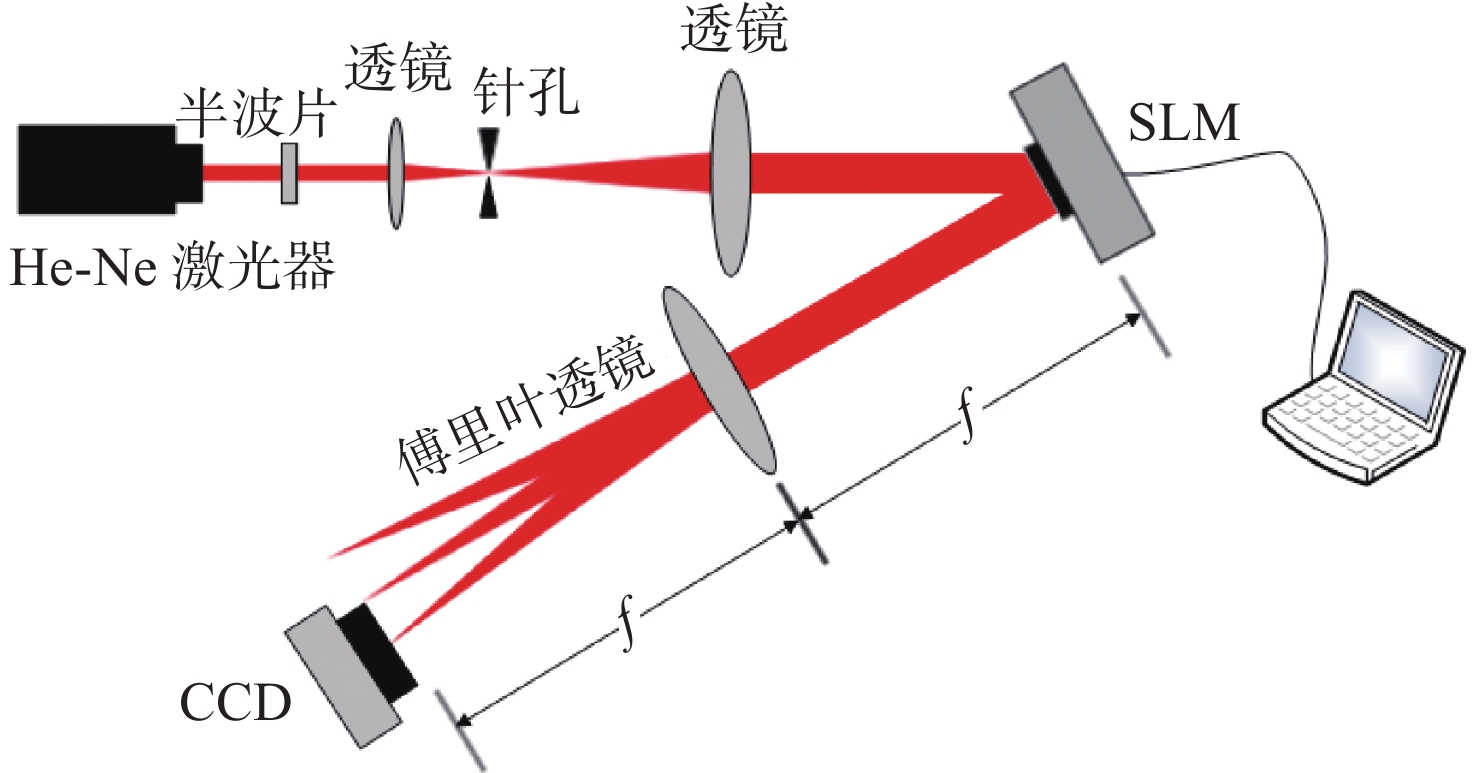
实验光路示意图如图1所示,本文使用了型号为DH-HN250P,功率约为2.4 mv,波长为632.8 nm的氦氖激光器作为光源,光束经过半波片将偏振方向调整到与SLM(Holoeye GAEA-2)的工作方向平行,SLM的分辨率为3840×2160,像素尺寸为3.74 µm,相面尺寸15.32 mm×9.22 mm。然后经透镜组与针孔整形、扩束后入射到SLM上。SLM位于傅里叶透镜的前焦面上,图像传感器(charge-coupled,CCD)位于傅里叶透镜的后焦面上,测量所需的正1级衍射光束。实验使用了焦距f = 300 mm的傅里叶透镜,并保持不变,这样光路经一次调整准直后就无需变更,在整个实验过程中可固定光路进行实验。
|
图 1 实验光路示意图 Figure 1 Diagram of experimental setup |
编码时改变式(10)中的

|
图 2 参数
|
由式(5)可知,编码时改变式(9)中的
|
表 1 参数
|
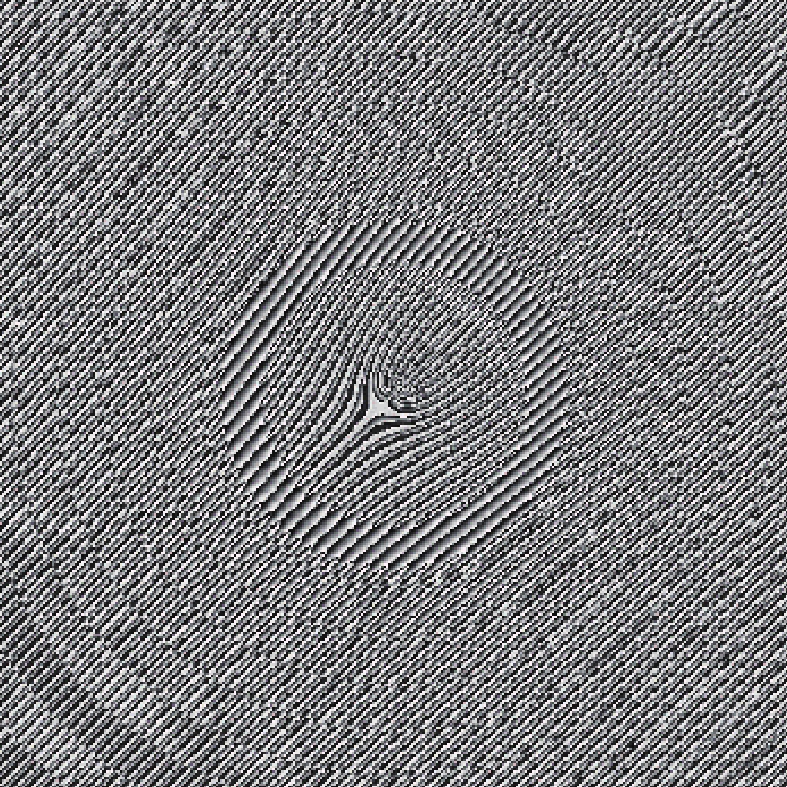

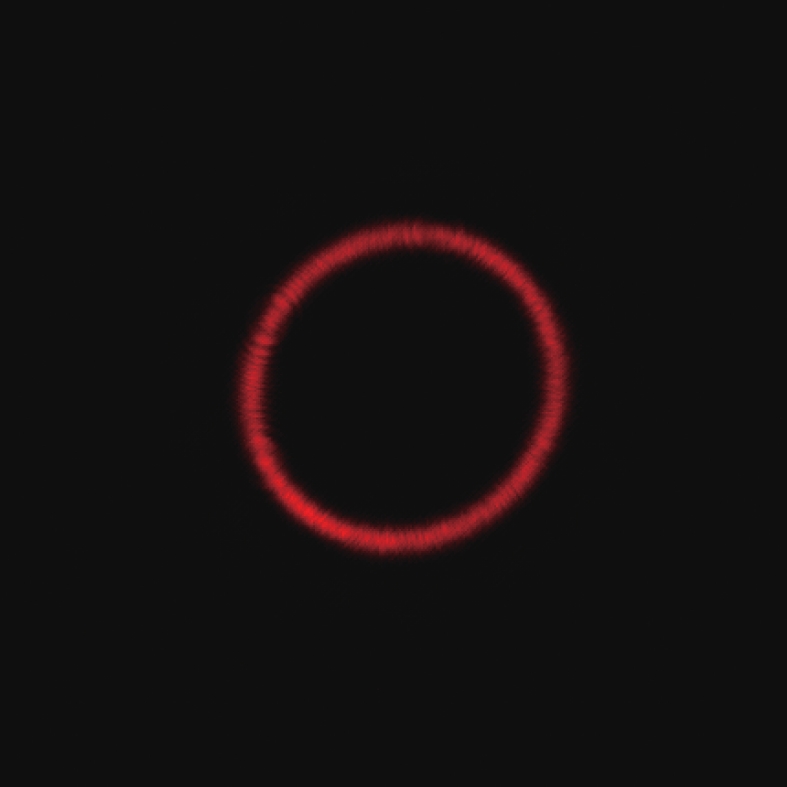
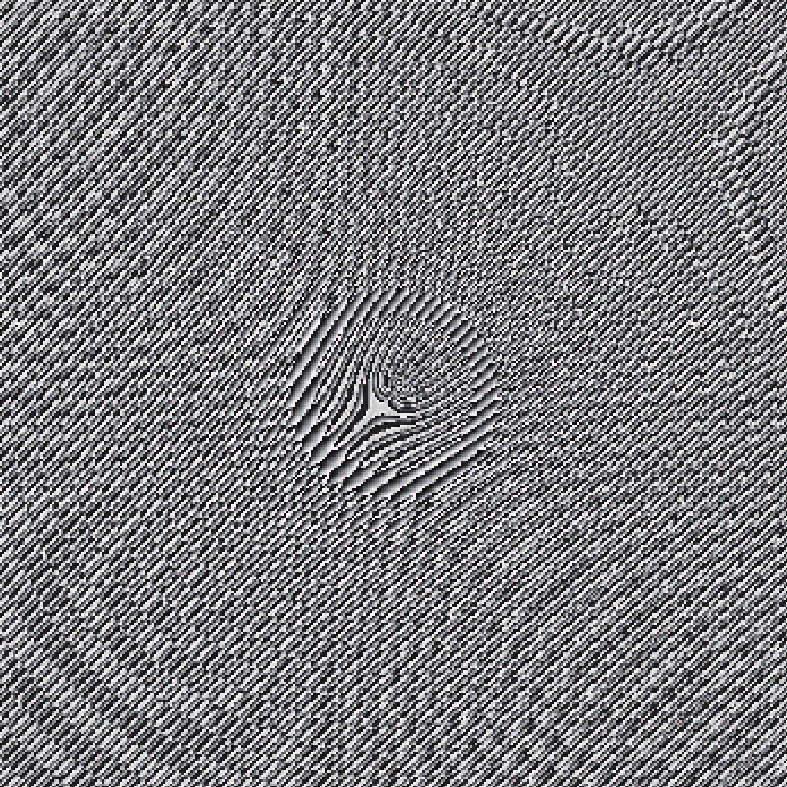

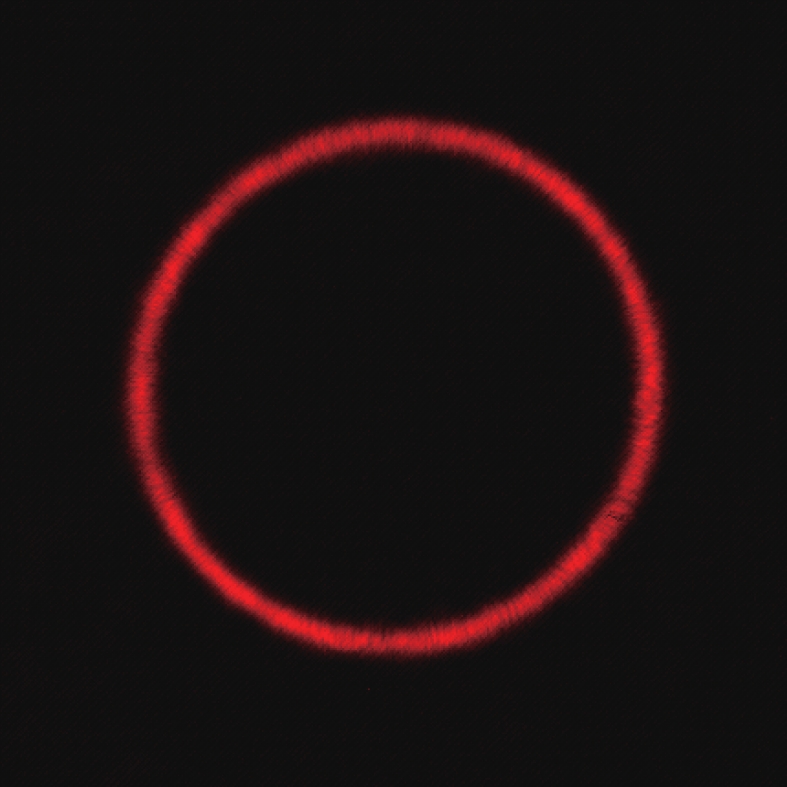
由式(6)可知,改变式(9)中的
|
|
表 2 参数
|
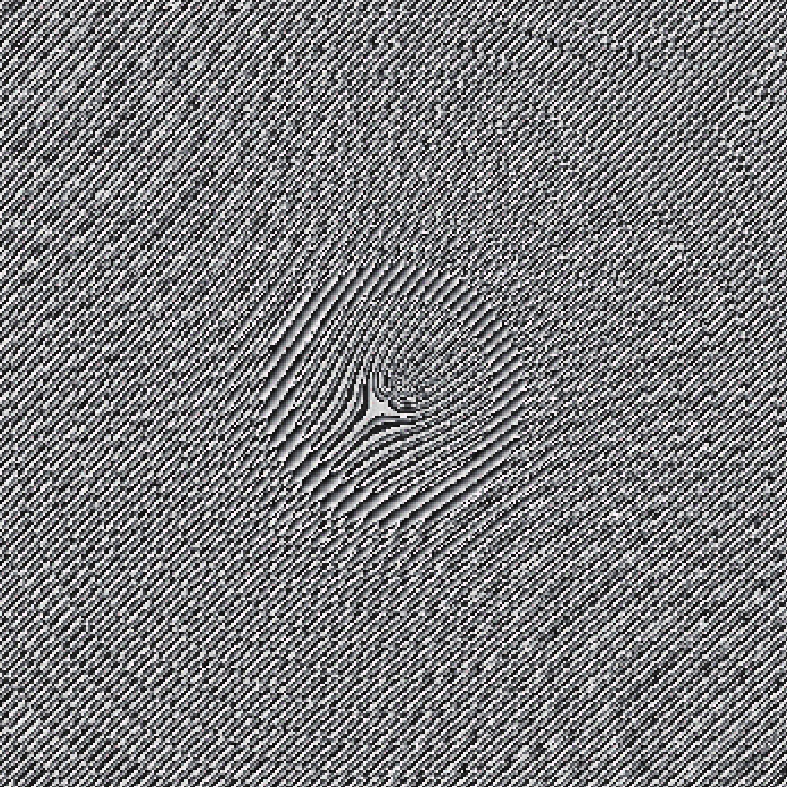

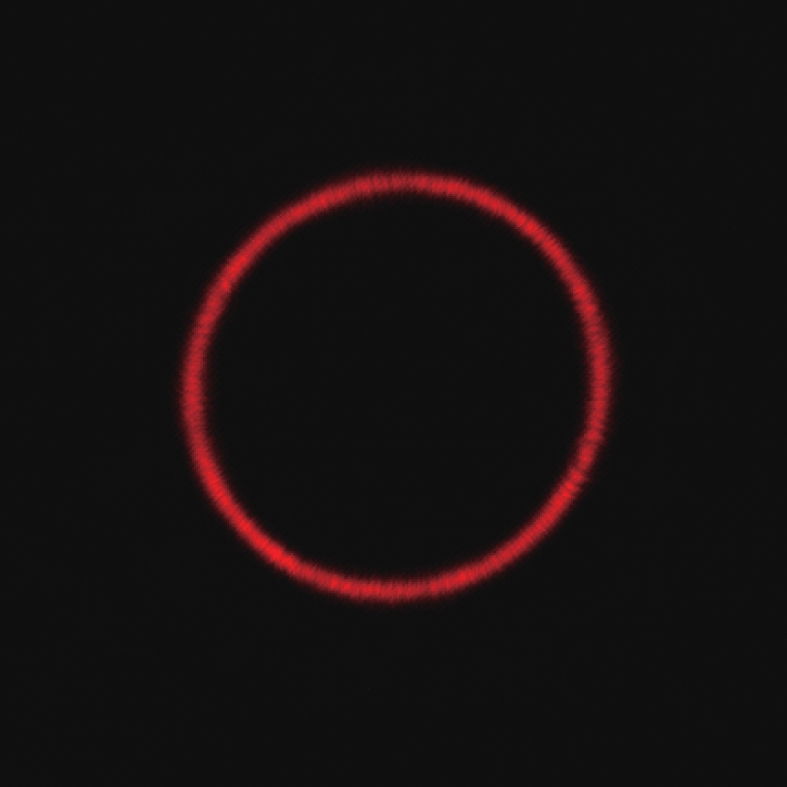
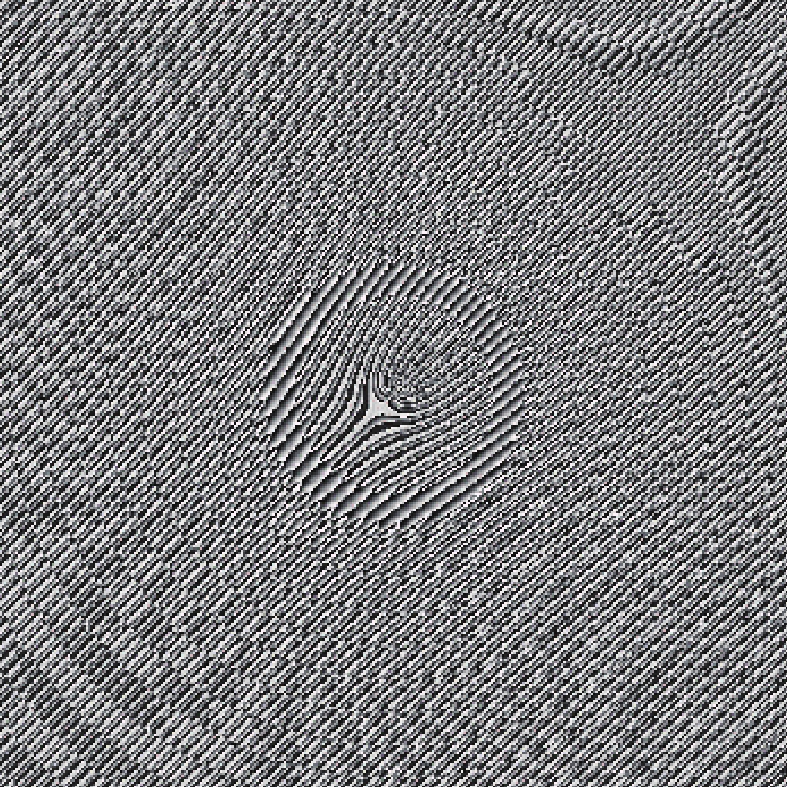

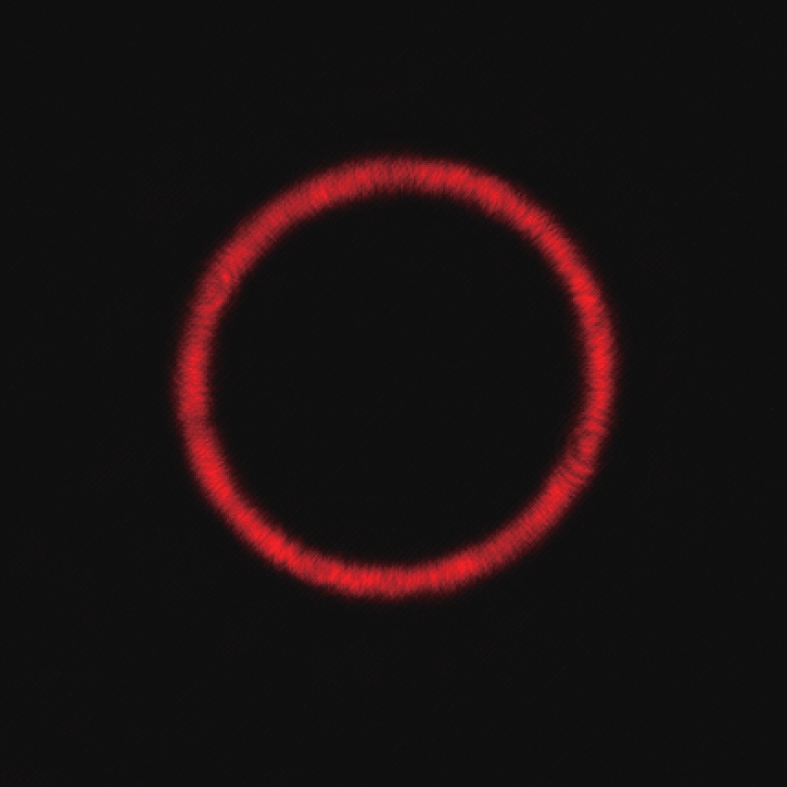
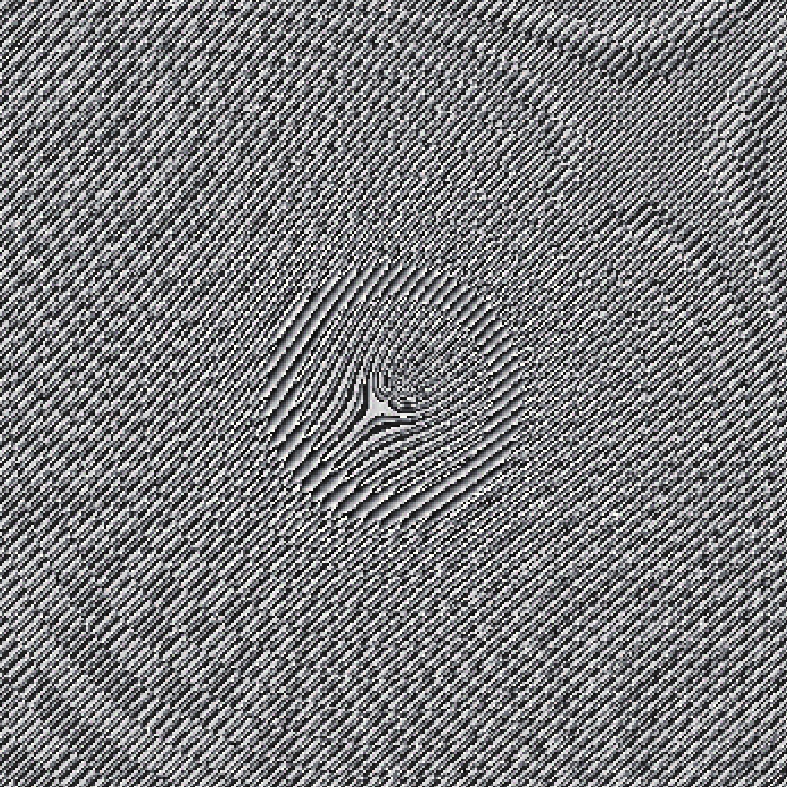

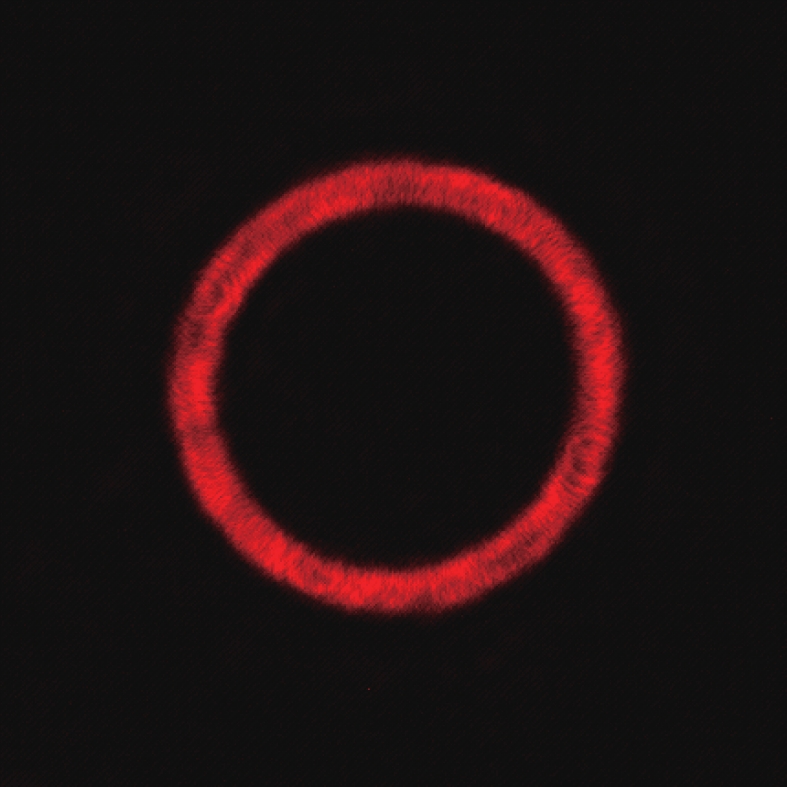
上述实验结果证明,使用傅里叶空间相位编码法可以方便地通过编码相位函数来调控包括环宽
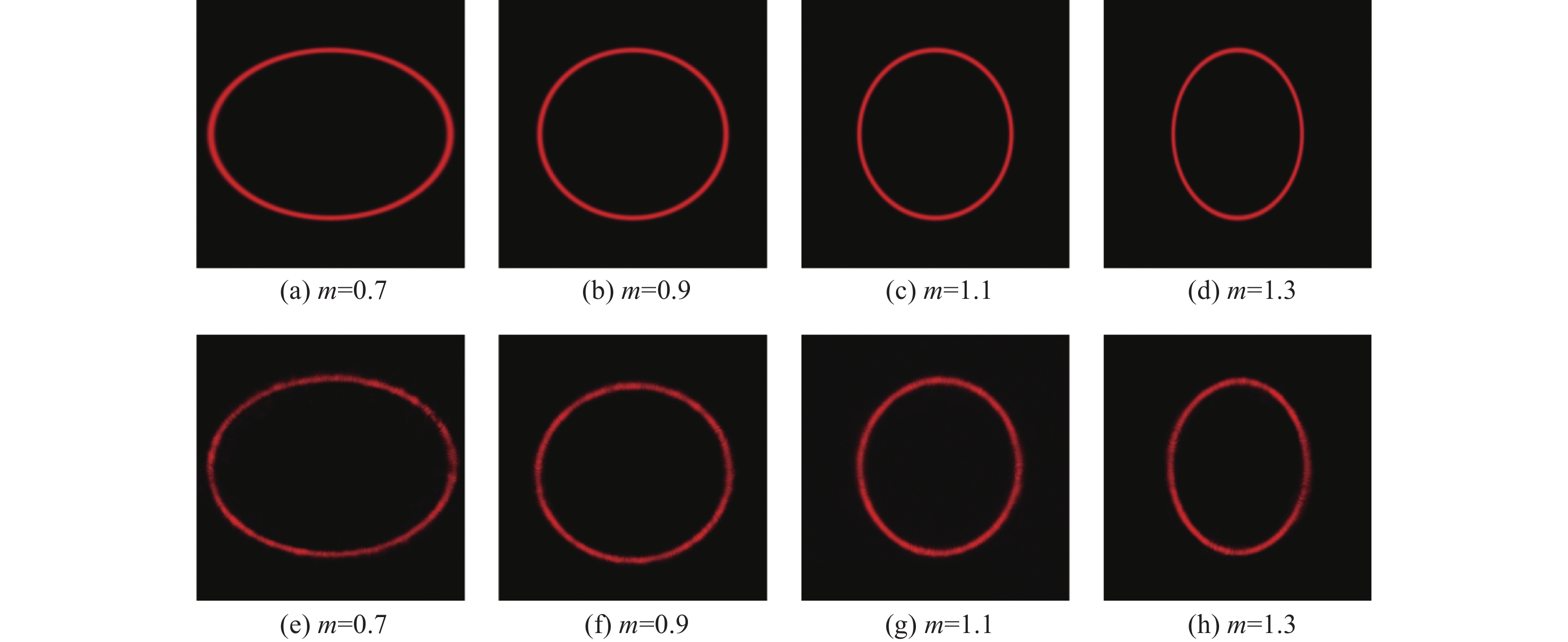
该方法还具有适用性广的优点,只要在编码时将式(3)替换为变形PVB的频谱,就可用此方法产生变形PVB,且无需变更光路。图3给出了不同参数的椭圆形PVB的理论光强分布和实验测量结果。光束参数选取
|
图 3 光束参数m不同的椭圆形PVB的理论光强分布和实验测量结果。(a)~(d)理论光强分布;(e)~(h)实验测量结果 Figure 3 Simulation and experimental results of intensity distributions of elliptic PVB with different m.(a)-(d)simulation results;(e)-(h)experimental results |
本文提出了使用傅里叶空间相位计算全息法产生、调控PVB。通过理论分析可知,使用该方法可以方便的通过改变相位编码函数实时调控PVB的3个主要光束参数,且光路简单,经一次调整准直后就无需变更,在整个实验过程中可固定光路进行实验,操作简便。实验测量结果与理论预期相吻合,实验产生的光束质量高,且光束质量几乎不受光束参数的影响。另一方面,计算相位全息法的通用性强,此方法还可用于产生高质量的变形PVB。本文实验产生了不同参数的椭圆形PVB,实验测量结果与理论结果相吻合。综上所述,傅里叶空间相位计算全息法是一种简便、通用、实用性更强的完美涡旋光产生、调控方法。
| [1] | ALLEN L, BEIJERSBERGEN M W, SPREEUW R J C, et al. Orbital angular momentum of light and the transformation of Laguerre-Gaussian laser modes[J]. Physical Review A, 1992, 45(11): 8185–8189. DOI:10.1103/PhysRevA.45.8185 |
| [2] | WILLNER A E, WANG J, HUANG H. A different angle on light communications[J]. Science, 2012, 337(6095): 655–656. DOI:10.1126/science.1225460 |
| [3] | WANG J, YANG J Y, FAZAL I M, et al. Terabit free-space data transmission employing orbital angular momentum multiplexing[J]. Nature Photonics, 2012, 6(7): 488–496. DOI:10.1038/nphoton.2012.138 |
| [4] | CHEN Y X, LIU S S, LOU Y B, et al. Orbital angular momentum multiplexed quantum dense coding[J]. Physical Review Letters, 2021, 127(9): 093601. DOI:10.1103/PhysRevLett.127.093601 |
| [5] | WILLNER A E, PANG K, SONG H, et al. Orbital angular momentum of light for communications[J]. Applied Physics Reviews, 2021, 8(4): 041312. DOI:10.1063/5.0054885 |
| [6] | DHOLAKIA K, ČIŽMÁR T. Shaping the future of manipulation[J]. Nature Photonics, 2011, 5(6): 335–342. DOI:10.1038/nphoton.2011.80 |
| [7] | PADGETT M, BOWMAN R. Tweezers with a twist[J]. Nature Photonics, 2011, 5(6): 343–348. DOI:10.1038/nphoton.2011.81 |
| [8] | OTTE E, DENZ C. Optical trapping gets structure: structured light for advanced optical manipulation[J]. Applied Physics Reviews, 2020, 7(4): 041308. DOI:10.1063/5.0013276 |
| [9] | FUJIWARA H, SUDO K, SUNABA Y, et al. Spin–orbit angular-momentum transfer from a nanogap surface plasmon to a trapped nanodiamond[J]. Nano Letters, 2021, 21(14): 6268–6273. DOI:10.1021/acs.nanolett.1c02083 |
| [10] | HELL S W, WICHMANN J. Breaking the diffraction resolution limit by stimulated emission: stimulated-emission-depletion fluorescence microscopy[J]. Optics Letters, 1994, 19(11): 780–782. DOI:10.1364/OL.19.000780 |
| [11] | JESACHER A, RITSCH-MARTE M, PIESTUN R. Three-dimensional information from two-dimensional scans: a scanning microscope with postacquisition refocusing capability[J]. Optica, 2015, 2(3): 210–213. DOI:10.1364/OPTICA.2.000210 |
| [12] | LIN Z Z, HU J Q, CHEN Y J, et al. Spectral self-imaging of optical orbital angular momentum modes[J]. APL Photonics, 2021, 6(11): 111302. DOI:10.1063/5.0067668 |
| [13] | XIAO Q, MA Q, YAN T, et al. Orbital-angular-momentum-encrypted holography based on coding information metasurface[J]. Advanced Optical Materials, 2021, 9(11): 2002155. DOI:10.1002/adom.202002155 |
| [14] | YAN H W, ZHANG E T, ZHAO B Y, et al. Free-space propagation of guided optical vortices excited in an annular core fiber[J]. Optics Express, 2012, 20(16): 17904–17915. DOI:10.1364/OE.20.017904 |
| [15] | CHEN M Z, MAZILU M, ARITA Y, et al. Dynamics of microparticles trapped in a perfect vortex beam[J]. Optics Letters, 2013, 38(22): 4919–4922. DOI:10.1364/OL.38.004919 |
| [16] | OSTROVSKY A S, RICKENSTORFF-PARRAO C, ARRIZÓN V. Generation of the "perfect" optical vortex using a liquid-crystal spatial light modulator[J]. Optics Letters, 2013, 38(4): 534–536. DOI:10.1364/OL.38.000534 |
| [17] | PINNELL J, RODRÍGUEZ-FAJARDO V, FORBES A. How perfect are perfect vortex beams?[J]. Optics Letters, 2019, 44(22): 5614–5617. DOI:10.1364/OL.44.005614 |
| [18] | GARCÍA-GARCÍA J, RICKENSTORFF-PARRAO C, RAMOS-GARCÍA R, et al. Simple technique for generating the perfect optical vortex[J]. Optics Letters, 2014, 39(18): 5305–5308. DOI:10.1364/OL.39.005305 |
| [19] | KOTLYAR V V, KOVALEV A A, PORFIREV A P. Optimal phase element for generating a perfect optical vortex[J]. Journal of the Optical Society of America A, 2016, 33(12): 2376–2384. DOI:10.1364/JOSAA.33.002376 |
| [20] | VAITY P, RUSCH L. Perfect vortex beam: Fourier transformation of a Bessel beam[J]. Optics Letters, 2015, 40(4): 597–600. DOI:10.1364/OL.40.000597 |
| [21] | CHEN Y, FANG Z X, REN Y X, et al. Generation and characterization of a perfect vortex beam with a large topological charge through a digital micromirror device[J]. Applied Optics, 2015, 54(27): 8030–8035. DOI:10.1364/AO.54.008030 |
| [22] | LI P, ZHANG Y, LIU S, et al. Generation of perfect vectorial vortex beams[J]. Optics Letters, 2016, 41(10): 2205–2208. DOI:10.1364/OL.41.002205 |
| [23] | KARAHROUDI M K, PARMOON B, QASEMI M, et al. Generation of perfect optical vortices using a Bessel-Gaussian beam diffracted by curved fork grating[J]. Applied Optics, 2017, 56(21): 5817–5823. DOI:10.1364/AO.56.005817 |
| [24] | LI D L, CHANG C L, NIE S P, et al. Generation of elliptic perfect optical vortex and elliptic perfect vector beam by modulating the dynamic and geometric phase[J]. Applied Physics Letters, 2018, 113(12): 121101. DOI:10.1063/1.5048327 |
| [25] | LIANG Y S, YAN S H, HE M R, et al. Generation of a double-ring perfect optical vortex by the Fourier transform of azimuthally polarized Bessel beams[J]. Optics Letters, 2019, 44(6): 1504–1507. DOI:10.1364/OL.44.001504 |
| [26] | GUO Z M, LIU H H, XIANG L N, et al. Generation of perfect vortex beams with polymer-based phase plate[J]. IEEE Photonics Technology Letters, 2020, 32(10): 565–568. DOI:10.1109/LPT.2020.2985745 |
| [27] | DAI K J, MILLER J K, LI W Z, et al. Fractional orbital angular momentum conversion in second-harmonic generation with an asymmetric perfect vortex beam[J]. Optics Letters, 2021, 46(14): 3332–3335. DOI:10.1364/OL.428859 |
| [28] | LIU Y C, KE Y G, ZHOU J X, et al. Generation of perfect vortex and vector beams based on Pancharatnam-Berry phase elements[J]. Scientific Reports, 2017, 7(1): 44096. DOI:10.1038/srep44096 |
| [29] | ZHOU Q W, LIU M Z, ZHU W Q, et al. Generation of perfect vortex beams by dielectric geometric metasurface for visible light[J]. Laser & Photonics Reviews, 2021, 15(12): 2100390. |
| [30] | XIE J F, GUO H M, ZHUANG S L, et al. Polarization-controllable perfect vortex beam by a dielectric metasurface[J]. Optics Express, 2021, 29(3): 3081–3089. DOI:10.1364/OE.413573 |
| [31] | LING J Y, YANG Q Y, ZHANG S X, et al. Improved generation method utilizing a modified Fourier spectrum for Airy beams with the phase-only filter technique[J]. Applied Optics, 2017, 56(25): 7059–7066. DOI:10.1364/AO.56.007059 |
| [32] | ARRIZÓN V, RUIZ U, CARRADA R, et al. Pixelated phase computer holograms for the accurate encoding of scalar complex fields[J]. Journal of the Optical Society of America A, 2007, 24(11): 3500–3507. DOI:10.1364/JOSAA.24.003500 |
| [33] | LI X Z, MA H X, YIN C L, et al. Controllable mode transformation in perfect optical vortices[J]. Optics Express, 2018, 26(2): 651–662. DOI:10.1364/OE.26.000651 |
| [34] | DU Y F, LIU D M, FU S N, et al. Reconfigurable generation of double-ring perfect vortex beam[J]. Optics Express, 2021, 29(11): 17353–17364. DOI:10.1364/OE.424664 |
| [35] | MA H X, LI X Z, TAI Y P, et al. In situ measurement of the topological charge of a perfect vortex using the phase shift method [J]. Optics Letters, 2017, 42(1): 135–138. DOI:10.1364/OL.42.000135 |