 2022, Vol. 44
 Issue (4): 49-56


2. 上海理工大学 光电信息与计算机工程学院,上海 200093
2. School of Optical-Electrical and Computer Engineering, University of Shanghai for Science and Technology, Shanghai 200093, China
相干反斯托克斯拉曼散射(coherent anti-Stokes Raman scattering,CARS)过程是一种基于四波混频的三阶非线性光学过程[1]。CARS作为一种基于分子键振动的非标记光学显微成像方法,广泛运用于显微学和光谱学领域。因为具有免标记、高灵敏度、选择性及三维层析能力等特点,CARS得到了大量持续的关注和研究[2]。CARS信号的产生需要一束频率为
圆偏振光激发的CARS(circularly polarized-CARS,CP-CARS)成像可以有效去除非共振背景[15],但其相关光谱方面的研究较少。
本文通过理论计算和实验测量,证明圆偏振光可以有效抑制各向异性样品CARS光谱中的非共振背景。
1 计算仿真不同于传统的偏振CARS,圆偏振CARS可用于检测各向异性样品,而偏振CARS适用于检测各向同性样品。
从三阶非线性极化强度的一般公式出发:
| $ \begin{split} {P}_{i}^{\left(3\right)}\left({\omega }_{\mathrm{o}\mathrm{u}\mathrm{t}}\right)=&\displaystyle\sum\limits_{jkl}\displaystyle\sum \limits_{\left(abc\right)}{\chi }_{ijkl}^{\left(3\right)}\left({\omega }_{\mathrm{o}\mathrm{u}\mathrm{t}};{\omega }_{a},{\omega }_{b},{\omega }_{c}\right) \times \\ &{E}_{j}\left({\omega }_{a}\right){E}_{k}\left({\omega }_{b}\right){E}_{l}\left({\omega }_{c}\right) \end{split}$ | (1) |
式中:
在CARS的计算中,只考虑探测的
计算CARS信号的一般公式为:
| $ {E}_{\mathrm{p}y}={E}_{\mathrm{p}x}{\mathrm{e}}^{\mathrm{i}{\phi }_{\mathrm{p}}} \text{,} {E}_{\mathrm{s}y}^{*}={E}_{\mathrm{s}x}^{*}{\left({\mathrm{e}}^{\mathrm{i}{\phi }_{\mathrm{s}}}\right)}^{*} \tag{2a}$ |
| $ {P}_{x}={3E}_{\mathrm{p}x}^{2}{E}_{\mathrm{s}x}^{*}\left[\begin{array}{c}{\chi }_{1222}^{\left(3\right)}{\mathrm{e}}^{\mathrm{i}{\phi }_{\mathrm{p}}}{\mathrm{e}}^{\mathrm{i}{\phi }_{\mathrm{p}}}{\left({\mathrm{e}}^{\mathrm{i}{\phi }_{\mathrm{s}}}\right)}^{*}+{\chi }_{1111}^{\left(3\right)}+\\ {\chi }_{1121}^{\left(3\right)}{\mathrm{e}}^{\mathrm{i}{\phi }_{\mathrm{p}}}+{\chi }_{1122}^{\left(3\right)}{\mathrm{e}}^{\mathrm{i}{\phi }_{\mathrm{p}}}{\left({\mathrm{e}}^{\mathrm{i}{\phi }_{\mathrm{s}}}\right)}^{*}+\\ {\chi }_{1211}^{\left(3\right)}{\mathrm{e}}^{\mathrm{i}{\phi }_{\mathrm{p}}}+{\chi }_{1212}^{\left(3\right)}{\mathrm{e}}^{\mathrm{i}{\phi }_{\mathrm{p}}}{\left({\mathrm{e}}^{\mathrm{i}{\phi }_{\mathrm{s}}}\right)}^{*}+\\ {\chi }_{1221}^{\left(3\right)}{\mathrm{e}}^{\mathrm{i}{\phi }_{\mathrm{p}}}{\mathrm{e}}^{i{\phi }_{\rm p}}+{\chi }_{1112}^{\left(3\right)}{\left({\mathrm{e}}^{\mathrm{i}{\phi }_{\mathrm{s}}}\right)}^{*}\end{array}\right] \tag{2b}$ |
| $ {P}_{y}={3E}_{\mathrm{p}x}^{2}{E}_{\mathrm{s}x}^{*}\left[\begin{array}{c}{\chi }_{2222}^{\left(3\right)}{\mathrm{e}}^{\mathrm{i}{\phi }_{\mathrm{p}}}{\mathrm{e}}^{\mathrm{i}{\phi }_{\mathrm{p}}}{\left({\mathrm{e}}^{\mathrm{i}{\phi }_{\mathrm{s}}}\right)}^{*}+{\chi }_{2111}^{\left(3\right)}+\\ {\chi }_{2212}^{\left(3\right)}{\mathrm{e}}^{\mathrm{i}{\phi }_{\mathrm{p}}}{\left({\mathrm{e}}^{\mathrm{i}{\phi }_{\mathrm{s}}}\right)}^{*}+{\chi }_{2112}^{\left(3\right)}{\left({\mathrm{e}}^{\mathrm{i}{\phi }_{\mathrm{s}}}\right)}^{*}+\\ {\chi }_{2122}^{\left(3\right)}{\mathrm{e}}^{\mathrm{i}{\phi }_{\mathrm{p}}}{\left({\mathrm{e}}^{\mathrm{i}{\phi }_{\mathrm{s}}}\right)}^{*}{+\chi }_{2121}^{\left(3\right)}{\mathrm{e}}^{\mathrm{i}{\phi }_{\mathrm{p}}}+\\ {\chi }_{2221}^{\left(3\right)}{\mathrm{e}}^{\mathrm{i}{\phi }_{\mathrm{p}}}{\mathrm{e}}^{\mathrm{i}{\phi }_{\mathrm{p}}}+{\chi }_{2211}^{\left(3\right)}{\mathrm{e}}^{\mathrm{i}{\phi }_{\mathrm{p}}}\end{array}\right] \tag{2c}$ |
当泵浦光与斯托克斯光为线偏振光时:
| $\begin{split} {P}_{x\mathrm{l}}= & 3\left({\chi }_{1111}^{\left(3\right)}+{\chi }_{1112}^{\left(3\right)}+{\chi }_{1121}^{\left(3\right)}+{\chi }_{1122}^{\left(3\right)}{+\chi }_{1212}^{\left(3\right)}+\right.\\ & \left.{\chi }_{1211}^{\left(3\right)}+{\chi }_{1221}^{\left(3\right)}+{\chi }_{1222}^{\left(3\right)}\right){E}_{\mathrm{p}x}^{2}{E}_{\mathrm{s}x}^{*} \end{split} \tag{3a} $ |
| $\begin{split} {P}_{y\mathrm{l}}=& 3\left({\chi }_{2222}^{\left(3\right)}+{\chi }_{2211}^{\left(3\right)}+{\chi }_{2212}^{\left(3\right)}+{\chi }_{2112}^{\left(3\right)}{+\chi }_{2121}^{\left(3\right)}+{\chi }_{2122}^{\left(3\right)}+\right.\\ & \left.{\chi }_{2221}^{\left(3\right)}+{\chi }_{2111}^{\left(3\right)}\right){E}_{\mathrm{p}x}^{2}{E}_{\mathrm{s}x}^{*} \end{split} \tag{3b}$ |
考虑到线偏振光和圆偏振光在相同功率下实验,圆偏振光两个分量的计算公式在公式(2b)、(2c)的基础上改为:
| $ {P}_{x\mathrm{c}}=\dfrac{\sqrt{2}}{2}{P}_{x} \text{,} {P}_{y\mathrm{c}}=\dfrac{\sqrt{2}}{2}{P}_{y} $ |
当泵浦光与斯托克斯光为反向圆偏振时:
| $ \begin{split} {P}_{x\mathrm{c}}=& \frac{3\sqrt{2}}{2}{E}_{\mathrm{p}x}^{2}{E}_{\mathrm{s}x}^{\mathrm{*}}\left({\chi }_{1111}^{\left(3\right)}+\mathrm{i}{\chi }_{1112}^{\left(3\right)}+{\mathrm{i}\chi }_{1121}^{\left(3\right)}-\right.\\ & \left.{\chi }_{1122}^{\left(3\right)}{+\mathrm{i}\chi }_{1212}^{\left(3\right)}-{\chi }_{1211}^{\left(3\right)}-{\chi }_{1221}^{\left(3\right)}-{\mathrm{i}\chi }_{1222}^{\left(3\right)}\right) \end{split} \tag{4a}$ |
| $ \begin{split} {P}_{y\mathrm{c}}=& \frac{3\sqrt{2}}{2}{E}_{\mathrm{p}x}^{2}{E}_{\mathrm{s}x}^{*}\left({\mathrm{i}\chi }_{2211}^{\left(3\right)}-\mathrm{i}{\chi }_{2222}^{\left(3\right)}-{\chi }_{2212}^{\left(3\right)}+\mathrm{i}{\chi }_{2112}^{\left(3\right)}-\right.\\ & \left.{\chi }_{2121}^{\left(3\right)}{+\mathrm{i}\chi }_{2122}^{\left(3\right)}-{\chi }_{2221}^{\left(3\right)}+{\chi }_{2111}^{\left(3\right)}\right) \end{split}\tag{4b} $ |
当泵浦光与斯托克斯光为同向圆偏振光时:
| $ \begin{split} {P}_{x\mathrm{c}}=& \frac{3\sqrt{2}}{2}{E}_{\mathrm{p}x}^{2}{E}_{\mathrm{s}x}^{*}\left({\chi }_{1111}^{\left(3\right)}-\mathrm{i}{\chi }_{1112}^{\left(3\right)}+\mathrm{i}{\chi }_{1121}^{\left(3\right)}+{\chi }_{1122}^{\left(3\right)}+\right.\\ &\left.{\mathrm{i}\chi }_{1212}^{\left(3\right)}+{\chi }_{1211}^{\left(3\right)}-{\chi }_{1221}^{\left(3\right)}+{\mathrm{i}\chi }_{1222}^{\left(3\right)}\right) \end{split}\tag{5a}$ |
| $ \begin{split} {P}_{y\mathrm{c}}=&\frac{3\sqrt{2}}{2}{E}_{\mathrm{p}x}^{2}{E}_{\mathrm{s}x}^{*}\left({\mathrm{i}\chi }_{2222}^{\left(3\right)}+\mathrm{i}{\chi }_{2211}^{\left(3\right)}+{\chi }_{2212}^{\left(3\right)}-\mathrm{i}{\chi }_{2112}^{\left(3\right)}+\right.\\ &\left.{\chi }_{2121}^{\left(3\right)}{+\mathrm{i}\chi }_{2122}^{\left(3\right)}-{\chi }_{2221}^{\left(3\right)}+{\chi }_{2111}^{\left(3\right)}\right) \end{split} \tag{5b}$ |
对于各项同性样品,
其中,当泵浦光与斯托克斯光为线偏振光时:
| $ {P}_{x\mathrm{l}}=3\left({\chi }_{1111}^{\left(3\right)}+{\chi }_{1122}^{\left(3\right)}+{\chi }_{1221}^{\left(3\right)}{+\chi }_{1212}^{\left(3\right)}\right){E}_{\mathrm{p}x}^{2}{E}_{\mathrm{s}x}^{*}\tag{6a} $ |
| $ {P}_{y\mathrm{l}}=3\left({\chi }_{2222}^{\left(3\right)}+{\chi }_{2211}^{\left(3\right)}+{\chi }_{2112}^{\left(3\right)}{+\chi }_{2121}^{\left(3\right)}\right){E}_{\mathrm{p}x}^{2}{E}_{\mathrm{s}x}^{*} \tag{6b}$ |
当泵浦光与斯托克斯光为反向圆偏振光时:
| $ {P}_{x\mathrm{c}}=\frac{3\sqrt{2}}{2}\left({\chi }_{1111}^{\left(3\right)}-{\chi }_{1122}^{\left(3\right)}-{\chi }_{1221}^{\left(3\right)}{-\chi }_{1212}^{\left(3\right)}\right){E}_{\mathrm{p}x}^{2}{E}_{\mathrm{s}x}^{\mathrm{*}} \tag{7a}$ |
| $ {P}_{y\mathrm{c}}=\frac{3\sqrt{2}}{2}\left({\chi }_{2222}^{\left(3\right)}-{\chi }_{2211}^{\left(3\right)}-{\chi }_{2112}^{\left(3\right)}{-\chi }_{2121}^{\left(3\right)}\right){E}_{\mathrm{p}x}^{2}{E}_{\mathrm{s}x}^{*} \tag{7b}$ |
当泵浦光与斯托克斯光为同向圆偏振光时:
| $ {P}_{x\mathrm{c}}=\frac{3\sqrt{2}}{2}\left({\chi }_{1111}^{\left(3\right)}+{\chi }_{1122}^{\left(3\right)}-{\chi }_{1221}^{\left(3\right)}{+\chi }_{1212}^{\left(3\right)}\right){E}_{\mathrm{p}x}^{2}{E}_{\mathrm{s}x}^{*} \tag{8a}$ |
| $ {P}_{y\mathrm{c}}=\frac{3\sqrt{2}}{2}\mathrm{i}\left({\chi }_{2222}^{\left(3\right)}+{\chi }_{2211}^{\left(3\right)}-{\chi }_{2112}^{\left(3\right)}{+\chi }_{2121}^{\left(3\right)}\right){E}_{\mathrm{p}x}^{2}{E}_{\mathrm{s}x}^{*} \tag{8b}$ |
各向同性样品又满足[16]:
| $ {\chi }_{1122}^{\left(3\right)}={\chi }_{1221}^{\left(3\right)}={\chi }_{1212}^{\left(3\right)}=\dfrac{1}{3}{\chi }_{1111}^{\left(3\right)} \tag{9a}$ |
| $ {\chi }_{2211}^{\left(3\right)}+{\chi }_{2112}^{\left(3\right)}+{\chi }_{2121}^{\left(3\right)}=\dfrac{1}{3}{\chi }_{2222}^{\left(3\right)} \tag{9b}$ |
式(2)~(5)为CARS信号计算的一般公式,适用于所有物质(各向同性与各向异性样品)。CARS信号由共振信号
为了计算具体材料在不同激发光偏振状态下的CARS光谱,首先通过实验测量了各向同性的聚苯乙烯(polystyrene,PS)和一种向列相液晶,4-氰基-4′-戊基联苯(简称:5CB)的三阶非线性极化率。拉曼光谱的强度正比于三阶非线性极化率的共振分量[17],由于PS是各向同性的,使用其拉曼光谱作为三阶非线性极化率的共振分量
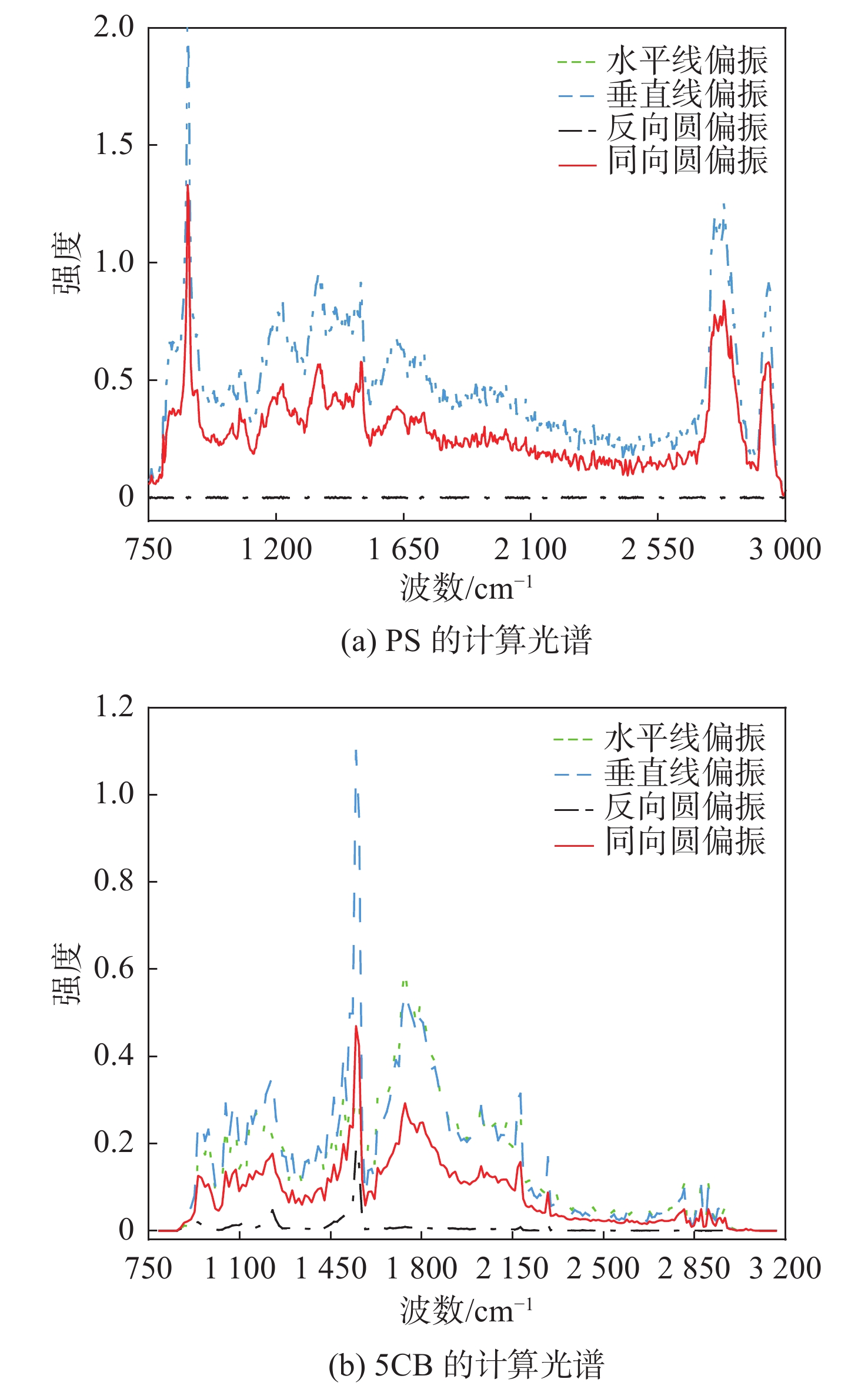
将测量到的三阶非线性极化率分量带入公式(3)~(5)和式(6)~(8),计算得到两种材料在线偏振、同向和反向圆偏振光激发时的CARS光谱,结果显示在图1中。从图1(a)可以看到,使用线偏振光激发时,偏振方向旋转90°对于各向同性的CARS信号没有影响;同向圆偏振激发的CARS光谱形状与线偏振光一致,但是强度有明显下降;当使用反向圆偏振光激发时,CARS信号完全消失,说明了反向圆偏振光对各项同性CARS信号的抑制作用。在图1(b)中,由于5CB的各向异性,当线偏振激发光的偏振方向平行于分子取向时,信号明显强于偏振方向垂直与分子取向时的信号,并且由于非共振信号的存在,每个信号峰都呈不对称性的形状;同向圆偏振光激发时信号强度相对于线偏振光激发信号的下降幅度与PS类似,但是在反向圆偏振光激发条件下,5CB依然有明显的CARS信号,并且信号只出现在分子振动的波数附近,其他波数信号基本被抑制,同时信号峰的形状趋于对称,说明反向圆偏振激发光可以有效抑制各向异性样品CARS的非共振背景信号。
|
图 1 PS和5CB在线偏振、反向圆偏振、同向圆偏振下的计算光谱 Figure 1 Calculated spectra of PS and 5CB at linear polarized, homodromous circular polarized and reversed circular polarized cases |
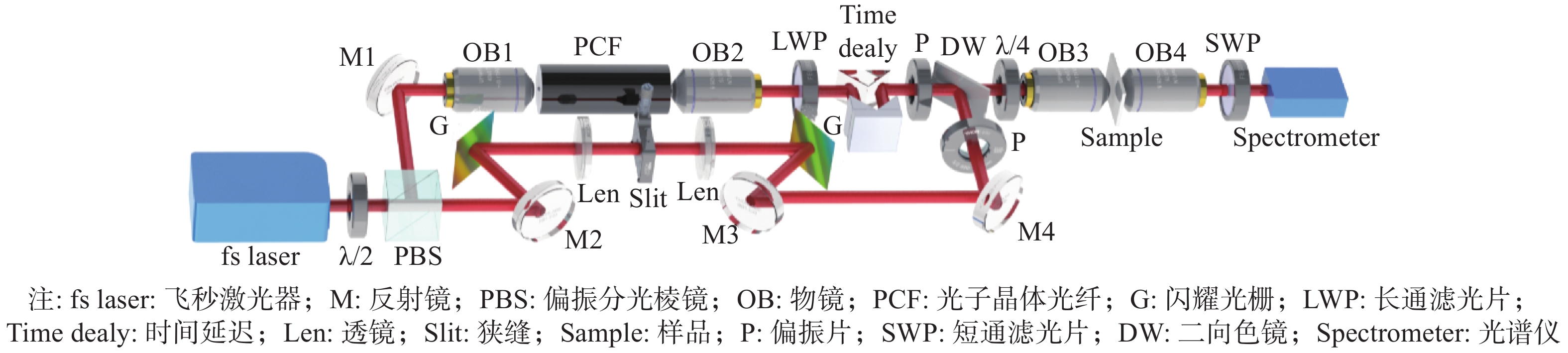
图2是CP-CARS的实验光路图。本文利用双色CARS方案[20]。使用的激光器是80 MHz可调飞秒激光器(Spectra-Physics InSight X3),波长为800 nm。一个λ/2波片和偏振分光棱镜(PBS)组合为分光系统,可以将一束光分为两束光,也可以调节两路光的光功率。其中一束光由一个40×物镜(Olympus)聚焦光束进入FemtoWhite CARS 光子晶体光纤(NKT Photonics)中,产生的超连续光谱被另一个同样的40×物镜收集作为斯托克斯光。该光纤有两个零色散波长:775 nm和945 nm。使用这两波长之间光激发都会因为孤子分裂等非线性作用得到光谱展宽,能够产生从650 nm到1 100 nm范围的超连续光谱[21]。使用800 nm长通滤光片,过滤获得实验所需要的斯托克斯连续光。另一束800 nm的飞秒激光经过两个闪耀光栅和可调狭缝的光谱滤波器,产生窄带的光源作为泵浦光。考虑到两路光存在光程差和时间差,在光程较短的斯托克斯光路中增加三角反射棱镜和中空屋脊反射棱镜构成时间延时线,以保证两路光在时间和空间的重合。两束光最终由一个二向色镜重合为一束光。使用100×的物镜将合束的光聚焦到样品上,信号的收集物镜同样是40×。750 nm的短通滤光片用于过滤激光器的光及其750 nm以上的杂光。最后使用光谱仪测量CARS信号。在使用圆偏振CARS的实验中,在以上光路的基础上,在二向色镜之前,两束光的光路中各增加了一个偏振片。在二向色镜合束之后放置了一个宽波段λ/4波片,这样可以实现对两束光偏振状态的调节。泵浦光和斯托克斯光都是线偏振光,并且偏振方向相同时,它们经过λ/4波片后,变为同向的圆偏振光;相反,当它们偏振方向垂直时经过λ/4波片变为反向圆偏振光。
|
图 2 CP-CARS的光路图 Figure 2 CP-CARS experiment setup |
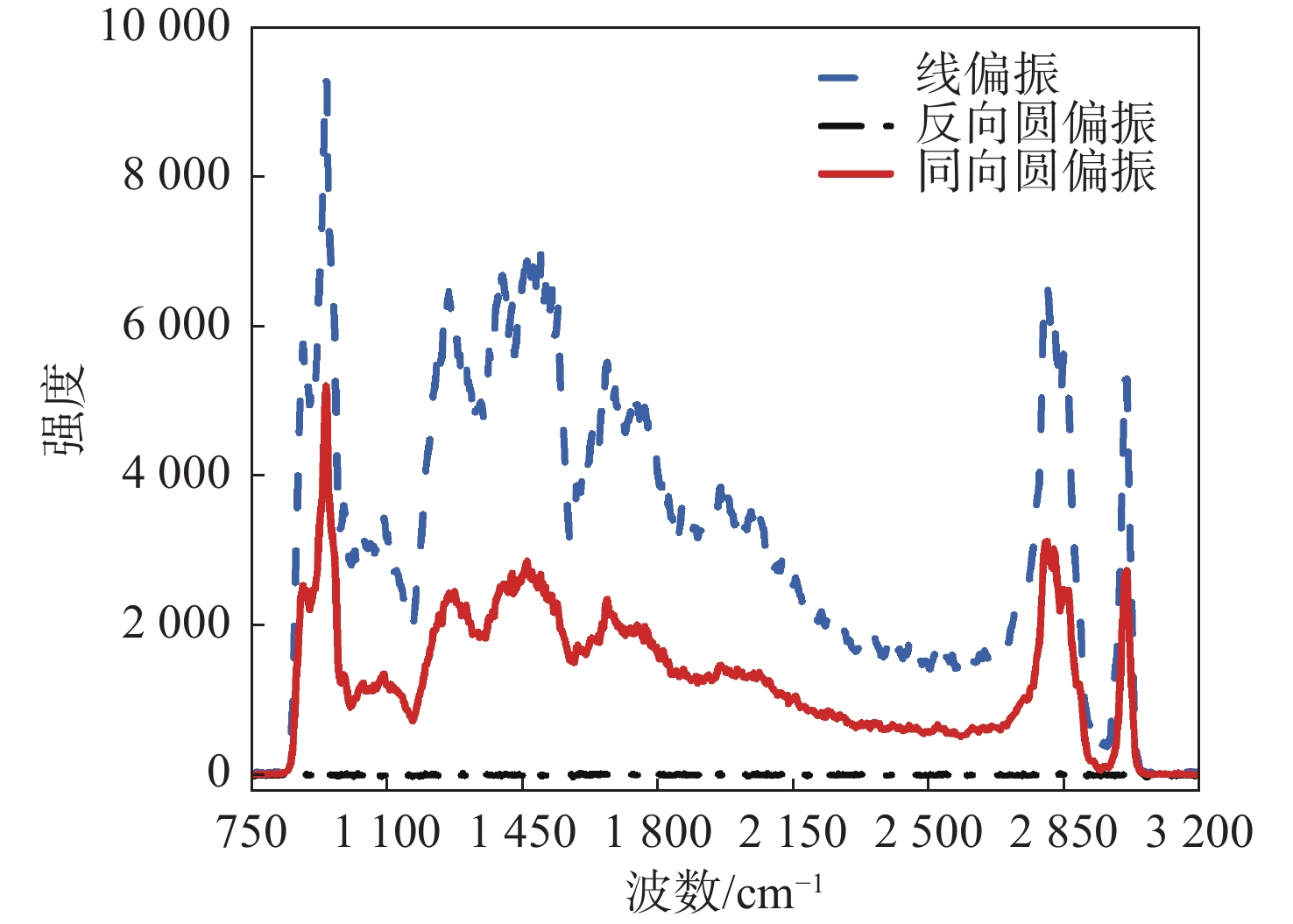
图3显示了PS微球在线偏振光,反向圆偏振、同向圆偏振下的CARS光谱。可以看到,这几种CARS光谱的相对关系与图1(a)中显示的计算结果类似,二者光谱形状的差异可能是由于PS微球对光有汇聚作用,而这一点在计算时没有考虑,导致实际的焦点电场强度与计算不一致。
|
图 3 PS在线偏振、反向圆偏振、同向圆偏振下的实验结果 Figure 3 CP-CARS experiment spectra of PS at linear polarized, homodromous circular polarized and reversed circular polarized cases |
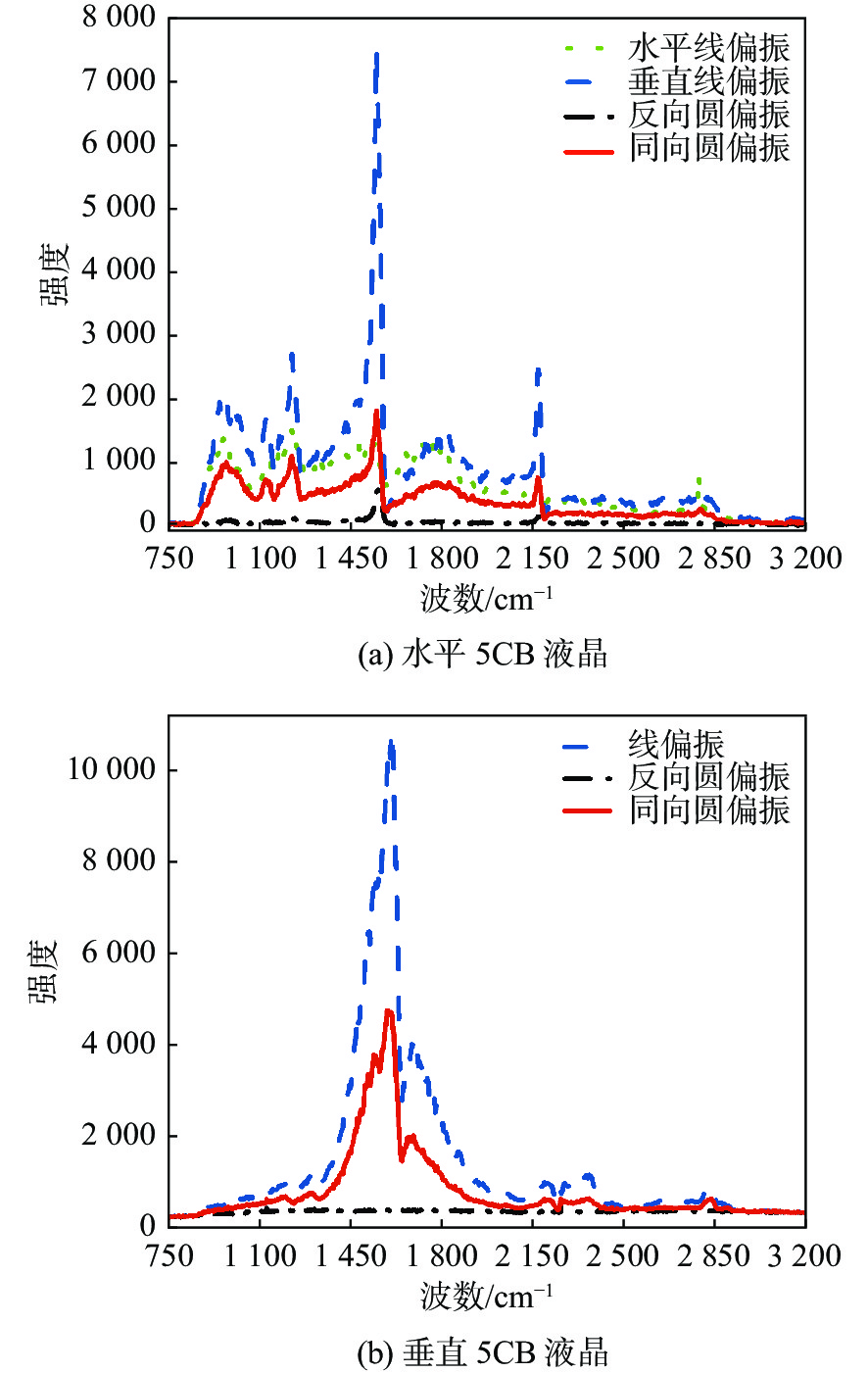
液晶是介于液体和晶体的物质,它具有液体的流动性和晶体的有序性,是很好的各向异性样品材料。5CB液晶只有一个相——液晶相,能够在室温下处于液晶态。因此,选取5CB液晶作为样品。制备两种分子取向的液晶样品,分别是平行于载玻片长边和垂直于载玻片表面的方向。平行状态液晶是将配制好的聚乙烯醇溶液经过浸渍提拉法在玻璃基底上镀一层薄膜,然后干燥箱烘干,用特质的绒布按一定方向摩擦,制得一层取向层,然后在表面稀疏分散一层5 μm聚苯乙烯微球用于控制厚度,上面加一层盖玻片形成液晶盒,使用毛细法灌入液晶,最后密封。垂直状态液晶是利用配置好的十六烷基三甲基溴化铵溶液将玻璃烷化,即将玻璃基底浸入溶液中,然后取出并在干燥箱中烘干,用同样方法制备液晶盒,通过毛细法灌入液晶并密封。玻璃的烷化是在玻璃表面形成疏水的烷基长链,5CB液晶因此垂直排列在这些烷链之间,从而垂直玻璃基底。图4(a)显示了在液晶分子取向平行于载玻片时的CARS光谱。可以看到,相互垂直的线偏振光CARS信号反应了材料的取向特性,同向圆偏振光激发时信号强度有明显下降;在反向圆偏振光激发下,非共振背景被有效去除。实验结果与计算结果基本保持一致。图4(b)显示了当液晶分子取向垂直于玻璃表面时的CARS光谱。可以看到,液晶分子的CARS信号比取向平行于玻璃表面时弱很多,而且在反向圆偏振激发时,光谱仪检测不到CARS信号。这是因为液晶分子取向平行于激发光的传播方向,在垂直于激发光的平面则具有各项同性,因此反向圆偏振的CARS信号被抑制。
|
图 4 水平和垂直5CB在线偏振、反向圆偏振、同向圆偏振下的实验结果 Figure 4 CP-CARS experiment spectra of horizontal and vertical 5CB at linear polarized, homodromous circular polarized and reversed circular polarized cases |
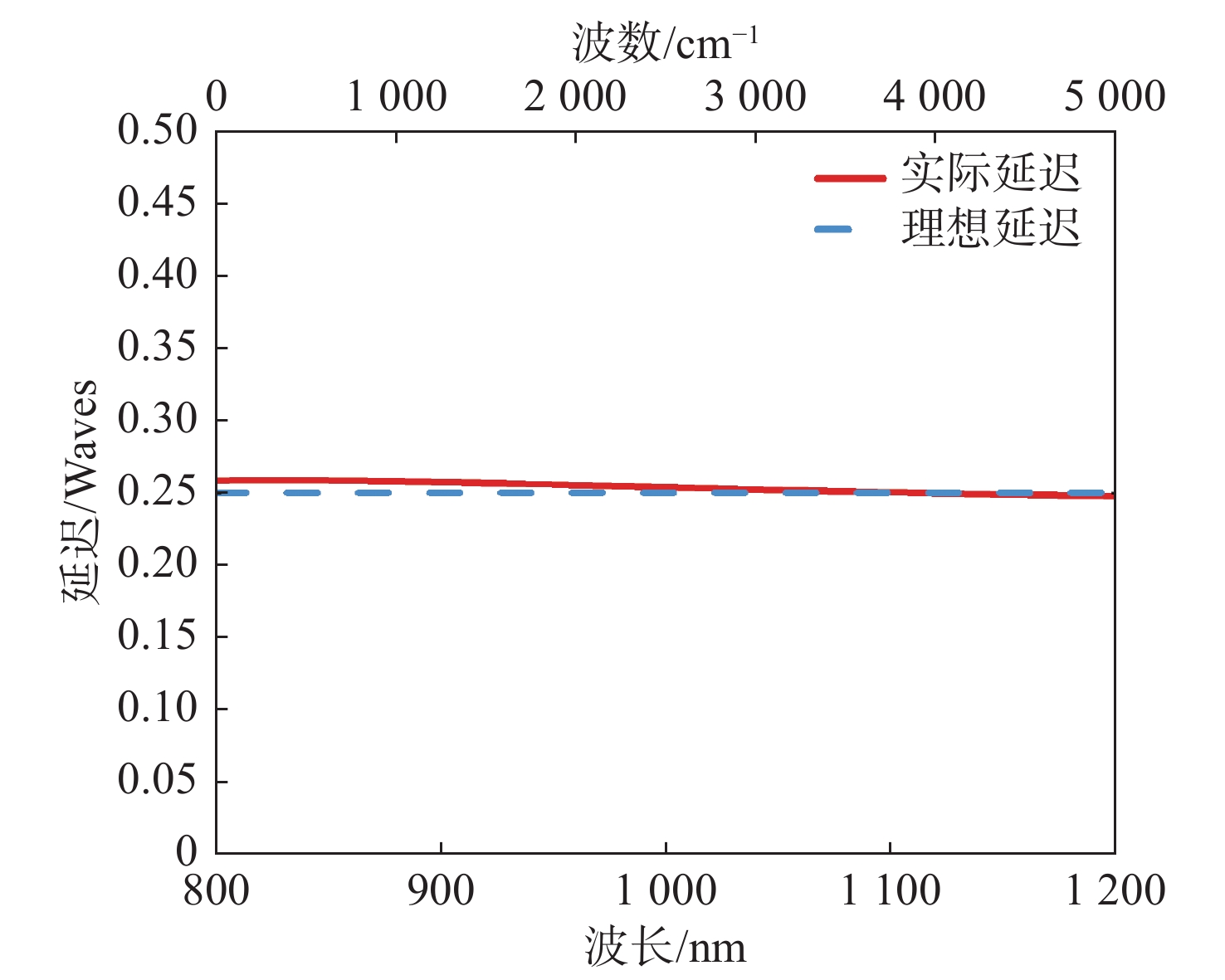
图5显示了λ/4波片对不同波长光的相位延迟。可以看到相位延迟在不同波长存在差异,这个差异对于宽带的斯托克斯光产生圆偏振可能会有影响。
|
图 5 λ/4波片对各波长线偏振光的延迟量 Figure 5 Retardance of the quarter-wave plate case |
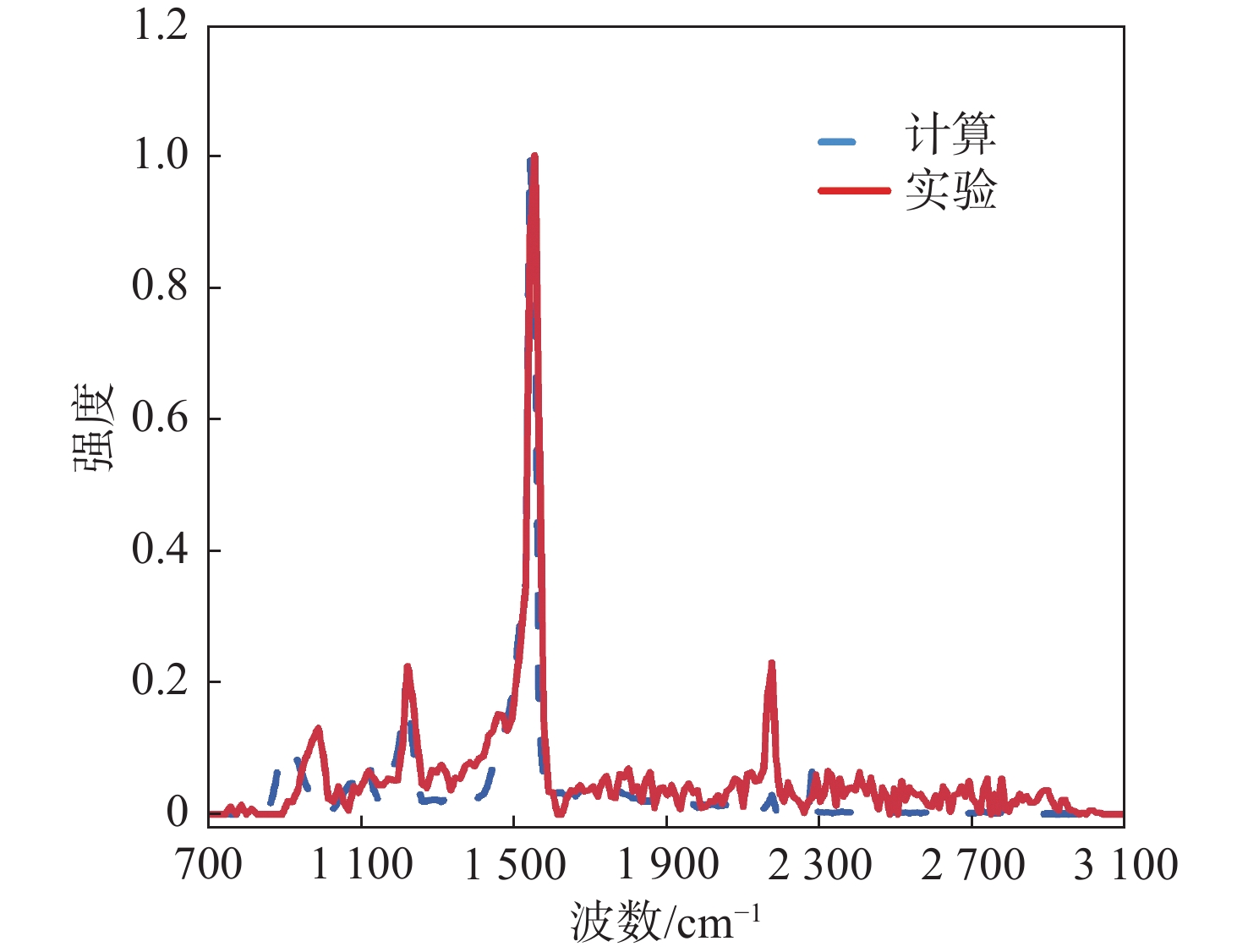
为了了解相位延迟差异对圆偏振CARS的影响,我们根据相位延迟数据,计算了5CB反向圆偏振的CARS光谱(红线),并与理想的反向圆偏振CARS光谱(蓝线)进行了对比,结果显示在图6中。可以看到,由于λ/4波片对于不同波长相位延迟的差异并不大,因此两个CARS光谱的差异很小(<0.4%)。这说明λ/4波片的相位延迟差异对于我们的圆偏振CARS光谱的影响基本可以忽略不计。
|
图 6 5CB反向圆偏振的实验与计算结果的比较 Figure 6 Comparison of experimental and calculated results of 5CB at reversed circular polarized |
对圆偏振宽带CARS光谱学的方法展开了深入和透彻的研究,通过理论计算和实验的方式证明该方法能够消除所有各向同性的CARS信号,因此可以用于去除各向异性样品CARS信号中的非共振背景,提高CARS光谱的化学灵敏度,用于材料的定量分析。λ/4波片在近红外波段的色散较小,在实验中对CARS光谱的影响不大,所以CP-CARS是一种可行的光谱技术。CP-CARS能够作为一种快速区分各向同性和各向异性物质的方法,运用于分子结构分析领域。
| [1] | CHENG J X, VOLKMER A, XIE X S. Theoretical and experimental characterization of coherent anti-Stokes Raman scattering microscopy[J]. Journal of the Optical Society of America B, 2002, 19(6): 1363–1375. DOI:10.1364/JOSAB.19.001363 |
| [2] | LI S W, LI Y P, YI R X, et al. Coherent anti-stokes Raman scattering microscopy and its applications[J]. Frontiers in Physics, 2020, 8: 598420. DOI:10.3389/fphy.2020.598420 |
| [3] | CHENG J X, VOLKMER A, BOOK L D, et al. An Epi-detected coherent anti-stokes Raman Scattering (E-CARS) microscope with high spectral resolution and high sensitivity[J]. The Journal of Physical Chemistry B, 2001, 105(7): 1277–1280. DOI:10.1021/jp003774a |
| [4] | CHENG J X, BOOK L D, XIE X S. Polarization coherent anti-Stokes Raman scattering microscopy[J]. Optics Letters, 2001, 26(17): 1341–1343. DOI:10.1364/OL.26.001341 |
| [5] | VOLKMER A, BOOK L D, XIE X S. Time-resolved coherent anti-Stokes Raman scattering microscopy: imaging based on Raman free induction decay[J]. Applied Physics Letters, 2002, 80(9): 1505–1507. DOI:10.1063/1.1456262 |
| [6] | UPPUTURI P K, GONG L, WANG H F. Chirped time-resolved CARS microscopy with square-pulse excitation[J]. Optics Express, 2014, 22(8): 9611–9626. DOI:10.1364/OE.22.009611 |
| [7] | EVANS C L, POTMA E O, XIE X S. Coherent anti-Stokes Raman scattering spectral interferometry: determination of the real and imaginary components of nonlinear susceptibility χ(3) for vibrational microscopy [J]. Optics Letters, 2004, 29(24): 2923–2925. DOI:10.1364/OL.29.002923 |
| [8] | POTMA E O, EVANS C L, XIE X S. Heterodyne coherent anti-Stokes Raman scattering (CARS) imaging[J]. Optics Letters, 2006, 31(2): 241–243. DOI:10.1364/OL.31.000241 |
| [9] | GANIKHANOV F, EVANS C L, SAAR B G, et al. High-sensitivity vibrational imaging with frequency modulation coherent anti-Stokes Raman scattering (FM CARS) microscopy[J]. Optics Letters, 2006, 31(2): 1872–1874. |
| [10] | KONOROV S O, BLADES M W, TURNER R F B. Lorentzian amplitude and phase pulse shaping for nonresonant background suppression and enhanced spectral resolution in coherent anti-stokes Raman scattering spectroscopy and microscopy[J]. Applied Spectroscopy, 2010, 64(7): 767–774. DOI:10.1366/000370210791666228 |
| [11] | OGILVIE J P, BEAUREPAIRE E, ALEXANDROU A, et al. Fourier-transform coherent anti-Stokes Raman scattering microscopy[J]. Optics Letters, 2006, 31(4): 480–482. DOI:10.1364/OL.31.000480 |
| [12] | TAMAMITSU M, SAKAKI Y, NAKAMURA T, et al. Ultrafast broadband Fourier-transform CARS spectroscopy operating at 50, 000 spectra/second[C]//Proceedings of SPIE 10076, High-Speed Biomedical Imaging and Spectroscopy: Toward Big Data Instrumentation and Management II. San Francisco: SPIE, 2017: 10076. |
| [13] | CHENG J X, XIE X S. Coherent Raman scattering microscopy[M]. Boca Raton: CRC Press, 2016: 237-251. |
| [14] | VALENSISE C M, GIUSEPPI A, VERNUCCIO F, et al. Removing non-resonant background from CARS spectra via deep learning[J]. APL Photonics, 2020, 5(6): 061305. DOI:10.1063/5.0007821 |
| [15] | UPPUTURI P K, LIN J, GONG L, et al. Circularly polarized coherent anti-Stokes Raman scattering microscopy[J]. Optics Letters, 2013, 38(8): 1262–1264. DOI:10.1364/OL.38.001262 |
| [16] | ZHANG C, WANG J, DING B, et al. Quantitative spectral analysis of coherent anti-stokes Raman scattering signals: C-H stretching modes of the methyl group[J]. The Journal of Physical Chemistry B, 2014, 118(27): 7647–7656. DOI:10.1021/jp5035807 |
| [17] | KAN Y, LENSU L, HEHL G, et al. Wavelet prism decomposition analysis applied to CARS spectroscopy: a tool for accurate and quantitative extraction of resonant vibrational responses[J]. Optics Express, 2016, 24(11): 11905–11916. DOI:10.1364/OE.24.011905 |
| [18] | HEUKE S, RIGNEAULT H. Laser scanning dark-field coherent anti-Stokes Raman scattering (DF-CARS): a numerical study[J]. Optics Express, 2021, 29(3): 3985–3995. DOI:10.1364/OE.414972 |
| [19] | MUNHOZ F, BRUSTLEIN S, BRASSELET S, et al. Polarization-resolved coherent anti-Stokes Raman scattering microscopy[C]//Proceedings of SPIE 7569, Multiphoton Microscopy in the Biomedical Sciences X. San Francisco: SPIE, 2010: 75690P. |
| [20] | FALCONIERI M, MARROCCO M, MERLA C, et al. Characterization of supercontinuum generation in a photonic crystal fiber for uses in multiplex CARS microspectroscopy[J]. Journal of Raman Spectroscopy, 2019, 50(9): 1287–1295. DOI:10.1002/jrs.5599 |
| [21] | PORQUEZ J G, KORFANTY E P, SLEPKOV A D. Ultra-broadband coherent anti-Stokes Raman scattering microscopy with a dynamically power-tuned Stokes supercontinuum[C]//Proceedings of SPIE 10069, Multiphoton Microscopy in the Biomedical Sciences XVII. San Francisco: SPIE, 2017: 10069. |