 2021, Vol. 43
 Issue (6): 77-86


自中国古代以航海为目的发明指南针以来,磁场的探测与测量便成为人类了解物理世界的主要方法之一,对人类文明具有重要意义。基于原子自旋效应的超高灵敏磁场测量装置是当代原子物理、矢量光学、精密仪器等前沿学科交叉领域发展融合的产物。原子磁场测量技术伴随着量子传感、信息、仪器仪表等技术发展而来,是新一代超高灵敏度磁场测量技术的发展方向。弱磁检测磁强计主要包括磁通门磁强计、超导量子干涉仪(superconducting quantum interference device,SQUID)和原子磁强计等。磁通门磁强计受限于线圈的几何结构,极限分辨率一般只能达到纳特斯拉量级;SQUID因其高灵敏度广泛应用于各领域,但由于其需要液氮杜瓦瓶来保持低温,导致磁强计体积增大、不易于小型化且成本昂贵;原子磁强计是一种用于探测外磁场作用下碱金属蒸气极化变化的光学仪器,可在较小的磁屏蔽室下工作,且能够利用许多常见的探测器元件,以相对较低的成本在多通道配置中工作,形成梯度检测以提高灵敏度。
无自旋交换弛豫(spin-exchange relaxation free,SERF)原子磁强计是一种运行在SERF态下的新型碱金属原子磁强计,灵敏度不受自旋交换弛豫的影响,是目前最敏感的传感器,并且具有非低温操作、易于小型化、高空间分辨率等优点。1957年,Bell等[1]通过实验验证了Dehmelt[2]所提出的磁场强度可由观察碱原子自旋进动来确定的理论。Happer等[3-4]于1973年发现当自旋交换率远远大于拉莫尔进动频率时,自旋交换弛豫会被抑制,并在高原子密度、小尺寸气室的碱蒸气中观测到200Hz的磁共振线,随后于1977年推导出这一现象的理论解释。自2002年普林斯顿大学科研人员[5-6]首次实现原子的无自旋交换弛豫(SERF)态,并于2003年实现灵敏度足以测量脑磁场信号的SERF磁强计后,世界各地许多科研团队都致力于SERF原子磁强计的研究。
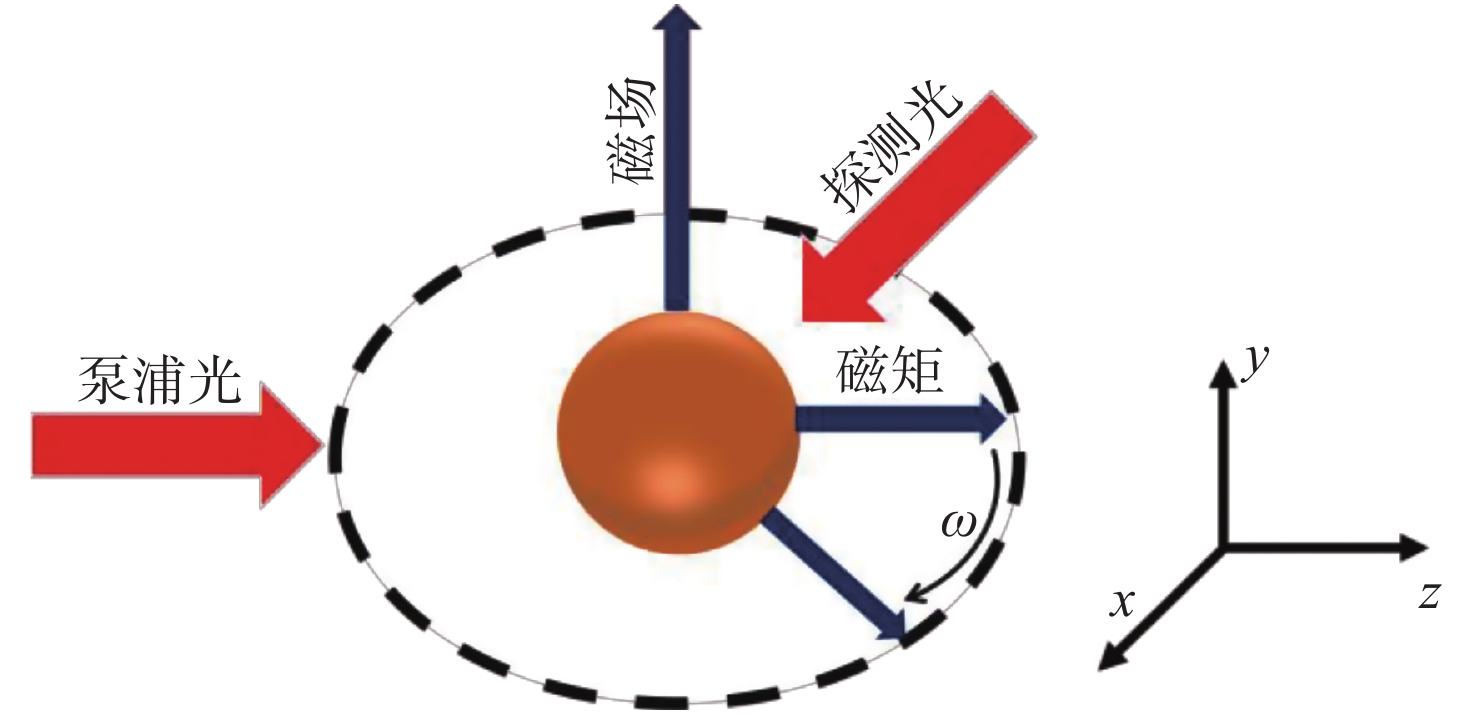
1 SERF原子磁强计工作原理SERF原子磁强计工作原理如图1所示,一束圆偏振泵浦光照射进碱金属原子气室后,碱金属原子从基态跃迁到激发态[7],碱金属原子产生自旋极化。
|
图 1 SERF原子磁强计的工作原理示意图 Figure 1 Schematic diagram of the working principle of SERF atomic magnetometer |
在外界弱磁场的作用下,碱金属原子会发生拉莫尔进动[8-9],另一束线偏振探测光垂直于泵浦光照射进碱金属气室,用于检测原子自旋的拉莫尔进动,外界磁场强度与拉莫尔进动频率之间的关系为
| $ \omega = \gamma \left\| B \right\| $ | (1) |
式中:
原子磁强计基本灵敏度由散粒噪声
| $ \delta B = \frac{1}{{\gamma \sqrt {n{T_2}Vt} }} $ | (2) |
式中:
在自旋进动足够慢的SERF体系中,即
| $ \frac{{\rm d}}{{{\rm d}t}}S = \frac{1}{q}\left[ {{\gamma ^{\rm e}}B \times S + {R_{\rm p}}\left( {\frac{1}{2}{\boldsymbol s}{\boldsymbol{z}} - S} \right) - {R_{{\rm rel}}}S} \right] $ | (3) |
式中:
在无磁场干扰的理想条件下,可以得到平衡自旋极化
| $ {S_0} = \frac{{{\boldsymbol s}{R_{\rm p}}}}{{2\left( {{R_{\rm p}} + {R_{{\rm rel}}}} \right)}} $ | (4) |
此外,为了简化运算过程,引入一个无量纲的参数
| $ \beta = \frac{{{\gamma ^{\rm e}}}}{{{R_{\rm p}} + {R_{{\rm rel}}}}} $ | (5) |
当磁场变化缓慢时,可将
| $ \left\{ {\begin{array}{*{20}{l}} {{S_{ x}} = {S_0}\dfrac{{\beta \left( {\beta {B_{ x}}{B_{ z}} + {B_{ y}}} \right)}}{{1 + {\beta ^2}\left( {B_{ x}^2 + B_{ y}^2 + B_{ z}^2} \right)}}} \\ {{S_{ y}} = {S_0}\dfrac{{\beta \left( {\beta {B_{ y}}{B_{ z}} - {B_{ x}}} \right)}}{{1 + {\beta ^2}\left( {B_{ x}^2 + B_{ y}^2 + B_{ z}^2} \right)}}} \\ {{S_{ z}} = {S_0}\dfrac{{1 + {\beta ^2}B_{ z}^2}}{{1 + {\beta ^2}\left( {B_{ x}^2 + B_{ y}^2 + B_{ z}^2} \right)}}} \end{array}} \right. $ | (6) |
式中,
对于SERF原子磁强计,通常需要较高的温度来保证高饱和蒸气密度以实现SERF态,以及尽可能小的温度梯度来使原子极化更为均匀。碱金属气室是超高灵敏磁场和惯性测量的灵敏核心,原子源种类决定了测量灵敏度的极限。SERF磁强计气室内的碱金属原子通常为钾原子、铷原子、铯原子或者其杂化构成。本文根据碱金属蒸气源对SERF磁强计的研究进行分类。
2.1 钾原子SERF磁强计普林斯顿大学前期主要针对钾原子SERF磁强计进行研究。Allred等[5]在2002年将钾原子SERF磁强计加热到190 ℃,首次实现SERF态,磁强计灵敏度为10
Gusarov等[15-17]于2009年将钾原子SERF磁强计加热到180 ℃,利用光电二极管阵列对垂直于探测激光束的气室进行逐层抽运,实现了三维场的测量,测量体积为2
2018年,北京航空航天大学刘学静等[19]将钾原子SERF磁强计加热到200 ℃,钾原子数密度约为
威斯康星大学麦迪逊分校学者[9][23-24] 致力于研究铷原子SERF磁强计,该校学者于2006、2012、2019年将铷原子SERF磁强计加热到188 ℃、140-180 ℃、175 ℃,分别达到60
2017年,东南大学Wu等[29]将铷原子SERF磁强计加热至140 ℃,在缓冲压力为0.2、0.88、2.35 amg时,磁强计分别达到900、500和150
2008年,加州大学伯克利分校的一种铯原子SERF磁强计[34]被加热到103 ℃,达到40
气室中含有两种或两种以上的碱原子的磁强计称为混合抽运磁强计,该磁强计利用自旋交换光抽运[40]实现电子自旋极化,即泵浦光偏振一种原子,该原子极化后再对另外一种原子进行复极化,具有减小光深和均匀自旋极化[41]的优点。目前,关于混合抽运SERF磁强计的研究主要为钾-铷原子SERF磁强计,其气室内的碱金属密度比是磁强计设计的重要参数。
普林斯顿大学的Romails等[42]于2010年偶然发现被微量铷原子污染的钾原子泵浦的灵敏度高于纯净钾原子,首次演示了混合泵式原子磁强计。日本京都大学的Ito等[43-45]于2011-2013年针对钾-铷原子混合抽运磁强计进行系统性研究,确定了钾-铷杂化原子的泵浦效率大于单个原子,泵浦钾原子探测铷原子的敏感度最高,实现了30
2014年,北京航空航天大学[47]]钾-铷原子SERF磁强计在加热温度为195 ℃时实现了5
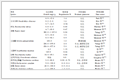
碱金属原子饱和蒸气压各不相同,因此其所需加热温度不同。表1列出了上述文章中较有代表性的一些不同碱金属原子的加热温度和实测灵敏度值。由表1可以看出,在相同密度下,钾原子所需加热温度较高,铯原子所需加热温度较低,因此铯原子SERF磁强计更适用于低温应用领域。在单一碱金属原子磁强计中,基于钾原子的SERF磁强计灵敏度最高,其次是铷原子与铯原子。在混合抽运磁强计中,主要为关于钾-铷原子混合抽运SERF磁强计的研究,并已实现极高灵敏度,展现出其实用价值与优良前景。
|
表 1 不同碱金属原子的加热温度及其实测灵敏度 Table 1 Heat temperature and measured sensitivity of different alkali metal atoms |
SERF原子磁强计具有较高的灵敏度,对超高精度磁场测量具有重要意义,广泛应用于生物医学、古地磁探索[10]、航空磁探测[31]、宇宙轴子自旋进动实验、探测类磁场效应[53]等领域。其中,宇宙轴子自旋进动实验指通过核磁共振技术测量由轴子或轴子样粒子暗物质引起的核自旋振荡扭矩,SERF磁强计因在低频区具有高灵敏度而在该领域十分有竞争力。2017年,王涛等[54]将SERF原子磁强计引入到宇宙轴子自旋进动实验,通过使用超导磁通变压器有效地消除大磁场以保证其SERF态,该磁强计灵敏度约为1
SERF磁强计在生物医学中主要应用于心磁图(MCG)和脑磁图(MEG)。心磁图是研究心脏生物活性的重要手段,通过磁强计记录心脏活动引起的弱磁场变化来可视化心肌活动,是一种无接触、无创的成像技术。脑磁图是一种通过测量头皮神经电流产生的磁场实现人脑的电生理直接成像的脑功能成像技术。通常使用超导量子干涉仪检测心脏和脑部弱磁信号,但其必须安装在液氮杜瓦瓶中,成本昂贵、体积庞大。测量时需真空空间[28]将磁强计与头皮分隔开,会因个体差异性而影响测量效果,还限制了婴儿及无法控制自己行为的特殊患者进行检测。SERF原子磁强计在实现超高精度磁场测量时可以规避以上问题,正在成为磁成像领域的有力工具,在生物磁场测量中发挥着越来越重要的作用。
2003年,Kominis等[6]通过简单的多通道操作成功获取了脑磁场信号,使个体大脑皮层模块的非侵入性研究成为了可能。SERF磁强计于2006年左右达到与超导量子干涉仪相当的灵敏度和空间分辨率,普林斯顿大学Xia等[57]使用钾原子SERF磁强计检测并绘制听觉刺激诱发的脑磁场,采用线性光电探测阵列获得六通道脑信号,其梯度灵敏度达到3.5
脑磁场比心磁场的磁信号要弱100倍左右,所以检测起来将会更有挑战性,桑迪亚国家实验室在该研究领域成果颇多。在2010年,Johnson等[25]使用光纤耦合的铷原子SERF磁强计测量人脑磁场,该磁强计的泵浦与检测光束参数可通过独特的双色泵浦探测技术进行调整和优化,成功探测到了正中神经和听觉刺激的脑磁响应信号。2016年,Colombo等[59]研究了一种采用无源衍射光学元件的四通道光泵浦原子磁强计,无源衍射光学元件将一束入射激光分为四束,简化光学组件的对准,向每个一阶光斑提供近似相同的激光功率,使各通道磁场均匀性增强,实现了小于5
2014年,韩国标准科学研究院Kim等[27]在一种几何结构中测量径向磁场作为距离源的函数,在另一种几何结构使用相同的传感器测量磁场的两个切向分量,优化了MEG检测多通道系统,该磁强计梯度灵敏度可达4
综上所述,SERF原子磁强计在技术上的研究已较为成熟,近几年来主要转向针对于应用方向的研究,并且在诸多领域都取得丰硕的研究成果,与脑科学的结合已成为重要发展方向。其中,关于SERF原子磁强计小型化的工作在科研和产业化两方面都有很大进展,多通道SERF磁强计在生物磁场测量上的优质潜力更是有目共睹,尤其是在心磁图与脑磁图方面,使非侵入性的心脏与脑部检测有了突破性进展。SERF原子磁强计具有广阔的应用前景,对生物医学,地磁勘探、航空探测、磁性纳米粒子检测、宇宙轴子自旋进动实验等众多领域的发展具有重要的推动作用。
目前,SERF磁强计的灵敏度尚未达到极限,小型化SERF原子磁强计的灵敏度仍有提升空间,尽管其已实现了极高灵敏度,但相比于实验室大装置SERF磁强计来说还有一定差距。其次,SERF原子磁强计的成本还有降低空间,基于MEMS的气室研究将进一步降低其气室成本,以便于更好地进行脑科学等相关应用的研究,促进其发展。此外,SERF原子磁强计应用时基本上仍需要处在无磁环境的屏蔽房内,因此解决其在地磁环境下的应用也很重要,这将使其扩展更广泛的应用领域,如磁异常探测、军事反潜等。
| [1] | BELL W E, BLOOM A L. Optical detection of magnetic resonance in alkali metal vapor[J]. Physical Review Journals Archive, 1957, 107(6): 1559–1565. |
| [2] | DEHMELT H G. Modulation of a light beam by precessing absorbing atoms[J]. Physical Review Journals Archive, 1957, 105(6): 1924–1925. |
| [3] | HAPPER W, TANG H. Spin-exchange shift and narrowing of magnetic resonance lines in optically pumped alkali vapors[J]. Physical Review Letters, 1973, 31(5): 273–276. DOI:10.1103/PhysRevLett.31.273 |
| [4] | HAPPER W, TAM A C. Effect of rapid spin exchange on the magnetic-resonance spectrum of alkali vapors[J]. Physical Review A, 1977, 16(5): 1877–1891. DOI:10.1103/PhysRevA.16.1877 |
| [5] | ALLRED J C, LYMAN R N, KORNACK T W, et al. High-sensitivity atomic magnetometer unaffected by spin-exchange relaxation[J]. Physical Review Letters, 2002, 89(13): 130801. DOI:10.1103/PhysRevLett.89.130801 |
| [6] | KOMINIS I K, KORNACK T W, ALLRED J C, et al. A subfemtotesla multichannel atomic magnetometer[J]. Nature, 2003, 422(6932): 596–599. DOI:10.1038/nature01484 |
| [7] | GHOSH R K. Spin exchange optical pumping of neon and its applications[D]. Princeton: Princeton University, 2009. |
| [8] | SELTZER S J. Developments in alkali-metal atomic magnetometry[D]. Princeton: Princeton University, 2008. |
| [9] | LI Z M, WAKAI R T, WALKER T G. Parametric modulation of an atomic magnetometer[J]. Applied Physics Letters, 2006, 89(13): 134105. DOI:10.1063/1.2357553 |
| [10] | 康翔宇, 徐俊, 范正焜, 等. 基于SERF原子磁强计的三轴磁场顺序补偿方法研究[J]. 光学仪器, 2021, 43(4): 47–54. |
| [11] | DANG H B, MALOOF A C, ROMALIS M V. Ultrahigh sensitivity magnetic field and magnetization measurements with an atomic magnetometer[J]. Applied Physics Letters, 2010, 97(15): 151110. DOI:10.1063/1.3491215 |
| [12] | CHEMLA Y R, GROSSMAN H L, POON Y, et al. Ultrasensitive magnetic biosensor for homogeneous immunoassay[J]. Proceedings of the National Academy of Sciences of the United States of America, 2000, 97(26): 14268–14272. DOI:10.1073/pnas.97.26.14268 |
| [13] | LEDBETTER M P, SAVUKOV I M, BUDKER D, et al. Zero-field remote detection of NMR with a microfabricated atomic magnetometer[J]. Proceedings of the National Academy of Sciences of the United States of America, 2008, 105(7): 2286–2290. DOI:10.1073/pnas.0711505105 |
| [14] | YOUNG D P, HALL D, TORELLI M E, et al. High-temperature weak ferromagnetism in a low-density free-electron gas[J]. Nature, 1999, 397(6718): 412–414. DOI:10.1038/17081 |
| [15] | GUSAROV A, LEVRON D, PAPERNO E, et al. Three-dimensional magnetic field measurements in a single SERF atomic-magnetometer cell[J]. IEEE Transactions on Magnetics, 2009, 45(10): 4478–4481. DOI:10.1109/TMAG.2009.2021404 |
| [16] | GUSAROV A, BARANGA A B A, LEVRON D, et al. Accuracy enhancement of magnetic field distribution measurements within a large cell spin-exchange relaxation-free magnetometer[J]. Measurement Science and Technology, 2018, 29(4): 045209. DOI:10.1088/1361-6501/aaa702 |
| [17] | GUSAROV A, BARANGA A B A, LEVRON D, et al. Measurement of the spatial magnetic field distribution in a single large spin-exchange relaxation-free vapor cell[J]. Applied Physics B, 2019, 125(1): 19. DOI:10.1007/s00340-018-7130-7 |
| [18] | KAMADA K, ITO Y, ICHIHARA S, et al. Noise reduction and signal-to-noise ratio improvement of atomic magnetometers with optical gradiometer configurations[J]. Optics Express, 2015, 23(5): 6976–6987. DOI:10.1364/OE.23.006976 |
| [19] | LIU X J, DING M, LI Y, et al. Transverse relaxation determination based on light polarization modulation for spin-exchange relaxation free atomic magnetometer[J]. Chinese Physics B, 2018, 27(7): 073201. DOI:10.1088/1674-1056/27/7/073201 |
| [20] | ZHAO J P, LIU G, LU J X, et al. A non-modulated triaxial magnetic field compensation method for spin-exchange relaxation-free magnetometer based on zero-field resonance[J]. IEEE Access, 2019, 7: 167557–167565. DOI:10.1109/ACCESS.2019.2954103 |
| [21] | ZHAO J P, DING M, LU J X, et al. Determination of spin polarization in spin-exchange relaxation-free atomic magnetometer using transient response[J]. IEEE Transactions on Instrumentation and Measurement, 2020, 69(3): 845–852. DOI:10.1109/TIM.2019.2905308 |
| [22] | XING B Z, SUN C, LIU Z A, et al. Probe noise characteristics of the spin-exchange relaxation-free (SERF) magnetometer[J]. Optics Express, 2021, 29(4): 5055–5067. DOI:10.1364/OE.416797 |
| [23] | WYLLIE R, KAUER M, SMETANA G S, et al. Magnetocardiography with a modular spin-exchange relaxation-free atomic magnetometer array[J]. Physics in Medicine & Biology, 2012, 57(9): 2619–2632. |
| [24] | ZHIVUN E, BULATOWICZ M, HRYCIUK A, et al. Dual-axis π-pulse magnetometer with suppressed spin-exchange relaxation[J]. Physical Review Applied, 2019, 11(3): 034040. DOI:10.1103/PhysRevApplied.11.034040 |
| [25] | JOHNSON C, SCHWINDT P D D, WEISEND M. Magnetoencephalography with a two-color pump-probe, fiber-coupled atomic magnetometer[J]. Applied Physics Letters, 2010, 97(24): 243703. DOI:10.1063/1.3522648 |
| [26] | GRIFFITH W C, KNAPPE S, KITCHING J. Femtotesla atomic magnetometry in a microfabricated vapor cell[J]. Optics Express, 2010, 18(26): 27167–27172. DOI:10.1364/OE.18.027167 |
| [27] | KIM K, BEGUS S, XIA H, et al. Multi-channel atomic magnetometer for magnetoencephalography: a configuration study[J]. Neuroimage, 2014, 89: 143–151. DOI:10.1016/j.neuroimage.2013.10.040 |
| [28] | BOTO E, HOLMES N, LEGGETT J, et al. Moving magnetoencephalography towards real-world applications with a wearable system[J]. Nature, 2018, 555(7698): 657–661. DOI:10.1038/nature26147 |
| [29] | WU L, SHANG J T, JI Y, et al. Influence of buffer-gas pressure inside micro alkali vapor cells on the performance of chip-scale SERF magnetometers[J]. IEEE Transactions on Components, Packaging and Manufacturing Technology, 2018, 8(4): 621–625. DOI:10.1109/TCPMT.2017.2773509 |
| [30] | JI Y, SHANG J T, GAN Q, et al. Improvement of sensitivity by using microfabricated spherical alkali vapor cells for chip-scale atomic magnetometers[J]. IEEE Transactions on Components, Packaging and Manufacturing Technology, 2018, 8(10): 1715–1722. DOI:10.1109/TCPMT.2018.2868313 |
| [31] | ZHANG X, QIN J N, WANG Y Z, et al. A fast identification on the spin-exchange relaxation-free regime of atomic magnetometer exploiting measurement on gyromagnetic ratio[J]. IEEE Transactions on Instrumentation and Measurement, 2019, 68(4): 1157–1164. DOI:10.1109/TIM.2018.2863519 |
| [32] | FANG X J, WEI K, ZHAO T, et al. High spatial resolution multi-channel optically pumped atomic magnetometer based on a spatial light modulator[J]. Optics Express, 2020, 28(18): 26447–26460. DOI:10.1364/OE.398540 |
| [33] | LIU K N, SHANG J T, ZHANG J, et al. Microfabricated SERF atomic magnetometers for measurement of weak magnetic field[C]//2020 IEEE 70th Electronic Components and Technology Conference (ECTC). Orlando: IEEE, 2020: 991 − 996. |
| [34] | LEDBETTER M P, SAVUKOV I M, ACOSTA V M, et al. Spin-exchange-relaxation-free magnetometry with Cs vapor[J]. Physical Review A, 2008, 77(3): 033408. DOI:10.1103/PhysRevA.77.033408 |
| [35] | PATTON B, ZHIVUN E, HOVDE D C, et al. All-optical vector atomic magnetometer[J]. Physical Review Letters, 2014, 113(1): 013001. DOI:10.1103/PhysRevLett.113.013001 |
| [36] | FANG J C, WAN S A, QIN J, et al. Spin-exchange relaxation-free magnetic gradiometer with dual-beam and closed-loop Faraday modulation[J]. Journal of the Optical Society of America B, 2014, 31(3): 512–516. DOI:10.1364/JOSAB.31.000512 |
| [37] | FANG J C, LI R J, DUAN L H, et al. Study of the operation temperature in the spin-exchange relaxation free magnetometer[J]. Review of Scientific Instruments, 2015, 86(7): 073116. DOI:10.1063/1.4927460 |
| [38] | BEVILACQUA G, BIANCALANA V, CHESSA P, et al. Multichannel optical atomic magnetometer operating in unshielded environment[J]. Applied Physics B, 2016, 122(4): 103. DOI:10.1007/s00340-016-6375-2 |
| [39] | SHENG J W, WAN S A, SUN Y F, et al. Magnetoencephalography with a Cs-based high-sensitivity compact atomic magnetometer[J]. Review of Scientific Instruments, 2017, 88(9): 094304. DOI:10.1063/1.5001730 |
| [40] | APPELT S, BARANGA B A, ERICKSON C J, et al. Theory of spin-exchange optical pumping of 3He and 129Xe [J]. Physical Review A, 1998, 58(2): 1412–1439. DOI:10.1103/PhysRevA.58.1412 |
| [41] | LI J D, QUAN W, ZHOU B Q, et al. SERF atomic magnetometer–recent advances and applications: a review[J]. IEEE Sensors Journal, 2018, 18(20): 8198–8207. DOI:10.1109/JSEN.2018.2863707 |
| [42] | ROMALIS M V. Hybrid optical pumping of optically dense alkali-metal vapor without quenching gas[J]. Physical Review Letters, 2010, 105(24): 243001. DOI:10.1103/PhysRevLett.105.243001 |
| [43] | ITO Y, OHNISHI H, KAMADA K, et al. Effect of spatial homogeneity of spin polarization on magnetic field response of an optically pumped atomic magnetometer using a hybrid cell of k and Rb atoms[J]. IEEE Transactions on Magnetics, 2012, 48(11): 3715–3718. DOI:10.1109/TMAG.2012.2199966 |
| [44] | ITO Y, OHNISHI H, KAMADA K, et al. Development of an optically pumped atomic magnetometer using a K-Rb hybrid cell and its application to magnetocardiography[J]. AIP Advances, 2012, 2(3): 032127. DOI:10.1063/1.4742847 |
| [45] | ITO Y, OHNISHI H, KAMADA K, et al. Rate-equation approach to optimal density ratio of K-Rb hybrid cells for optically pumped atomic magnetometers[C]//2013 35th Annual International Conference of the IEEE Engineering in Medicine and Biology Society (EMBC). Osaka: IEEE, 2013: 3254-3257. |
| [46] | ITO Y, SATO D, KAMADA K, et al. Optimal densities of alkali metal atoms in an optically pumped K–Rb hybrid atomic magnetometer considering the spatial distribution of spin polarization[J]. Optics Express, 2016, 24(14): 15391–15402. DOI:10.1364/OE.24.015391 |
| [47] | FANG J C, WANG T, ZHANG H, et al. Optimizations of spin-exchange relaxation-free magnetometer based on potassium and rubidium hybrid optical pumping[J]. Review of Scientific Instruments, 2014, 85(12): 123104. DOI:10.1063/1.4902567 |
| [48] | XING L, QUAN W, FAN W F, et al. Field optimization method of a dual-axis atomic magnetometer based on frequency-response and dynamics[J]. Measurement Science and Technology, 2018, 29(5): 055005. DOI:10.1088/1361-6501/aaaefc |
| [49] | YAO H, LI Y, MA D Y, et al. Acousto-optic modulation detection method in an all-optical K-Rb hybrid atomic magnetometer using uniform design method[J]. Optics Express, 2018, 26(22): 28682–28692. DOI:10.1364/OE.26.028682 |
| [50] | LI Y, DING M, LIU X J, et al. Suppression method of AC-stark shift in SERF atomic magnetometer[J]. IEEE Photonics Journal, 2018, 10(5): 5300207. |
| [51] | LI Y, LIU X J, CAI H W, et al. Optimization of the alkali-metal density ratio in a hybrid optical pumping atomic magnetometer[J]. Measurement Science and Technology, 2019, 30(1): 015005. DOI:10.1088/1361-6501/aaefe2 |
| [52] | QUAN W, LIU F, FAN W F. A new method for reduction of atomic magnetometer noise based on multigene genetic programming[J]. IEEE Access, 2019, 7: 67438–67445. DOI:10.1109/ACCESS.2019.2918246 |
| [53] | KIM Y J, CHU P H, SAVUKOV I. Experimental constraint on an exotic spin- and velocity-dependent interaction in the sub-meV range of axion mass with a spin-exchange relaxation-free magnetometer[J]. Physical Review Letters, 2018, 121(9): 091802. DOI:10.1103/PhysRevLett.121.091802 |
| [54] | WANG T, KIMBALL D F J, SUSHKOV A O, et al. Application of spin-exchange relaxation-free magnetometry to the cosmic axion spin precession experiment[J]. Physics of the Dark Universe, 2018, 19: 27–35. DOI:10.1016/j.dark.2017.11.003 |
| [55] | FAN W F, QUAN W, ZHANG W J, et al. Analysis on the magnetic field response for nuclear spin co-magnetometer operated in spin-exchange relaxation-free regime[J]. IEEE Access, 2019, 7: 28574–28580. DOI:10.1109/ACCESS.2019.2902181 |
| [56] | CHU P H, KIM Y J, SAVUKOV I. Search for exotic spin-dependent interactions with a spin-exchange relaxation-free magnetometer[J]. Physical Review D, 2016, 94(3): 036002. DOI:10.1103/PhysRevD.94.036002 |
| [57] | XIA H, BARANGA B A, HOFFMAN D, et al. Magnetoencephalography with an atomic magnetometer[J]. Applied Physics Letters, 2006, 89(21): 211104. DOI:10.1063/1.2392722 |
| [58] | ZHANG S L, CAO N. A synthetic optically pumped gradiometer for magnetocardiography measurements[J]. Chinese Physics B, 2020, 29(4): 040702. DOI:10.1088/1674-1056/ab7801 |
| [59] | COLOMBO A P, CARTER T R, BORNA A, et al. Four-channel optically pumped atomic magnetometer for magnetoencephalography[J]. Optics Express, 2016, 24(14): 15403–15416. DOI:10.1364/OE.24.015403 |
| [60] | BORNA A, CARTER T R, GOLDBERG J D, et al. A 20-channel magnetoencephalography system based on optically pumped magnetometers[J]. Physics in Medicine & Biology, 2017, 62(23): 8909–8923. |
| [61] | BORNA A, CARTER T R, DEREGO P, et al. Magnetic source imaging using a pulsed optically pumped magnetometer array[J]. IEEE Transactions on Instrumentation and Measurement, 2019, 68(2): 493–501. DOI:10.1109/TIM.2018.2851458 |
| [62] | 黄圣洁, 张桂迎, 胡正珲, 等. 利用高灵敏的无自旋交换弛豫原子磁力仪实现脑磁测量[J]. 中国激光, 2018, 45(12): 1204006. |
| [63] | ZHANG G Y, HUANG S J, LIN Q. Magnetoencephalography using a compact multichannel atomic magnetometer with pump-probe configuration[J]. AIP Advances, 2018, 8(12): 125028. DOI:10.1063/1.5066604 |
| [64] | LI J J, DU P C, FU J Q, et al. Miniature quad-channel spin-exchange relaxation-free magnetometer for magnetoencephalography[J]. Chinese Physics B, 2019, 28(4): 040703. DOI:10.1088/1674-1056/28/4/040703 |
| [65] | DU P C, LI J J, YANG S J, et al. Observing the steady-state visual evoked potentials with a compact quad-channel spin exchange relaxation-free magnetometer[J]. Chinese Physics B, 2019, 28(4): 040702. DOI:10.1088/1674-1056/28/4/040702 |
| [66] | JODKO-WŁADZIŃSKA A, WILDNER K, PAŁKO T, et al. Compensation system for biomagnetic measurements with optically pumped magnetometers inside a magnetically shielded room[J]. Sensors, 2020, 20(16): 4563. DOI:10.3390/s20164563 |