 2016, Vol. 38
 Issue (3): 238-242


2. 赫瑞瓦特大学 光电子与量子科学研究所, 爱丁堡 EH144AS, 英国
2. Institute of Photonics and Quantum Sciences, Heriot-Watt University, Edinburgh, EH144 AS, United Kingdom
Ultrawide band (UWB) radio communication is regarded as one of the promising techniques for the next-generation high-data-rate short-range wireless communication systems because of its advantages of low cost,low power consumption,high capacity and multipath robust[1, 2, 3].Various schemes of UWB signal generation have been proposed by means of photonic techniques,including electro-optic phase modulation,relaxation oscillations of a semiconductor laser and cross-phase modulation in a semiconductor optical amplifier,to realize UWB-over-fiber technology as well as to reduce the use of expensive high-speed radio frequency (RF) components [4, 5, 6, 7].The key challenge of UWB signal generation is to meet the requirement of spectral mask specified by the federal communications commission (FCC)[8].However,some well-known UWB signals,such as monocycle and doublet pulses,have low-frequency components,which may interfere with the global positioning system (GPS) (GPS band at 0.96~1.61 GHz).Thus,the power attenuation is needed for these UWB signals to avoid disturbance to the GPS systems,resulting in low spectral power efficiency.As a result,UWB systems using monocycle and doublet pulses have spectral power efficiency of only 0.12% and 1.38%,respectively[9, 10].
Now,we put a novel scheme to generate a group of 5.5 GHz UWB signals.Owing to high coherence,good stability and low cost,dual-drive Mach-Zehnder modulator (DD-MZM),which was driven by two RF signals and controlled by two direct-current (DC) bias in the two arms of a MZM,was used in the many photonic microwave applications,we use our previously proposed photonic versatile waveform generator,which has been theoretically studied and experimentally demonstrated to generate short pulse and trapezoidal,triangular and sawtooth waveforms from a continuous-wave (CW) light at a repetition rate of 10 GHz[11, 12],to generate monocycle and doublet pulses,which are widely used in the current UWB systems.To use RF spectrum efficiently,the generation of high-spectral-power-efficiency UWB signals is desired.Thus,we use the generator to generate a spectral-power-efficient UWB signal.
1 Theoretical ModelThe setup of photonic versatile waveform generator is shown in Fig. 1.The waveform generation is based on single-stage dual-drive Mach-Zehnder modulation and chromatic dispersion.A CW laser is used as a light source,whose center wavelength is tunable.The CW light is injected into a dual-drive Mach-Zehnder modulator (DD-MZM),which is modulated by two sinusoidal RF signals and driven by two DC bias voltages.The RF signals on the two branches are generated by using a RF synthesizer and a 3 dB coupler.The powers of the two RF signals are adjusted by two RF attenuators.The one RF signal is delayed by a RF phase shifter to produce some relative phase shift between the two RF signals.The modulated light is then fed into a span of single-mode fiber (SMF),which is used to induce chromatic dispersion for the formation of waveforms.A following photodetector (PD) is employed to convert the optical signal into electrical signal.In the waveform generator,there are four variables,the amplitudes A1 and A2 ,the phase shift φ of the two RF signals,the difference of two DC bias voltages (VBias1-VBias2) and induced chromatic dispersion,which is determined by the length of the fiber z,affecting the generation of waveform.
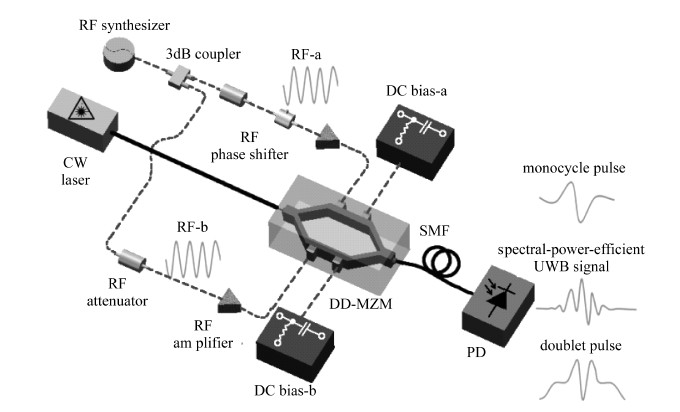 | Fig. 1 Setup of photonic versatile waveform generator. |
In the calculation,both switching voltage and switching bias voltage of the DD-MZM are 4 V.The frequency of the two RF signals is 1 GHz.The center wavelength of CW light is 1550 nm.Only first-order chromatic dispersion is considered.The chromatic dispersion coefficient is 17 ps/(nm·km-1)The bandwidth of PD is 40 GHz.
2 Generation of UWB signalsVersatile waveforms can be generated from the generator by controlling the variables.A monocycle pulse is generated when A1=6 V,A2=4 V,VBias1-VBias2=1 V,the length of SMF is 200 m and the delay between the two RF signals is 45 ps.The generated waveform and the power spectral density with the FCC indoor emission mask are shown in Fig. 2.The pulse width is about 150 ps.The power spectral density of the monocycle pulse is not FCC compliant.To avoid the interference with GPS,the signal is attenuated to ensure that its low-frequency component is below the FCC indoor emission mask.The spectral power efficiency is calculated within the frequency band for communications and field disturbance sensing (3.1~10.6 GHz),as follows.

The spectral power efficiency of the generated monocycle pulse is only 0.1%.The utilization of the spectrum is very low.
In the generation of doublet pulse,the amplitudes of the RF signals and the DC bias voltages become A1=5 V,A2=5 V,VBias1=4 V and VBias2=0 V.A 175 ps delay is added to one of the RF signals,corresponding to a phase shift of 0.35π.The length of SMF is kept 200 m.The waveform of the doublet pulse is illustrated in Fig. 3(a).The doublet pulse is symmetric and has a deep dip in the middle.The power spectral density of the doublet pulse is plotted together with the FCC indoor emission mask in Fig. 3(b).The power spectrum of the doublet pulse is centered around 6.5 GHz and has a 10 dB bandwidth of about 6 GHz,which fits well the FCC-specified spectral mask.Besides,there is a notch around the GPS band.However,the power spectral density of the doublet pulse is not fully FCC compliant.The low-frequency components still exist.Therefore,the power of the doublet pulse is attenuated to fit the FCC mask.The resultant spectral power efficiency is 0.74%.
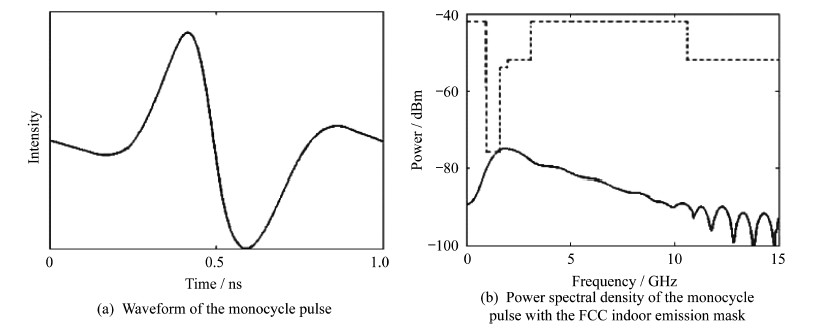 | Fig. 2 Generation of monocycle pulse |
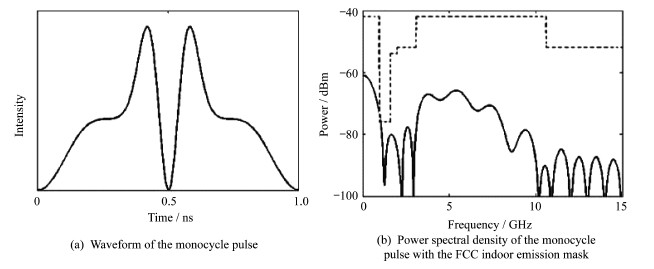 | Fig. 3 Generation of doublet pulse |
To generate a spectral-power-efficient signal,we searching the values of the variables to generate a signal whose spectral power density is below FCC mask and which has the highest spectral power efficiency within the frequency band of 3.1~10.6 GHz.First of all,the spectral power density of the target waveform is calculated,which are the conditions of the waveform generation.Secondly,original values are assigned to the four variables and the roughly searching ranges are given to generate waveforms.Lastly,the properties of the generated waveform are calculated and compared with the target waveform.If they are unmatched,we change the values of the variables one by one for another round of matching.The values of the variables are obtained as follows:A1=6 V,A2=4 V,VBias1=2 V and VBias2=0 V.The delay of one RF signal is 20 ps and the length of the SMF becomes 450 m.Which can generate a larger chromatic dispersion.The shape of the signal is oscillated,as shown in Fig. 4(a).The power spectrum is centered at 5.5 GHz and the 10 dB bandwidth is about 7 GHz,as shown in Fig. 4(b).A notch appears at the GPS band and the low-frequency components are relatively weak comparing with those within the 3.1~10.6 GHz.The power spectral density is almost FCC compliant.The calculated spectral power efficiency is 24.03%,which is significantly improved.Compared to the monocycle and doublet pulses,the spectral-power-efficient UWB signal efficiently utilizes the RF spectral resource.
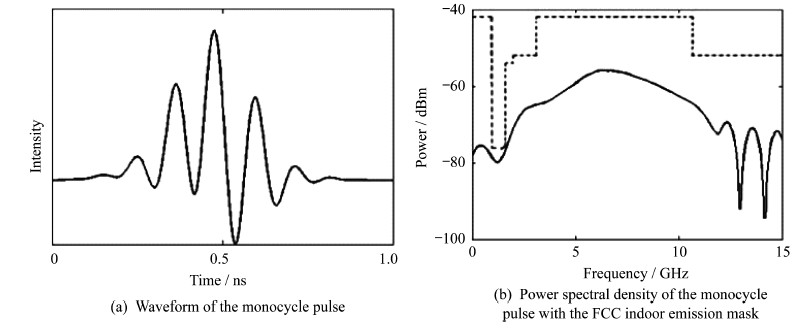 | Fig. 4 Generation of spectral-power-efficient signal |
We have proposed the generation of monocycle and doublet pulses and a spectral-power-efficient UWB signal using a simple-structured photonic versatile waveform generator.Monocycle and doublet pulses are widely used in the current UWB systems.However,the spectral power efficiencies of the monocycle and doublet pulses are very low.Furthermore,to achieve high spectral power efficiency,we have developed the algorithm to determine the variables for generating spectral-power-efficient UWB signal.Comparing to the monocycle and doublet pulses,the generated spectral-power-efficient UWB signal fits the FCC indoor emission mask well and has the spectral power efficiency of up to 24.03%,which is a desired UWB signal and very suitable for the UWB systems.
| [1] | AIELLO G R,ROGERSON G D.Ultra-wideband wireless systems[J].IEEE Microwave Magazine,2003,4(2):36-47. |
| [2] | PORCINO D,HIRT W.Ultra-wideband radio technology:potential and challenges ahead[J].IEEE Communications Magazine,2003,41(7):66-74. |
| [3] | GHAVAMI M,MICHAEL L B,KOHNO R.Ultra wideband signals and systems in communication engineering[M].Chichester,England:John Wiley & Sons Inc,2004. |
| [4] | ZENG F,YAO J P.An approach to ultrawide band pulse generation and distribution over optical fiber[J].IEEE Photonics Technology Letters,2006,18(7):823-825. |
| [5] | YU X B,GIBBON T B,PAWLIK M,et al.A photonic ultra-wideband pulse generator based on relaxation oscillations of a semiconductor laser[J].Optics Express,2009,17(12):9680-9687. |
| [6] | DONG J J,ZHANG X L,XU J,et al.Ultrawideband monocycle generation using cross-phase modulation in a semiconductor optical amplifier[J].Optics Letters,2007,32(10):1223-1225. |
| [7] | DONG J J,YU Y,ZHANG Y,et al.All-optical binary phase-coded UWB signal generation for multi-user UWB communications[J].Optics Express,2011,19(11):10587-10594. |
| [8] | Federal Communications Commission.Revision of part 15 of the commission's rules regarding ultra-wideband transmission systems[M].Washington,DC,USA:Federal Communications Commission,2002. |
| [9] | ABTAHI M,MAGNE J,MIRSHAFIEI M,et al.Generation of power-efficient FCC-compliant UWB waveforms using FBGs:analysis and experiment[J].Journal of Lightwave Technology,2008,26(5):628-635. |
| [10] | ABRAHA S T,OKONKWO C M,TANGDIONGGA E,et al.Power-efficient impulse radio ultrawideband pulse generator based on the linear sum of modified doublet pulses[J].Optics Letters,2011,36(12):2363-2365. |
| [11] | DAI B,GAO Z S,WANG X,et al.Versatile waveform generation using single-stage dual-drive Mach-Zehnder modulator[J].Electronics Letters,2011,47(5):336-338. |
| [12] | DAI B,Gao Z S,WANG X,et al.Generation of versatile waveforms from CW light using a dual-drive Mach-Zehnder modulator and employing chromatic dispersion[J].Journal of Lightwave Technology,2013,31(1):145-151. |