 2015, Vol. 37
 Issue (2): 175-183


LIGO’s scientific mission is to explore the physics and astrophysics of gravitational waves by their direct detection.Beyond the first detections,LIGO aims to open a new window on the Universe,gravitational wave astronomy.The detection and exploitation of gravitational waves by a ground-based instrument requires the development of exquisitely sensitive km-scale interferometers operated as remotely separated facilities.At the current time LIGO operates two separated observatories:LIGO Hanford Observatory(LHO)is located in eastern Washington State in the northwest of the U.S.and LIGO Livingston Observatory(LLO)is located in Louisiana approximately 40 km east of Baton Rouge; the light-travel time between the two LIGO sites is 10 ms[1].
LIGO Laboratory together with the LIGO Scientific Collaboration(LSC)carry out in concert the data analysis and research and development that drives improvements in interferometry that are eventually applied to the LIGO instruments.The LSC is an international organization numbering more than 900 members,comprising more than 80 institutions from 14 countries,including scientists and engineers from LIGO Laboratory.
1 Gravitational wavesGravitational waves are a prediction of Einstein’s General Theory of Relativity,and reflect the fact that the propagation of information is limited by the speed of light,as required by his earlier Special Theory of Relativity.Gravitational waves are effectively ripples in the fabric of space-time that propagate at the speed of light.Their existence was first demonstrated by precision timing measurements of the binary pulsar system PSR1913+16 by Hulse and Taylor,for which discovery they were awarded the Nobel Prize in Physics for 1993.To date,however,there has been no direct detection of gravitational waves with an instrument designed to respond to their passage through the device:this is the mission of LIGO,as well as a number of other km-scale interferometer projects around the globe(Virgo,GEO,KAGRA).
Referring to Fig. 1,gravitational waves are quadrupolar in nature and come in two orthogonal polarizations,“+”,“×”.The upper is a gravitational wave impinges on an array of test masses along the normal to the plane of the ring.Lower:The ring of test masses will respond to passage of a gravitational wave by being alternately compressed and then distended along perpendicular directions.The series of figures correspond to the configuration of the ring at different times during one period of the gravitational wave of frequency ω=2πf.One polarization,+,is aligned with the coordinate axes(x,y)while the other,×,is aligned 45° to the coordinate axes.The magnitude of the distortion,h≡ ,corresponds to the dimensionless strain amplitude of the wave.Gravitational strain is a tidal effect which perturbs space-time and is detectable by measuring the distance between pairs of“test masses”arranged,e.g.,in an L configuration.
Gravitational waves propagating from astrophysical sources at extragalactic distances produce extremely weak perturbations in the local space-time here on earth,and are therefore very difficult to detect.To set the scale,one can use the quadrupole approximation to the GW radiation formula[2]:

Here,G is Newton’s constant of gravitation,M is the mass of one of the two(equal)bodies orbiting each other,Rsep is the separation distance between the centers of the bodies,forb is the orbital frequency with which they orbit each other,c is the speed of light,and r is the distance to the orbiting binary.A representative astrophysical source might be a pair of neutron stars,each having the mass M=1.4M⊙,where M⊙ is the solar mass.When they are separated by Rsep=40 km,they are orbiting each other at a frequency of forb=380 Hz.At a distance of 15 Mpc(corresponding to the distance to the local Virgo cluster of galaxies),the gravitational strain produced on earth would correspond to h≈10-21,tiny indeed.Referring again to Fig.1 the effect on a pair of test masses separated by 4 km would be to displace their separation by approximately to 1/1 000 the diameter of a proton!
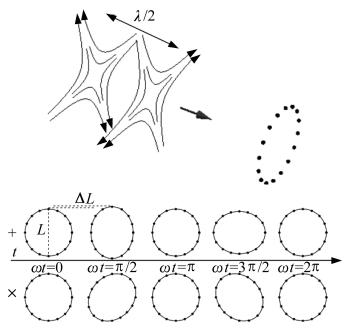 |
Fig. 1 Gravitational waves are quadrupolar in nature and come in two orthogonal polarizations |
Nonetheless,it is possible to apply precision interferometry to detect and measure such minute dimensional changes,which is what LIGO and the other large-scale interferometer projects are designed to do.Fig. 2 shows a schematic arrangement of suspended mirrors which serve as the test masses described earlier.The LIGO arm lengths are 4 km.Such an L-shaped interferometer acts as an antenna for gravitation radiation.Fig. 3 shows the corresponding antenna patterns for the two polarization states as well as the polarization-averaged response.The polarization averaged(RMS)response is shown in the rightmost panel.The “peanut” shaped pattern as a ~2∶1 ratio in responses along the polar and equatorial directions.In addition the response in the equatorial plan has minima at 45° relative to the two arms.
In initial LIGO,the laser light source operated at ~5 W; the resonant Fabry-Perot cavities in the arms stored the light in the arms for ~10 ms.For maximum sensitivity,the interferometer is operated at the dark fringe on the photo detector.
A power recycling mirror forms a compound resonant cavity that reflects the light returning to the laser back into the interferometer,thereby increasing the effective light circulating within the interferometer to levels well above the laser power,by a factor ~50×.The initial LIGO interferometer had a limiting noise floor which at high frequencies,f  100 Hz,is limited by the shot noise on the light.Below f
  50 Hz,the residual motion of the suspended mirrors due to unfiltered seismic motion limits sensitivity.Between these regimes Brownian motion(thermal noise)of the mirrors,their coatings,and the suspension fibers becomes the ultimate limiting factor in sensitivity.Taken together,the typical frequency-dependent sensitivity curve for an interferometer is a U shaped curve.Fig. 4 presents an overlay of the science requirement design with the actual sensitivities achieved during the last initial LIGO science run,S6.The data shown in the figure correspond to two interferometers,LHO,LLO,which operated together in coincidence during the S6 run.
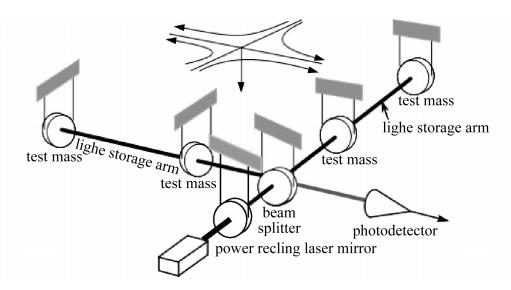 |
Fig. 2 Simplified schematic of a suspended mirror Michelson interferometer with Fabry-Perot cavities in the arms |
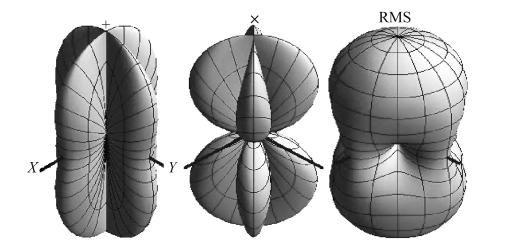 |
Fig. 3 A Michelson interferometer with arms aligned along the (x,y) axes has a quadrupolar antenna pattern to a plane gravitational wave.The two polarizations have responses as shown in the first two panels |
To date,the LIGO Scientific Collaboration(LSC)has published more than 80 papers on the observational results with the initial LIGO interferometers.The initial LIGO era spanned the period the period 2002-2010 and consisted of six science runs,each having progressively better sensitivity that the previous one.S6 culminated in performance that exceeded the original interferometer design,as may be seen in Fig. 4 for frequencies f  60 Hz.
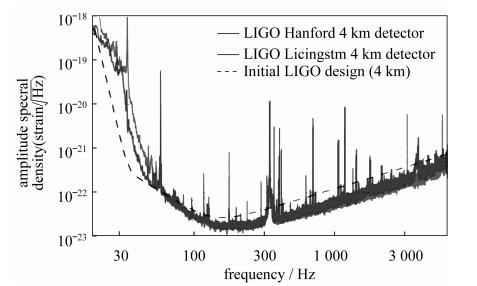 |
Fig. 4 The spectral density of amplitude noise for the LIGO interferometer during the last run,S6.Refer to text for details on shape of curves,performance,etc. |
The LSC organizes the observing program with LIGO data according to different classes of astrophysical sources:
- Coalescing compact binary systems,e.g.neutron star pairs(NS/NS),black hole pairs(BH/BH),or heterogenous systems composed of a NS+BH pair.These systems produce a characteristic“chirp”signal as they compete their last few hundred orbits with ever increasing frequency before their merger(ref.Eq.1).Depending on the bandwidth of the interferometer and the masses involved,these signals will last from seconds to minutes within the LIGO band.In addition,such events are expect to be associated with gamma ray bursts that are produced at the end of the coalescence[3,4,5,6].
- Unmodeled burst sources,such as supernova(SN)explosions[7,8].When a massive star exhausts its nuclear fuel,it can undergo catastrophic gravitational collapse,leading to either a neutron star or black hole.If the conditions of this collapse are such that there is an asymmetry to the collapse that leads to a dynamically varying mass quadrupole moment,a burst of gravitational waves will be emitted,lasting ≤ 1 sec.
- Rotating neutron stars with equatorial asymmetries.If a rapidly spinning neutron star(analog to an EM pulsar)has a “mountain” on its surface,there will be a dynamically varying quadruple which will result in the generation of gravitational waves[9,10].Such sources are expected to be extremely narrowband signals with an instantaneous frequency that will be modulated by a number of factors.These include deterministic effects:earth rotation(~3×10⁻⁶ effect); earth orbital motion about the sun (~2×10⁻⁴ effect).There are also unknown effects associated with the source-specific motion of the rotating neutron star-these are modeled as a Taylor series expansion in terms of source velocity,and higher derivatives.
- Stochastic gravitational sources.These include primordial waves from the Big Bang[11],as well a superposition of many unresolved foreground astrophysical sources[12].These signals are detectable by cross-correlating the outputs of multiple interferometers,looking for common signals associated with the sky that are detectable across continental distances.
Selected highlights of observational results published by the LSC together with the Virgo Collaboration include:
- Results from the search for binary coalescences[13,14].This search utilized a network of three interferometers,the two LIGO and the Virgo instrument,operating at the best sensitivity achieved; binary neutron star mergers to a distance from earth of approximately 40 Mpc away and binary black hole mergers up to approximately 90 Mpc could have been detected.No gravitational wave signals were identified.This “null result” led to new observational new limits on the rate of compact binary mergers in the local universe.These limits are still about 100 times higher than expected rates from astronomical observations,so the fact that no gravitational waves were detected was consistent with expectations.
- Results from searches for gravitational waves associated with GRBs.During the initial LIGO era a number of nearby GRBs provided triggers to search the LIGO data for evidence of associated GW bursts.For a number of these GRBs,interesting upper limits were able to be set.For example,the error box for GRB070201 overlapped the nearby Andromeda galaxy(M31).LIGO data showed that the GRB did not originate from a binary coalescence in that galaxy at the 95% confidence level[15].Similarly,analysis of observations made by LIGO during an epoch of data triggered by GRB051103,was able to rule out the collision of two neutron stars or a neutron star and a black hole as being responsible for the GRB in the nearby galaxy M81[16].
-
Results from the search for gravitational waves from known pulsars[17].This search looked for signals from a population of 195 known EM pulsars,including the Crab and Vela pulsars.For the Crab pulsar,J0534+2200,(d ~2 kpc from earth),it was determined that the upper limit to the strength of gravitational waves was h<1.6×10⁻²⁵,which translates to an upper limit in the emission of gravitational waves corresponding to less than 1.2% of the total power radiated by the pulsar as evidenced by its spin-down rate.Further,this result corresponds to a maximum deviation from axial symmetry of
 <8.6×10⁻⁵,where δI is the difference between the two equatorial moments of inertia and I is the principle moment of inertia of the neutron star.
 - Results from the search for an isotropic(cosmological)stochastic gravitational wave background[18,19].This search looked for a correlated signal between the two LIGO interferometers that could be attributed to gravitational waves of a cosmological origin.No signals were detected.For a frequency-independent gravitational wave spectrum,Ω(f)~Ω0,this corresponds to an upper limit to the energy density in gravitational waves in the LIGO frequency band corresponding to Ω0<5.6×10⁻⁶.
In October 2014 LIGO completed fabrication,assembly and installation of the upgrades to the initial LIGO interferometers,termed Advanced LIGO.The upgrade was funded primarily by the U.S.National Science Foundation( US $205M )and included in-kind contributions by LIGO collaborators in the UK( ~ US $12M ),Germany( ~ US $12M ),and Australia(~US$2M).
Advanced LIGO was a complete rebuild of the interferometers,introducing newer,more sensitive technologies made possible through an intense R&D program over the past decade and not available when the first instruments were built.In particular,Advanced LIGO utilizes the following improvements:
- Better,2-stage actively controlled seismic isolation capable of reducing ground motion at much lower frequencies f ~10 Hz compared to the initial LIGO,f ~60 Hz.This will allow LIGO to detect signals at lower frequencies,thereby increasing the signal to noise ratio for sources such as coalescing binary systems.Ref.to Fig. 5
- More sophisticated,4-stage monolithic(glass)suspensions and larger,more massive mirrors.These serve to reduce the limiting mid frequency-band noise due to Brownian motion of the optics and their suspensions.Ref.to Fig. 6
- Higher laser power,capable of producing 200 W of λ=1 064 nm.This will allow high-frequency operation at lower shot noise levels than possible with initial LIGO.Ref.to Fig. 7
- A more flexible,more sensitive optical configuration.
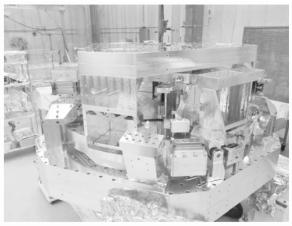 |
Fig. 5 The Advanced LIGO multi-stage active seismic isolation system under assembly |
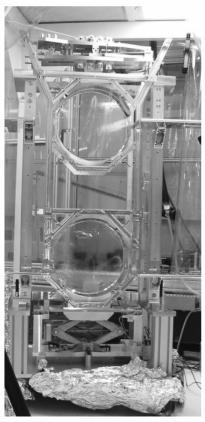 |
Fig. 6 The Advanced LIGO multi-stage fused silica suspension system and 40 kg mirror under assembly |
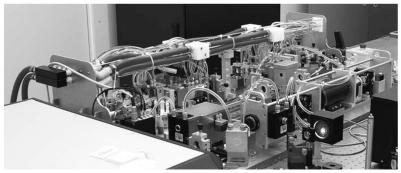 |
Fig. 7 The Advanced LIGO 200 W laser under assembly |
Combining these improvements,the Advanced LIGO design has an optimal sensitivity near f ~100 Hz that is ~10×better than initial LIGO.Because interferometers respond to the amplitude of a gravitational wave,a 10× better sensitivity corresponds to a 10× greater range to which sources may be detected,and this results in a 1 000× increase in their detection rate:a single day of observation with Advanced LIGO corresponds to almost three years of observations with initial LIGO.
At this early stage of commissioning,performance exceeded the best performance ever achieved during the initial LIGO era(ref.to legend in the plot).Note:to obtain strain sensitvitivity,the ordinate must be divided by 4 000(the LIGO arm length).As of this writing,commissioning is continuing on both LIGO interferometers to prepare them for the first observational run of the advanced interferometer era.
Since May 2014,LIGO has been commissioning the new instruments.Fig. 8 shows a commissioning spectrum from the LLO instrument taken in late September 2014,showing that that the sensitivity now exceeds by almost 2× the best achieved during the initial LIGO era.
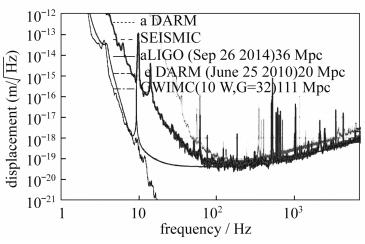 |
Fig. 8 Displacement sensitivity for the LA 4 km interferometer as of 26 Sept.2014 |
There are currently five major km-scale interferometers at various stages of construction around the globe(ref.Fig. 9).These include the two 4-km U.S.LIGO interferometers,0.6 km GE0600 advanced technology interferometer in Germany[20] the 3-km Virgo interferometer in Italy,and the 3-km cryogenic KAGRA interferometer in Japan.The LSC(which includes U.S.LIGO and GE0600),Virgo,and KAGRA have agreements in place to jointly analyze data from the various instruments when they are operating at comparable sensitivities.The combined data will be analyzed coherently,allowing the network of interferometers to operate as a phased array,thereby allowing for aperture-synthesis gravitational wave astronomy.A global network provides multiple detections of a common(plane)gravitational wave.Using time-of-arrival information across the network as well as details of the signal waveform allows one to localize the source on the sky,provide(low resolution)pointing information,permitting EM observatories to follow up gravitational wave events with observations across the electromagnetic spectrum[21].
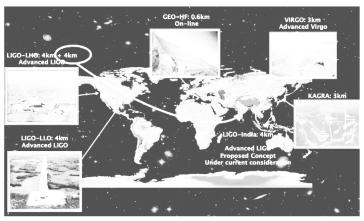 |
Fig. 9 The global network of km-scale interferometers is growing |
At the present time,LIGO Laboratory is planning with Indian collaborators to install an identical third Advanced LIGO interferometer at a site in that country.The proposal for India to identify a site and begin work on a facility similar to the LIGO facilities in the U.S.is under consideration for approval by the Government of India.This third LIGO site would be located closer to the equator compared to the extant facilities.The additional node to the network,plus the more southerly location of a site in India serves improve the ability of the global network to localize events on the sky for hand-off to EM observatories.With the addition of LIGO-India to the U.S-European-Japanese network,80% of detected sources can be localized to within 20 sq.deg,compared to 80 sq.deg.for the network without India.This factor ~4x improvement in localization will enable the global network to play a key role in initiating the era of multi-messenger astronomy with gravitational waves[22,23].
6 AcknowledgmentsThe author gratefully acknowledges the support of the United States National Science Foundation for the construction and operation of the LIGO Laboratory.The scientific program of the LSC and Virgo is made possible through funding from Science and Technology Facilities Council of the United Kingdom,the Max-Planck-Society,and the State of Niedersachsen/Germany for support of the construction and operation of the GEO600 detector,and the Italian Istituto Nazionale di Fisica Nucleare and the French Centre National de la Recherche Scientifique for the construction and operation of the Virgo detector.The authors also gratefully acknowledge the support of the research by these agencies and by the Australian Research Council,the International Science Linkages program of the Commonwealth of Australia,the Council of Scientific and Industrial Research of India,the Istituto Nazionale di Fisica Nucleare of Italy,the Spanish Ministerio de Economía y Competitividad,the Conselleria dEconomia Hisenda i Innovació of the Govern de les Illes Balears,the Foundation for Fundamental Research on Matter supported by the Netherlands Organisation for Scientific Research,the Polish Ministry of Science and Higher Education,the FOCUS Programme of Foundation for Polish Science,the Royal Society,the Scottish Funding Council,the Scottish Universities Physics Alliance,The National Aeronautics and Space Administration,OTKA of Hungary,the Lyon Institute of Origins(LIO),the National Research Foundation of Korea,Industry Canada and the Province of Ontario through the Ministry of Economic Development and Innovation,the National Science and Engineering Research Council Canada,the Carnegie Trust,the Leverhulme Trust,the David and Lucile Packard Foundation,the Research Corporation,and the Alfred P.Sloan Foundation.This article has LIGO document number LIGO-P1400230.
| [1] | ABBOTT B P,ABBOTT R,ADHIKARI R,et al.,LIGO:the laser interferometer gravitational-wave observatory[J].Reports on Progress in Physics,2009,72:1-2. |
| [2] | FOSTER J,NIGHTENGALE J D.A short conrse in general relativity[M].Berlin:Springer-Verlag,1995. |
| [3] | CHEN H Y,HOLTZ D E.Gamma-ray-burst beaming and gravitational-wave observations[J].Physical Review Letters,2013,111:181101. |
| [4] | FONG W,BERGER E,FOX D B,et al.Hubble space telescope observations of short gamma-ray burst host galaxies:morphologies,offsets,and local environments[J].The Astrophysical Journal,2010,708(1):9. |
| [5] | CHURCH R P,LEVAN A J,DAVIES M B,et al.Implications for the origin of short gamma-ray bursts from their observed positions around their host galaxies[J].Monthly Notices of the Royal Astronomical Society,2011,413:2004-2014. |
| [6] | BERGER E.The environments of short-duration gamma-ray bursts and implications for their progenitors[J].New Astronomy Reviews,2011,55:1-22. |
| [7] | OTT C D.The gravitational-wave signature of core-collapse supernovae[J].Classical and Quantum Gravity,2009,26(6):06300l. |
| [8] | KOTAKE K.Multiple physical elements to determine the gravitational-wave signatures of core-collapse supernovae[J].Comptes Rendus Physique,2013,14(4):318-351. |
| [9] | OWEN B J.Maximum elastic deformations of compact stars with exotic equations of state[J].Physical Review Letters,2005,95:211101. |
| [10] | OWEN B J.Detectability of periodic gravitational waves by initial interferometers[J].Classical and Quantum Gravity,2006,23(8):S1-S7. |
| [11] | MAGGIORE M.Gravitational wave experiments and early universe cosmology[J].Physics Reports,2000,331(6):283-367. |
| [12] | REGIMBAU T.The astrophysical gravitational wave stochastic background[J].Research in Astronomy and Astrophysics,2011,11(14):369-390. |
| [13] | The LIGO Scientific Collaboration,Virgo Collaboration.Search for gravitational waves from low mass compact binary coalescence in LIGO’s sixth science run and vVirgo’s science runs 2 and 3[J].Physical Review D.,2012,85:082002. |
| [14] | The LIGO Scientific Collaboration,Virgo Collaboration.Search for gravitational waves from binary black hole inspiral,mergerand,ringdown in LIGO-Virgo data from 2009-2010[J].Physical Review D.,2013,87:022002. |
| [15] | HURLEY K.Implications for the origin of GRB 070201 from LIGO Observations[J].The Astrophysical Journal,2008,681(2):1419. |
| [16] | ABADIE J,ABBOTT B P,ABBOTT T D,et al.Implications for the orign of GRB 051103 from LIGO obeservations[J].The Astrophysical Journal,2012,755(2):1-8. |
| [17] | AASIL J,ABADIE1 J,ABBOTTL B P,et al.Gravitational waves from known pulsars:results from the initial detector era[J].The Astrophysical Journal,2014,785(2):119. |
| [18] | The LIGO Scientific Collaboration,Virgo Collaboration.An upper limit on the stochastic gravitational-wave background of cosmological origin[J].Nature,2009,460:990-994. |
| [19] | The LIGO Scientific Collaboration,Virgo Collaboration.Improved upper Limits on the stochastic gravitational-wave background from 2009-2010 LIGO and Virgo data[J].Physical Review Letters,2014,113:231101. |
| [20] | AFFELDT C,DANZMANN K,DOOLEY K L,et al.Advanced techniques in GEO 600[J].Classical and Quantum Gravity,2014,31:224002. |
| [21] | NISSANKE S,KASLIWAL M,GEORGIEVA A.Identifying elusive electromagnetic counterparts to gravitational wave mergers:an end-to-end simulation[J].The Astrophysical Journal,2013,767:124. |
| [22] | FAIRHURST S.Source localization with an advanced gravitational wave detector network[J].Classical and Quantum Gravity,2011,28:105021. |
| [23] | SATHYAPRAKASH B S,FAIRHURST S,SCHUTZ B F,et al.Scientific benefits of moving one of LIGO Hanford detectors to India,LIGO Document[DB/OL]http://www.ligo.caltech.edu/NSF/related/10.2011/ligo-india-110923.pdf,2012,No.LIGO-T1200219-v1. |