 2014, Vol. 36
 Issue (4): 369-376


2. 上海理工大学 上海市现代光学系统重点实验室, 上海 200093
2. Shanghai Key Laboratory of Modern Optical System, University of Shanghai for Science and Technology, Shanghai 200093, China
Introduction
Optical code en/decoders are the most crucial components in plenty of optical applications.A lot of optical components have been developed into optical en/decoders,including fiber-optic delay lines(FODL),planar lightwave circuits(PLC),spatial light modulators(SLM),arrayed-waveguide grating(AWG),holographic device,and micro electromechanical systems(MEMS)[1, 2, 3, 4, 5, 6, 7].Among the various en/decoders,superstructured fiber Bragg grating(SSFBG)is a good candidate because of low insertion loss,polarization insensitivity,high compactness and low cost[8].
In this paper,we review our past work on the development of SSFBG en/decoders.We firstly briefly introduce the operation principle of SSFBG based en/decoders and then we demonstrate two proposed novel en/decoders for security improvement and multiple-output en/decoding.
1 Operation principle of SSFBG based en/decoder
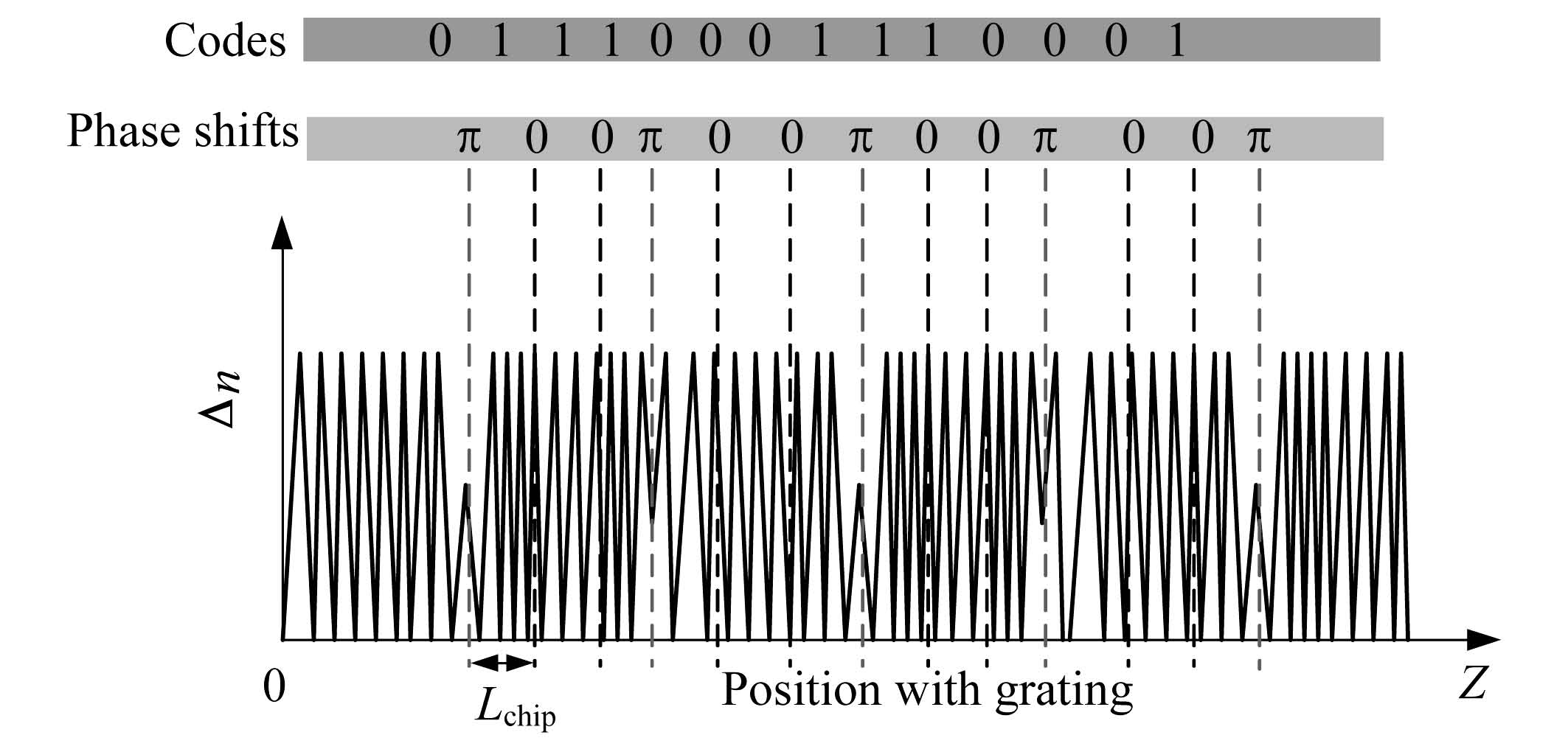
A SSFBG is defined as an FBG with a rapidly varying refractive index modulation of uniform amplitude and pitch,also with a slowly varying refractive-index modulation profile imposed along its length[9].In addition,a full complex refractive-index modulation profile can be realized in a SSFBG by inserting phase shifts between different segments,as shown in Fig. 1. After input of a short optical pulse,the SSFBG can generate a series of coherent short optical pulses whose phases are decided by the pattern of the phase shifts in the SSFBG.If the lengths of whole segments are all the same and the refractive-index modulation is constant along the whole grating,the light can pierce the whole grating and the respective segments of the grating contribute more or less equally to the reflected response.The SSFBG thus works as an optical transversal filter to generate a binary-phase-shift-key(BPSK)or a quaternary-phase-shift-key(QPSK)optical code from its impulse response.Besides,it can perform correlation for optical code recognition.The SSFBG can be manufactured with a single short phase mask by continuous grating writing or holographic techniques which can provide a high elasticity in generating different ultra-long optical code.High accuracy phase control can be achieved as well for BPSK,QPSK or even more multiple phase level optical code.
 | Fig. 1 Superstructured FBG with phase shifts for optical code generation/recognition |
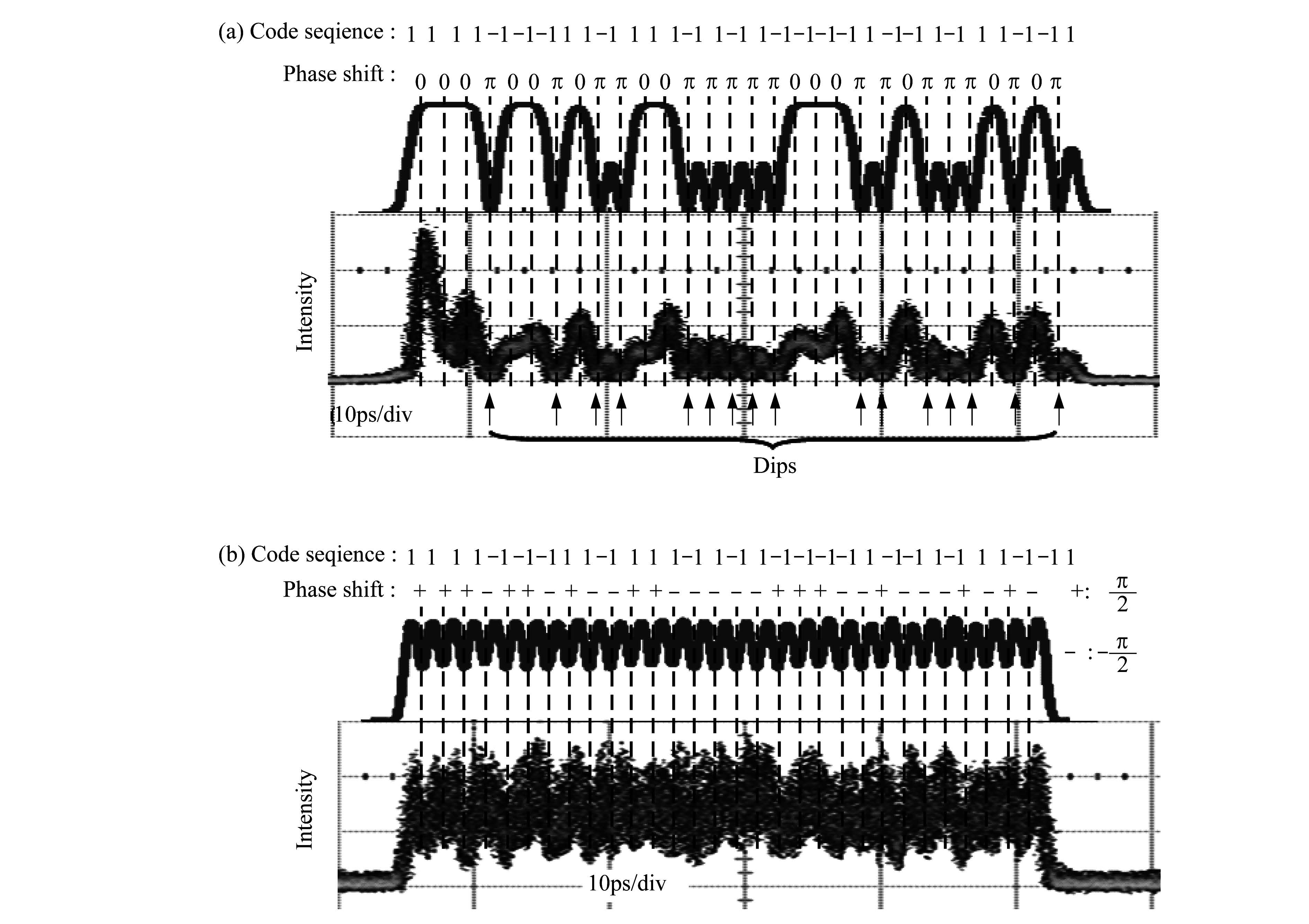
Typically,0/π-phase-shifted SSFBG(0/π-SSFBG)en/decoder,which has the structure of 0 or π phase shift between adjacent chips,is always used for the temporal binary phase coding.Nevertheless,the security vulnerability of the 0/π-SSFBG encoder has been revealed.The cancellation of the adjacent chips,due to the π phase shift,resulting in a dip,implies the vulnerable regularity in the encoded waveform.In consequence of this regularity,in the single-user system,eavesdroppers can easily extract the code sequence from the encoded waveform.To address the security problem,± π/2-phase-shifted SSFBG(± π/2-SSFBG)en/decoder is proposed,which has the phase shift of either + π/2 or - π/2 between adjacent chips subject to the code pattern,to provide uniform encoded waveform,which is regardless of code pattern,and significantly improve the security[10, 11].
In the experiment,we generate the Gaussian shaped optical pulse with the pulse width of 1 ps(FWHM)and inject into the 0/π-SSFBG and ± π/2-SSFBG encoders(CG1 and NG1)to investigate the security of the encoded waveforms,as shown in the Fig. 2.We can found dips easily in the waveform,which is encoded by the 0/π-SSFBG encoder.The existence of the dips infers the π phase shifts in the code pattern,resulting in the vulnerable regularity.Then,eavesdroppers can easily extract the code sequence from the encoded waveform of the 0/π-SSFBG encoder.In the Fig. 2(b),the encoded waveform has same peaks and valleys,and no regularity can be found,so it is hard for eavesdroppers to figure out the code sequence used in the ± π/2-SSFBG encoder,which improves encoding security.
 | Fig. 2 Encoded waveforms of 0/π-SSFBG and ± π/2-SSFBG encoders with different chip durations(a)CG1 and(b)NG1 |
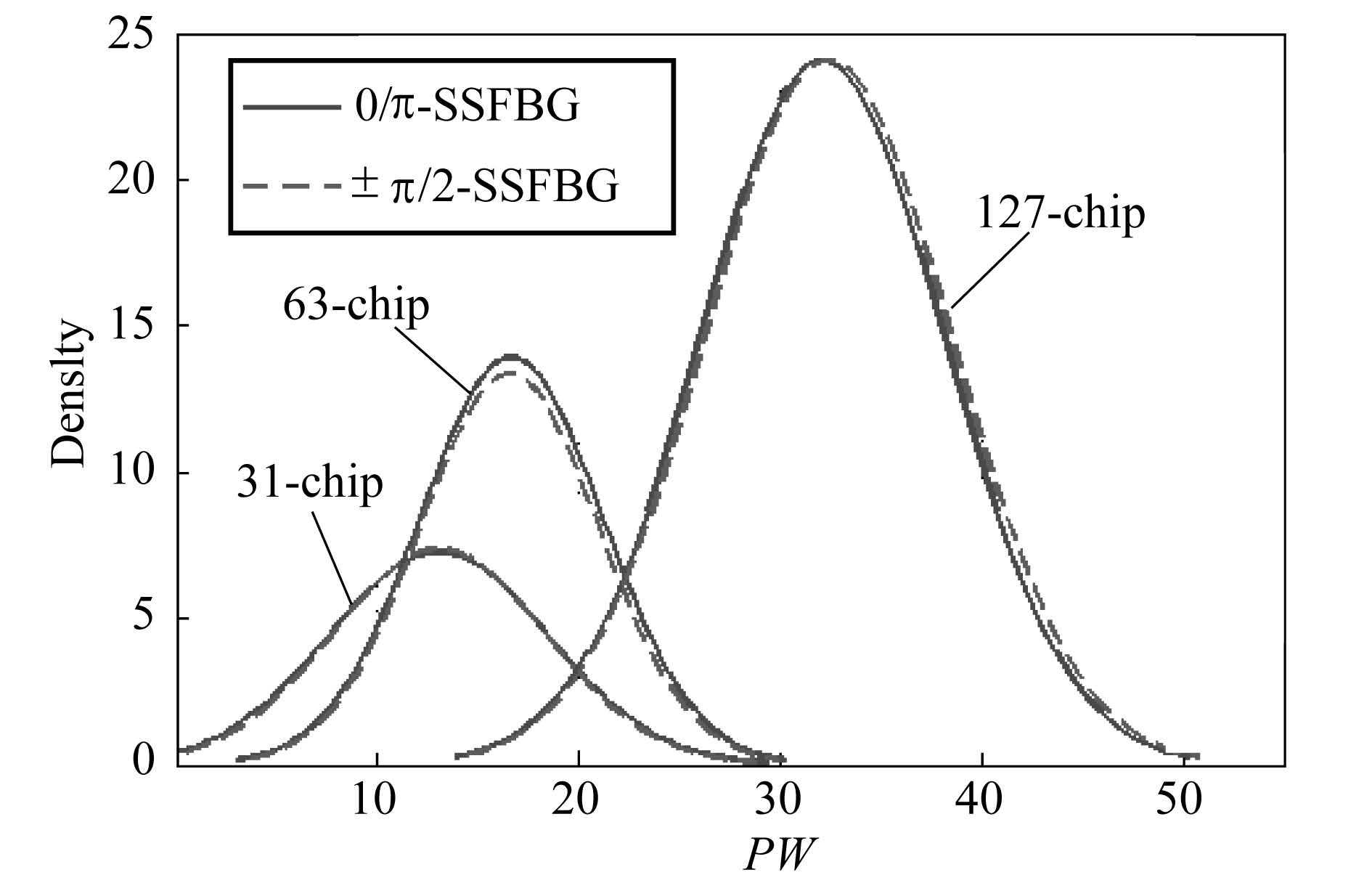
Except for the security performance,the coding performance of both 0/π-SSFBG and ± π/2-SSFBG en/decoders were also investigated by evaluating the ratio of autocorrelation intensity peak over the maximum wing level(PW)for three different code lengths.
In Fig. 3,we can easily see the ± π/2-SSFBG en/decoder almost has the same autocorrelation performance as the 0/π-SSFBG en/decoder do.When the code length increases,the autocorrelation performances of both en/decoders improve and the code capacity expands.Compared to the 31-chip and 63-chip cases,we found the en/decoders using 127-chip Gold code behaves much better performance.
 | Fig. 3 Autocorrelation of the 0/π-SSFBG and ± π/2-SSFBG en/decoders with 31-chip, 63-chip and 127-chip Gold code |
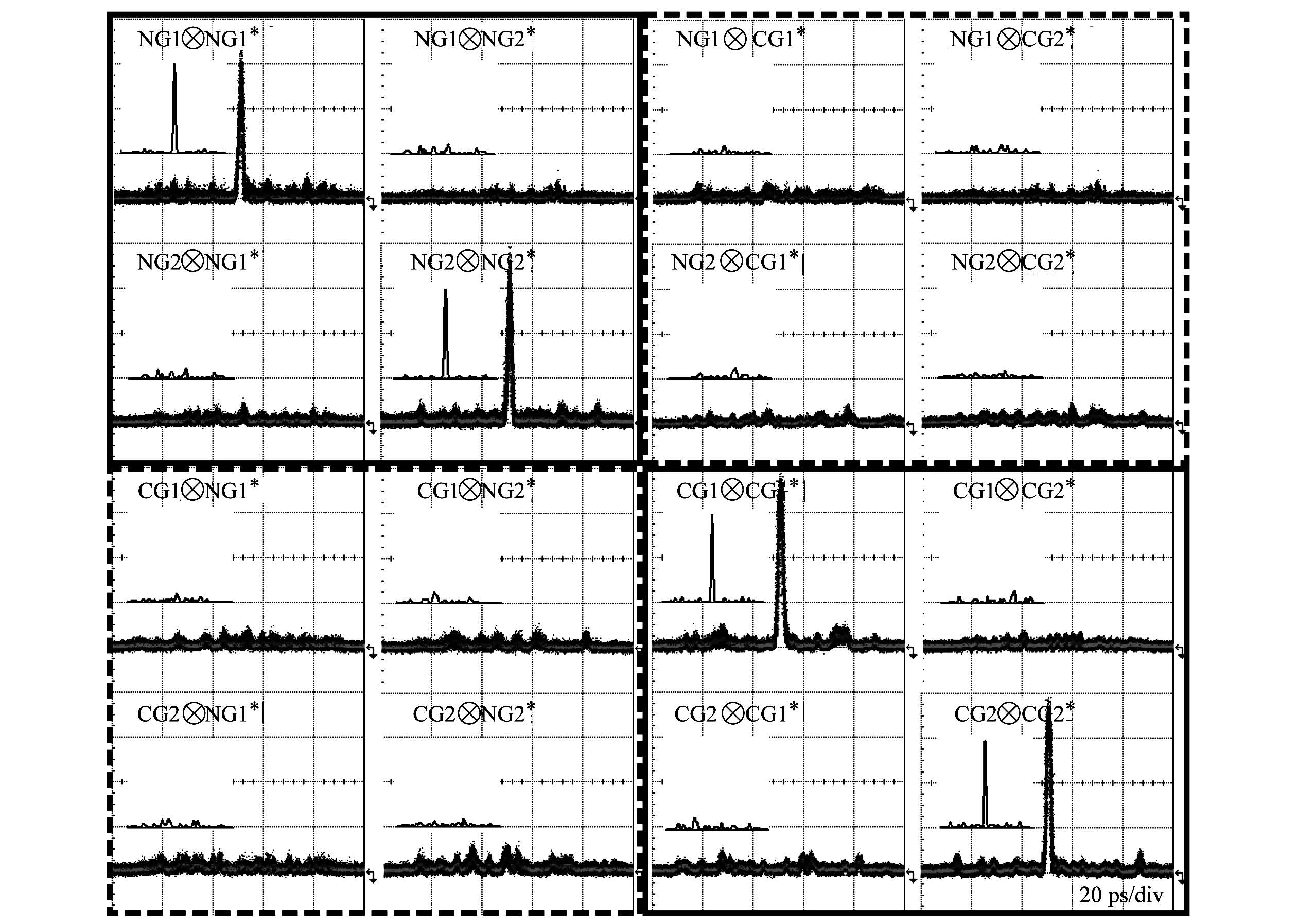
Furthermore,we analyze the hybrid use of both en/decoders,i.e.0/π-SSFBG encoder to ±π/2-SSFBG decoder and ± π/2-SSFBG encoder to 0/π-SSFBG decoder.In the experiment,a 1 ps Gaussian shaped optical pulse is injected into the encoder and the decoder followed the encoder directly.Both measured and calculated decoded waveforms are shown in Fig. 4.The decoded waveforms of 0/π-SSFBG and ± π/2-SSFBG en/decoders are in the top-left and bottom-right box and the waveforms of the hybrid use is in the bottom-left and top-right box.If the decoder matches the encoder,then generates an autocorrelation high peak.Otherwise,a cross-correlation low power signal is produced.The hybrid use of the 0/π-SSFBG and ± π/2-SSFBG en/decoders also results in the low power level cross-correlation.The P/W is larger than 7.The good correlation guarantees the coding performance of both en/decoders and promises the hybrid use of the 0/π-SSFBG and ± π/2-SSFBG en/decoders.The code recognition in SSFBG is aperiodic correlation,but the code sets used in the OCDMA system are periodic correlation properties.The number of codes with good aperiodic correlation is limited.The hybrid use of both kinds of en/decoders is capable of reusing the same codes.According to the experimental measurement,even though 0/π-SSFBG and ± π/2-SSFBG en/decoders use the same code,they still perform good cross-correlation.It allows the same code being used twice in the same system.Therefore,the hybrid use makes it possible to expand the number of the available codes.
 | Fig. 4 Measured and calculated correlation of 0/π-SSFBG and ± π/2-SSFBG en/decoders |
In this section,we review a SSFBG en/decoder,which has a single input and multiple outputs.The en/decoder is able to generate a group of independent optical codes and distribute the encoded and decoded signal into different optical paths.
3.1 StructureFig. 5 shows the block diagrams and schematic diagrams of the single-input multiple-output(SIMO)en/decoder[12].It consists of an optical circulator array,a set of optical tunable delay lines(OTDL),a group of SSFBG en/decoders and variable optical attenuators(VOA).All the circulators have three ports and they are placed orderly.Port 1 of the first circulator is used as the input port.All Port 3’s of the circulators are connected to the OTDLs and VOAs for the outputs.The SSFBG en/decoders and the circulators are connected serially.Port 2 of the circulator is connected to one side of the SSFBG and Port 1 of the next-stage circulator is connected to the other side.Since the SSFBGs are designed with relatively low reflectivity,avoiding multi-reflection of the light inside the gratings,the transmission of the SSFBGs en/decoders has very low loss and slight distortion.
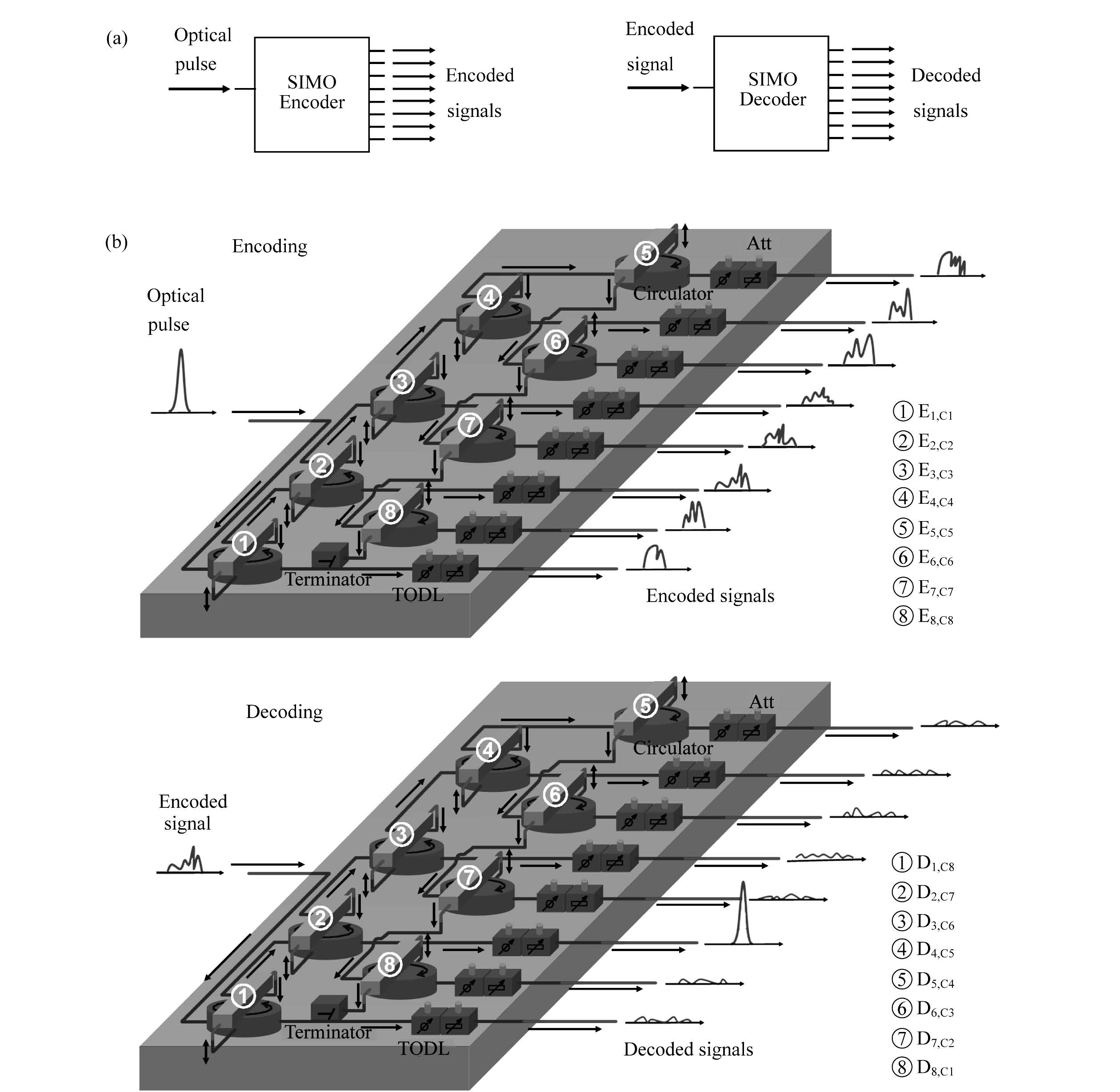 | Fig. 5 (a)Block diagrams of the SIMO en/decoder.(b)Schematic diagrams of the SIMO en/decoder.E and D stands for encoder and decoder.The first inferior,1,2…M,is marshalling sequence.The second inferior,C1,C2…CN,is code number |
During the encoding,an optical pulse passes through circulators and SSFBGs orderly.The encoded signals are reflected from the SSFBGs into Port 2′s of the circulators and output from Port 3′s of the circulators.The TODLs and VOAs are designed to adjust the temporal delay and balance the power.Consequently,the encoded signals could simultaneously be generated from the output ports of the SIMO encoder.
In the decoding,an encoded signal is input into the SIMO decoder then passes through all the circulators and SSFBGs,which is used in the SIMO decoder have spatially reversed structures of those used in the SIMO encoder to form pairs of matched en/decoders,which can be easily realized by spatially reversely writing the gratings using the same mask.Only when the encoded signal passes through a matched decoder,a needle-shape optical pulse is generated.Otherwise,only very low noise-like signals could be generated.The decoded signals are output simultaneously from the SIMO decoder and the needle-shape decoded signal can be acquired from the corresponding output port.
3.2 Coding performanceThe mathematical investigation of the coding performance about the SIMO en/decoder has been done.In the calculation,we design 16 pairs of SSFBGs with 31-chip Gold codes and 16 pairs of SSFBGs with 63-chip Gold codes.We calculate autocorrelation and cross-correlation functions of any two pairs of SSFBGs when they are placed in the different stages of the SIMO en/decoder.Fig. 6 shows the normalized peak power of the decoded signals and PC,which is an very important parameter which could evaluate the coding performance.When the SSFBG is moved from the first stage(conventional back-to-back en/decoding)to the sixteenth stage in the SIMO decoder,the coding performance(PC)slightly degrades.The average degradation of 8 stages is only 5.3% for 31-chip SSFBG and 7.1% for 63-chip SSFBG,while the average degradation of 16 stages is 17.6% and 19.4% for 31-chip and 63-chip SSFBGs respectively.Although the coding performance degrades,it is not difficult to distinguish the autocorrelation signal from the cross-correlation noises.
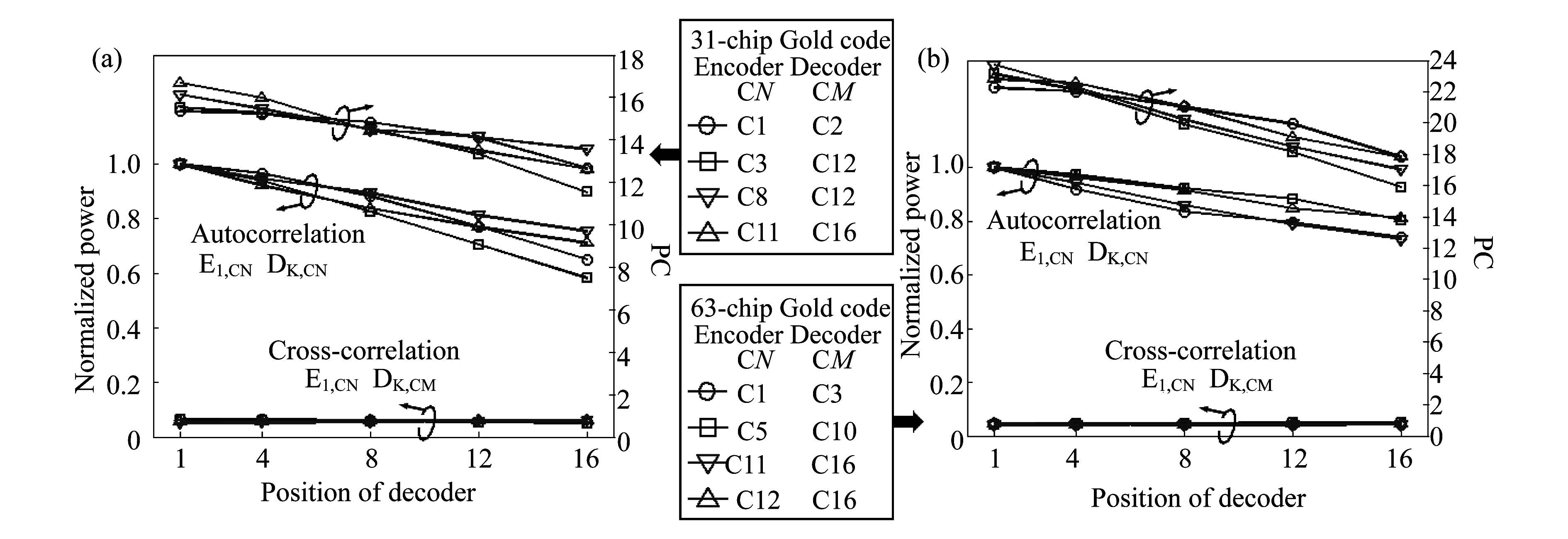 | Fig. 6 Normalized power of the decoded signals and the ratio of the autocorrelation and cross-correlation functions with the change of the positions of the SSFBG in the SIMO decoder.SSFBGs with(a)31-chip Gold codes and(b)63-chip Gold codes |
Besides,We keep the four pairs of SSFBGs in the first four stages of the SIMO en/decoder and detect encoded and decoded waveforms.A sequence of 10 GHz optical pulses with pulse width of 2 ps(FWHM)is produced by a mode-locked laser diode(MLLD),launched into the SIMO encoder.From the first four output ports of the SIMO encoder,four encoded signals can be obtained simultaneously,as shown in Fig. 7(a).The encoded waveforms are noise-like signals.Then the encoded signal is input into the SIMO decoder respectively.Then,the decoded signals are output from the first four output ports of the SIMO decoder.The sixteen measured and calculated decoded signals are illustrated in Fig. 7(b).Optical pulses with high-intensity peaks are obtained only from the output ports when SSFBGs match.However,from other output ports,we can only obtain very low-intensity noise-like signals.The perfect coding performance indicates that the SIMO en/decoder is viable to generate and recognize a set of independent optical codes simultaneously.
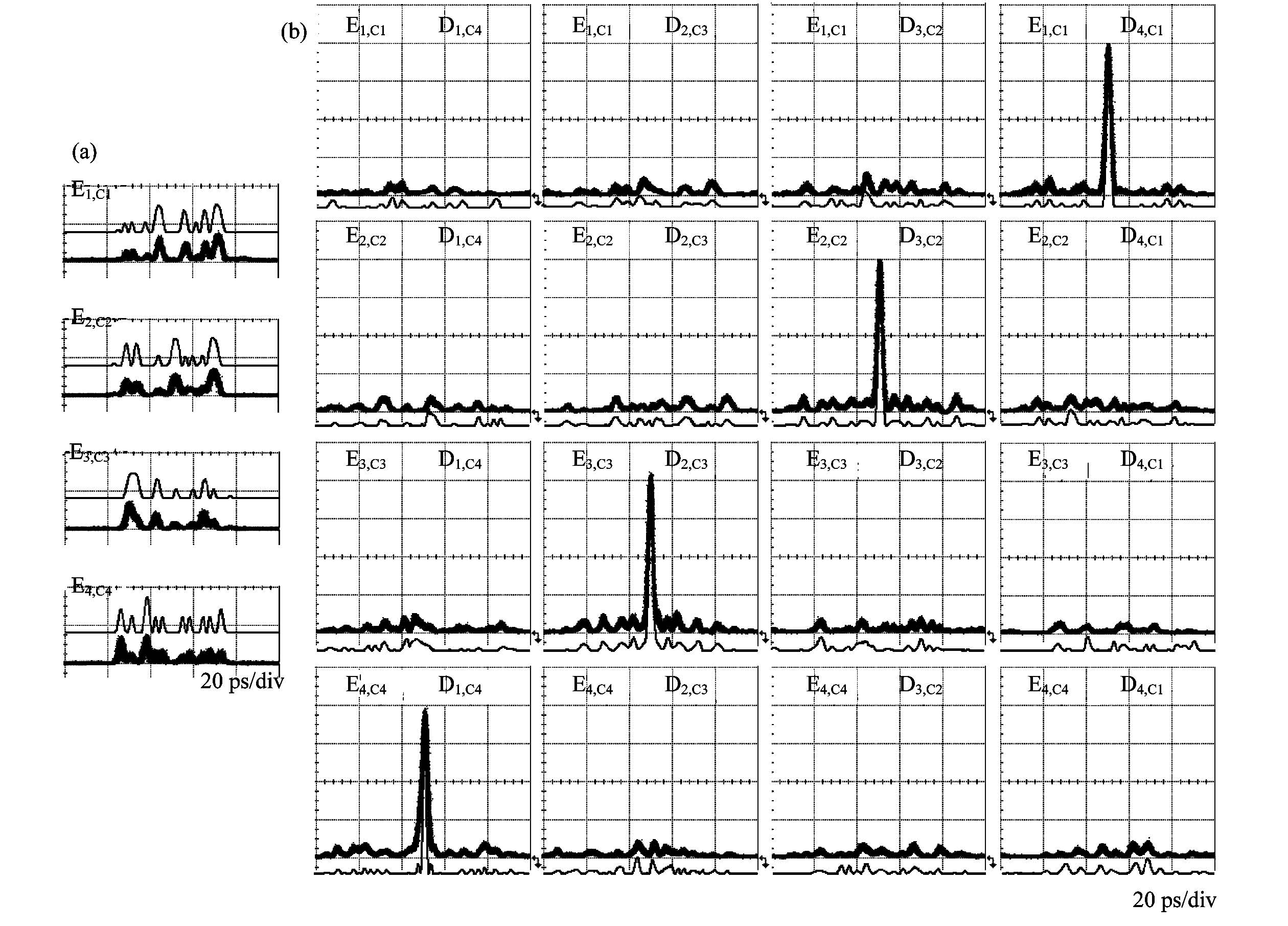 | Fig. 7 (a)Encoded and(b)decoded waveforms |
In this paper,the development of the SSFBG based en/decoders is reviewed.The security of encoding can be significantly improved by using ±π/2 phase shift instead of 0/π phase shift.The SIMO en/decoder is able to generate and recognize a group of optical codes and distribute the encoded and decoded signals into different optical paths.The technology of SSFBG based en/decoders develops rapidly and it makes SSFBG based en/decoders a promising device in the optical code based applications.
| [1] | TSUDA H,TAKENOUCHI H,ISHII T,et al.Spectral encoding and decoding of 10 Gbit/s femtosecond pulses using high resolution arrayed-waveguide grating[J].Electron Lett,1999,35(14):1186-1188. |
| [2] | WANG X,WADA N,CINCOTTI G,et al.Demonstration of over 128-gb/s-capacity(12-User/spl times/10.71-gb/s/user)asynchronous OCDMA using FEC and AWG-based multiport optical encoder/decoders[J].IEEE Photon.Technol.Lett,2006,18(15):1603-1605. |
| [3] | TOWN G E,CHAN K,YOFFE G.Design and performance of high-speed optical pulse-code generators using optical fiber Bragg gratings[J].IEEE J Sel Top Quantum Electron,1999,5(5):1325-1331. |
| [4] | TEH P C,PETROPOULOS P,IBSEN M,et al.A comparative study of the performance of seven- and 63-chip optical code-division multiple-access encoders and decoders based on superstructured fiber Bragg gratings[J].J Lightwave Technol,2001,19(9):1352-1365. |
| [5] | GRUNNET-JEPSEN A,JOHNSON A E,MANILOFF E S,et al.Fiber Bragg grating based spectral encoder/decoder for lightwave CDMA[J].Electron Lett,1999,35(13):1096-1097. |
| [6] | FSAIFES I,MILLAUD A,CORDETTE S,et al.Spectral phase OCDMA encoder/decoder using travelling interference fringe photo-writing technique[C].Communications and Photonics Conference and Exhibition(ACP),Asia,Shanghai,China,2009. |
| [7] | AGARWAL A,TOLIVER P,MENENDEZ R,et al.Fully programmable ring-resonator-based integrated photonic circuit for phase coherent applications[J].J Lightwave Technol,2006,24(1):77-87. |
| [8] | WANG X,MATSUSHIMA K,NISHIKI A,et al.High reflectivity superstructured FBG for coherent optical code generation and recognition[J].Opt Exp,2004,12(22):5457-5468. |
| [9] | ERDOGAN T.Fiber Grating Spectra[J].J Lightwave Technol,1997,15(8):1277-1294. |
| [10] | DAI B,WANG X.Security improvement using ±π/2-phase-shifted SSFBG en/decoder in time-spreading OCDMA[J].IEEE Photon Technol Lett,2010,22(12):881-883. |
| [11] | DAI B,GAO Z,WANG X,et al.Performance comparison of 0/π- and ± π/2-phase-shifted superstructured Fiber Bragg grating en/decoder[J].Opt Exp,2011,19(13):12248-12260. |
| [12] | DAI B,SHIMIZU S,WADA N,et al.Application of a novel SSFBG-based single-input multiple-output encoder/decoder to optical packet switching[J].Opt Exp,2014,22(3):2236-2246. |